Battle of Zama
The battle in which Scipio Africanus defeated Hannibal, ending the Second Punic War.
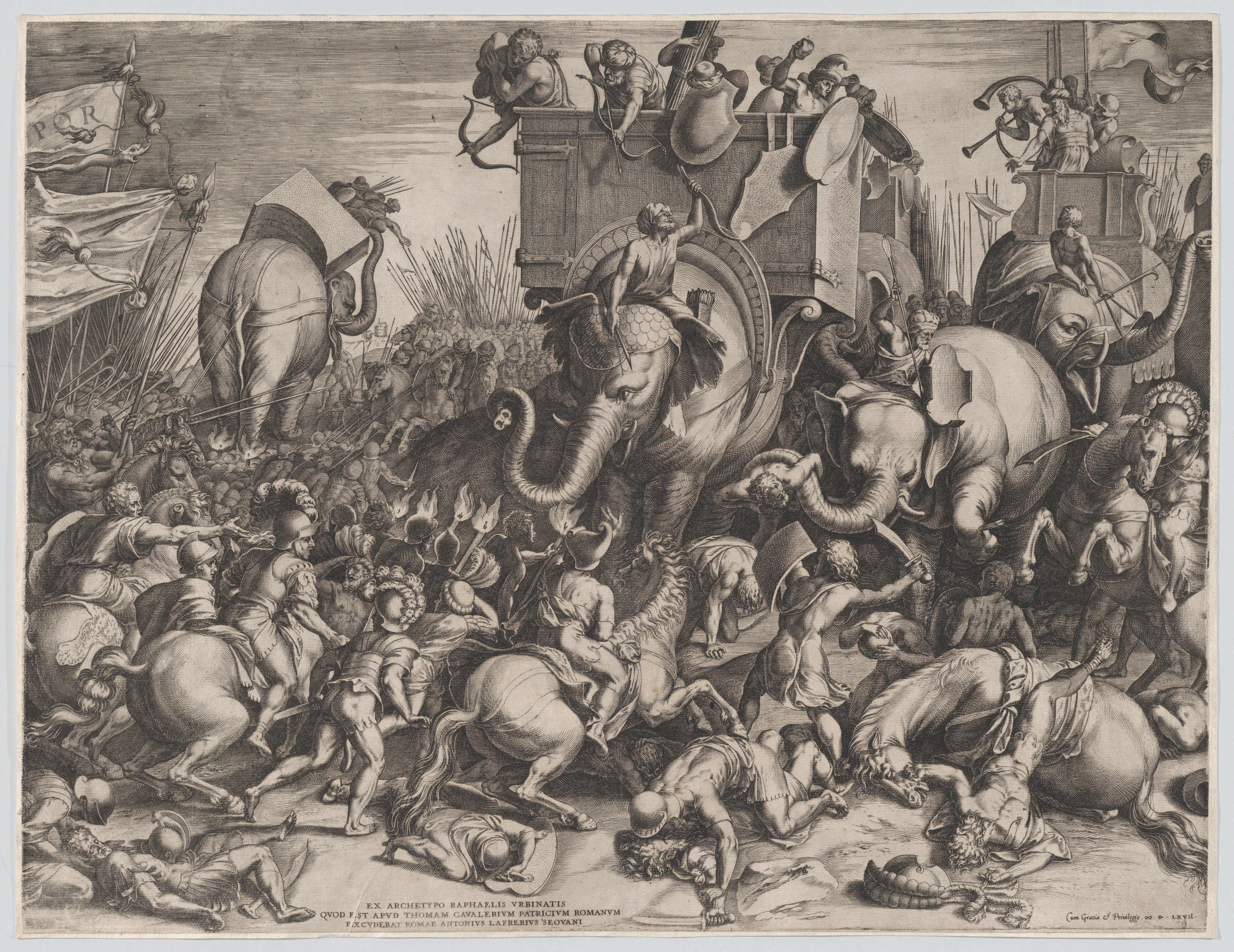
Key Historical Facts
| Fact | Detail |
|---|---|
| Epic Battles | Battle of Zama |
| Date | 202 BC |
| Location | Zama, Tunisia (36.3, 9.3) |
| Belligerents, Commanders & Forces | Roman Republic: Scipio Africanus (Strength: 35,000, Casualties: 4,500) · Carthage: Hannibal Barca (Strength: 50,000, Casualties: 20,000) |
| Weather | Hot |
| Outcome | Roman Victory |
Belligerents, Commanders & Forces
Roman Republic
- Commander
- Scipio Africanus
- Stance
- Attacker
- Strength
- 35,000
- Casualties
- 4,500
Carthage
- Commander
- Hannibal Barca
- Stance
- Defending
- Strength
- 50,000
- Casualties
- 20,000
Historical Significance
Carthage ceased to be a power. Rome became the ruler of the Mediterranean.
Outcome
Roman Victory
Chronological Phases of the Battle
-
1. 205 BC
Hippo Regius Coastal Campaign and Plunder
In 205 BC, Scipio's senior deputy commander, Gaius Laelius, raided the North African coast around Hippo Regius with a Roman fleet of thirty ships. During this operation, large amounts of booty and captives were collected. The Carthaginian administration went into great panic, mistaking this raid for the expected main Roman invasion; He quickly strengthened the defensive fortifications and recruited new troops. During the campaign, Laelius managed to re-establish diplomatic and military contact with Masinissa, his ally in the struggle for the Numidian throne. Masinissa expressed his displeasure at the delay in preparations for the Roman army's landing in Africa.
-
2. 204–203 BC
Siege of Utica and Night Attack on Encampments
Landing in Africa in 204 BC, Scipio besieged the port of Utica, but was forced to retreat due to the fortified camps established nearby by Hasdrubal Gisco and Syphax. Using the peace talks for reconnaissance purposes, Scipio prepared a fake attack on Utica in the spring of 203 BC and divided his forces into two at night. The reed huts in the Numidian camp were set on fire, creating great panic and chaos. The Carthaginian camp, unable to comprehend what was happening, was also taken by surprise. While the Roman legions dispersed the enemy lines in the night attack and inflicted heavy losses, Hasdrubal took refuge in Carthage with his two thousand five hundred surviving soldiers.
-
3. 203 BC
Battle of Cirta and the Fall of the City
After the defeat in the Great Plains, Syphax retreated to his capital Cirta and gathered new troops. Laelius and Masinissa, accompanied by some of the Roman forces, pursued the fleeing enemy to the front of Cirta. In the ensuing battle, Syphax's troops initially gained the upper hand; But the turning point was when Laelius gradually led the Roman infantry groups into the battle line. The dispersed army of Syphax fled and Syphax was taken prisoner. Seeing Syphax chained and paraded in front of the walls of Cirta, the city surrendered to Masinissa. Thus, most of Syphax's lands came under Masinissa's control.
-
4. 203–202 BC
Hannibal Gathers Force at Hadrumetum
Hannibal, who was recalled by the Carthaginian Senate after sixteen years of campaigning in Italy, sailed from Croton, landed on Leptis Minor and gathered his army at Hadrumetum. After the draft peace treaty was rejected, Scipio began capturing towns in Carthage's hinterland. Although the Carthaginian Senate pressured Hannibal to immediately march against Scipio, Hannibal delayed action until the arrival of a reinforcement of two thousand elite Numidian cavalry brought by a relative of Syphax. After joining his forces, he advanced near Zama on a five-day march and set up camp three kilometers from the Roman camp.
-
5. 202 BC
Elephant Attack and Wing Cavalry Clashes in Zama
The battle began when Hannibal led eighty war elephants into the Roman infantry lines. Scipio foiled this attack by leaving wide corridors between the maniplas and frightening the elephants with trumpet sounds. Some elephants got out of control and fled back, completely disrupting the order of the Numidian cavalry on the Carthaginian left wing. Taking advantage of this confusion, Masinissa attacked with four thousand Numidian cavalry and drove his opponents out of the battlefield. Similarly, Laelius on the left wing defeated and chased the Carthaginian cavalry, which was mauled by the elephants. Thus, the Carthaginian cavalry was cleared on both wings, and the Roman cavalry began to pursue.
-
6. 202 BC
Infantry Battle and Cavalry Encirclement in Zama
After the elephants and cavalry withdrew from the field, the heavy infantry of both sides engaged in direct hand-to-hand combat. Hastati's troops forced Carthage's first two lines to retreat after heavy battles. Hannibal's third line, consisting of Italian veterans, remained a fresh force. Scipio recalled his pursuing troops and spread the ranks of the principes and triarii on the flanks, forming a single, expanded line equivalent to the Carthaginian front. As the two lines fought fiercely again, the cavalry of Masinissa and Laelius, returning from pursuit, launched a deadly charge into the rear of the Carthaginian army. Surrounded from behind, the Carthaginian lines completely collapsed.
-
7. 202–201 BC
Conquest of Tunisia and the Defeat of Vermina
After the victory at Zama and the plunder of the enemy camp, Scipio went to Tunisia with his legions. In the face of heavy defeat, Carthage immediately sought peace. However, while negotiations were ongoing, news was received that Syphax's son Vermina was approaching Carthage with a Numidian army in support. A Roman force consisting mainly of cavalry moved quickly, surrounded and decisively defeated Vermina's forces. Following this final conflict of the Second Punic War, with Hannibal's support, the peace treaty was ratified in the spring of 201 BC; Carthage became politically dependent on Rome.
Frequently Asked Questions
When and where did Battle of Zama take place, and what was the outcome?
Battle of Zama took place on 202 BC at Zama, Tunisia and ended with Roman Victory.
Who were the commanders and troop numbers in Battle of Zama?
Roman Republic: Scipio Africanus (Strength: 35,000, Casualties: 4,500) · Carthage: Hannibal Barca (Strength: 50,000, Casualties: 20,000)
Why is Battle of Zama historically significant?
Carthage ceased to be a power. Rome became the ruler of the Mediterranean.