Battle of Ad Decimum
At the Battle of Ad Decimum—the first major test of Eastern Roman Emperor Justinian I's policy to reconquer the West—Roman forces under the command of General Flavius Belisarius defeated the Vandal Kingdom's army led by King Gelimer near Carthage. This victory ensured the collapse of the Vandal Kingdom and the reincorporation of North Africa into the Empire.
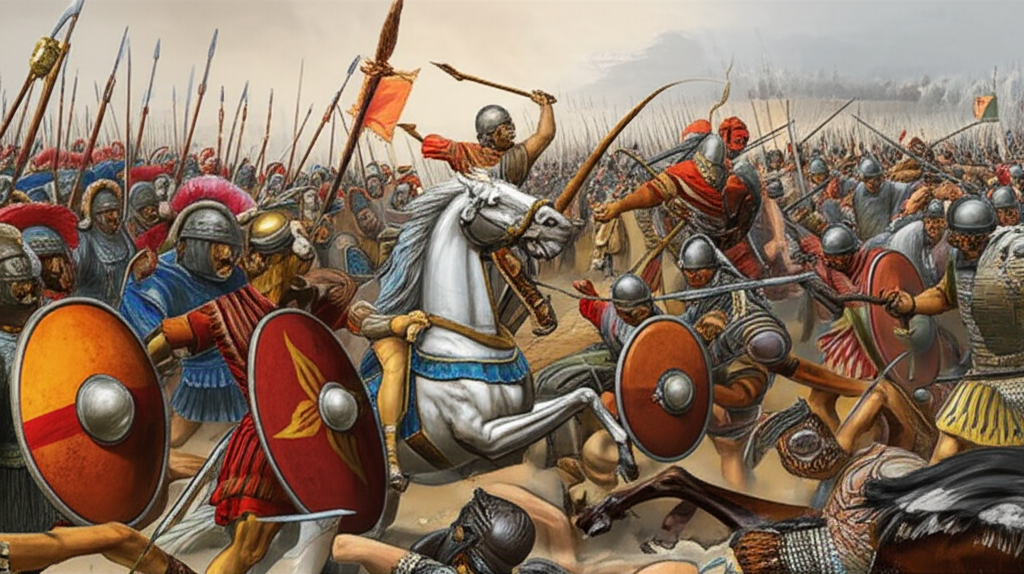
Key Historical Facts
| Fact | Detail |
|---|---|
| Epic Battles | Battle of Ad Decimum |
| Date | 13 September 533 |
| Location | 10 Miles South of Carthage, Tunisia (36.7214, 10.3278) |
| Belligerents, Commanders & Forces | Eastern Roman Empire: Flavius Belisarius (Strength: 15,000, Casualties: Bilinmiyor, hafif ila orta düzeyde) · Vandal Kingdom: King Gelimer (Strength: 20,000, Casualties: 3.000'den fazla ölü, ağır dağılma) |
| Weather | The scorching September sun and dusty desert winds of North Africa |
| Outcome | Decisive Eastern Roman Victory; Carthage surrendered without a fight the next day. |
Belligerents, Commanders & Forces
Eastern Roman Empire
- Commander
- Flavius Belisarius
- Stance
- Attacker
- Strength
- 15,000
- Casualties
- Bilinmiyor, hafif ila orta düzeyde
Vandal Kingdom
- Commander
- King Gelimer
- Stance
- Defending
- Strength
- 20,000
- Casualties
- 3.000'den fazla ölü, ağır dağılma
Historical Significance
It initiated the collapse process of the Vandal Kingdom, re-established Eastern Roman dominance in the Mediterranean basin, and proved the feasibility of Justinian's vision of 'Renovatio Imperii'.
Outcome
Decisive Eastern Roman Victory; Carthage surrendered without a fight the next day.
Chronological Phases of the Battle
-
1. 09:00 in the morning
Gelimer's Three-Pronged Pincer
Vandal King Gelimer devised a complex ambush plan to destroy the Roman army advancing along the coast toward Carthage. His brother Ammatas would sally forth from Carthage, his nephew Gibamund would strike the Roman left flank, and Gelimer would envelop them from the rear with the main army. However, the rugged terrain severed communications between the units, and coordination collapsed from the very beginning.
-
2. 11:30 AM
Victory of the Hun Riders
A 2,000-strong Vandal vanguard led by Gibamund encounters 600 allied Hunnic cavalry guarding the Roman left flank near the salt lake. Faced with the Huns' superior mobility and deadly archer volley, the Vandal cavalry completely shatters. Gibamund loses his life on the battlefield while his force is utterly annihilated.
-
3. 1:00 PM
The Engagement at Milestone Ten
Ammatas, setting out early from Carthage, encounters the Roman vanguard force of federates. Although Ammatas personally fights and kills several Romans, he loses his life to a spear thrust. Seeing their commander fall, the Vandals panic and begin fleeing toward the walls of Carthage. Pursuing the fleeing Vandals, the Roman vanguard pushes all the way to the city gates.
-
4. 3:30 PM
Gelimer's Hesitation
When Gelimer, having repulsed the Roman rear guard with his main body, arrived at the battlefield, he found the lifeless body of his brother Ammatas. Overwhelmed by grief, the king stopped his troops to attend to his brother's funeral instead of immediately pursuing the fleeing Romans to win the battle. This fatal pause gave the scattered Roman army an opportunity to regroup.
-
5. 5:00 PM
Belisarius's Counter-Offensive
Realizing Gelimer's inactivity, Belisarius rapidly rallied his main cavalry force and launched a counterattack. Striking the disorganized and grief-stricken Vandal lines, the Romans caught the enemy by surprise. The dissolving Vandal army fled west toward the Numidian desert. Victory was absolute, and the gates of Carthage opened to Belisarius the next morning.
Frequently Asked Questions
When and where did Battle of Ad Decimum take place, and what was the outcome?
Battle of Ad Decimum took place on 13 September 533 at 10 Miles South of Carthage, Tunisia and ended with Decisive Eastern Roman Victory; Carthage surrendered without a fight the next day..
Who were the commanders and troop numbers in Battle of Ad Decimum?
Eastern Roman Empire: Flavius Belisarius (Strength: 15,000, Casualties: Bilinmiyor, hafif ila orta düzeyde) · Vandal Kingdom: King Gelimer (Strength: 20,000, Casualties: 3.000'den fazla ölü, ağır dağılma)
Why is Battle of Ad Decimum historically significant?
It initiated the collapse process of the Vandal Kingdom, re-established Eastern Roman dominance in the Mediterranean basin, and proved the feasibility of Justinian's vision of 'Renovatio Imperii'.