Siege of Carthage
The Siege of Carthage, central to the Third Punic War, was an attempt to completely erase Carthage, the ancient enemy of the Roman Republic, from history. Beginning in 149 BC, the siege dragged on for three years due to the incompetence of Roman commanders and the extraordinary resistance of the Carthaginian people, ultimately resulting in Scipio Aemilianus entering the city, its complete destruction by fire, and the enslavement of the survivors.
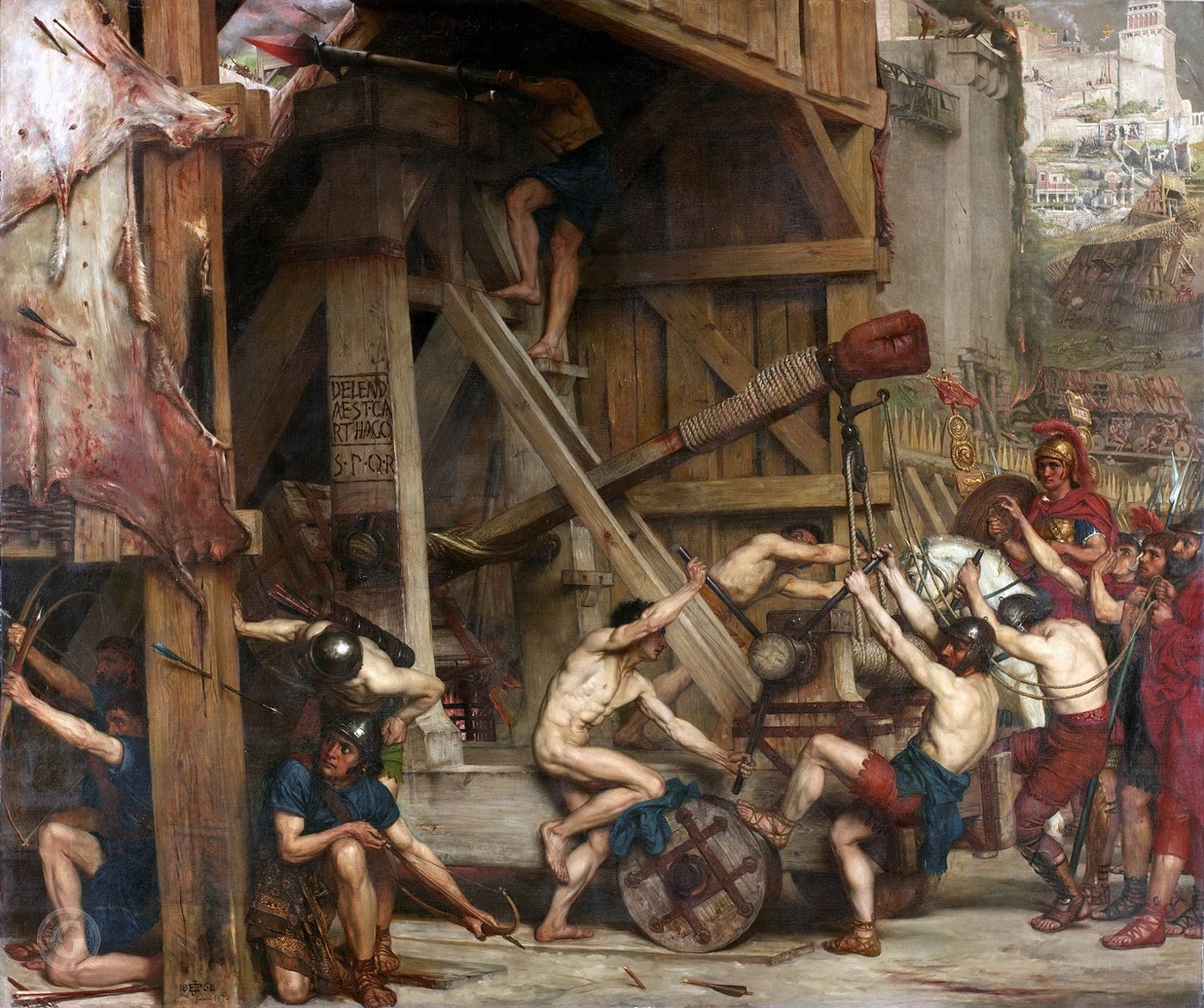
Key Historical Facts
| Fact | Detail |
|---|---|
| Epic Battles | Siege of Carthage |
| Date | 149 BC – 146 BC |
| Location | Carthage, Tunisia (36.8528, 10.3233) |
| Belligerents, Commanders & Forces | Roman Republic: Scipio Aemilianus (Manius Manilius) (Strength: 80,000, Casualties: 17.000 civarında ölü veya yaralı) · Carthage: Hasdrubal Boethark (Strength: 90,000, Casualties: 450.000 ölü (sivil ve asker), 50.000 esir ve köle) |
| Weather | The scorching sun, arid summer winds, and humid marine air of North Africa. |
| Outcome | Decisive Roman Victory; the city of Carthage was completely destroyed and burned. |
Belligerents, Commanders & Forces
Roman Republic
- Commander
- Scipio Aemilianus (Manius Manilius)
- Stance
- Attacker
- Strength
- 80,000
- Casualties
- 17.000 civarında ölü veya yaralı
Carthage
- Commander
- Hasdrubal Boethark
- Stance
- Defending
- Strength
- 90,000
- Casualties
- 450.000 ölü (sivil ve asker), 50.000 esir ve köle
Historical Significance
Carthage, the Phoenician civilization's greatest power in the Western Mediterranean, was completely destroyed, North Africa was transformed into a Roman province, and Rome became the absolute master of the Mediterranean basin.
Outcome
Decisive Roman Victory; the city of Carthage was completely destroyed and burned.
Chronological Phases of the Battle
-
1. Spring 149 BC
Ultimatum and Decision to Resist
The Roman Senate demanded that the Carthaginians surrender their weapons and then completely abandon the city to settle in the interior. The populace angrily rejected this humiliating condition. Women cut their hair to make bowstrings, and workshops began forging weapons day and night. When Roman consuls Manilius and Censorinus reached the walls, they found not surrender, but preparations for a fight to the death.
-
2. Summer 149 BC
Repulsion of the Initial Roman Attacks
Consul Censorinus attacked from the sea, while Manilius assaulted via the isthmus. Although massive battering rams breached the walls, the Carthaginians rapidly repaired these breaches by night and, with a sudden sortie, set fire to the Roman siege engines. The Romans were forced to retreat, suffering heavy casualties due to epidemic diseases and Hasdrubal's cavalry skirmishes outside the city.
-
3. 148 BC
The Nepheris Expedition and the Roman Stalemate
The Roman army launched expeditions to Nepheris to crush Carthaginian forces stationed in the interior and supplying the city. However, ambushed in the rugged terrain, the legions came to the brink of disaster. Thanks to the military genius and cavalry maneuvers of the young officer Scipio Aemilianus, the army was saved from total annihilation. This success paved Scipio's way to the consulship and renewed hopes in Rome.
-
4. Spring 147 BC
Scipio Taking Command and the Blockade
Elected consul and returning to the gates of Carthage, Scipio Aemilianus established strict discipline in the army. His first act was to construct a massive fortification line along the Carthaginian isthmus, severing all land connections of the city. He then had a breakwater built from giant rocks at the mouth of the Carthaginian harbor, completely blocking the secret supply and ammunition routes coming from the sea.
-
5. Summer 147 BC
Harbor Battle and Breakwater Combat
Wishing to break the blockade, the Carthaginians secretly dug a new canal from the closed section of the harbor out to sea and built a fleet of fifty galleys from scratch. Setting sail unexpectedly, the Carthage fleet attacked the Roman navy. In the fierce naval engagement that lasted all day, the Carthaginian fleet became trapped against the breakwater while retreating into the harbor and was largely destroyed by the Romans.
-
6. Spring 146 BC
Fall of the Walls and Street Fighting
Scipio launched a general offensive against the exhausted defenders. Roman soldiers scaled the walls from the harbor district and infiltrated the marketplace. The Carthaginians retreated to the roofs of houses and towers, showering stones and tiles down upon them. In savage house-to-house, street-to-street combat lasting six days and six nights, Roman engineers set buildings on fire, advanced along the street, and besieged the Byrsa Citadel.
-
7. Spring 146 BC
The Fall of Byrsa and the End of Carthage
Fifty thousand civilians who took refuge in the Citadel of Byrsa surrendered and were taken captive. While Commander Hasdrubal chose surrender, his wife refused to submit to the Romans and cast herself along with her children into the flames of the Temple of Eshmun. As Scipio watched the ancient city burn, he recited lines from Homer. Carthage was completely destroyed, its lands cursed, and this pearl of the Mediterranean was reduced to a heap of ashes.
Frequently Asked Questions
When and where did Siege of Carthage take place, and what was the outcome?
Siege of Carthage took place on 149 BC – 146 BC at Carthage, Tunisia and ended with Decisive Roman Victory; the city of Carthage was completely destroyed and burned..
Who were the commanders and troop numbers in Siege of Carthage?
Roman Republic: Scipio Aemilianus (Manius Manilius) (Strength: 80,000, Casualties: 17.000 civarında ölü veya yaralı) · Carthage: Hasdrubal Boethark (Strength: 90,000, Casualties: 450.000 ölü (sivil ve asker), 50.000 esir ve köle)
Why is Siege of Carthage historically significant?
Carthage, the Phoenician civilization's greatest power in the Western Mediterranean, was completely destroyed, North Africa was transformed into a Roman province, and Rome became the absolute master of the Mediterranean basin.