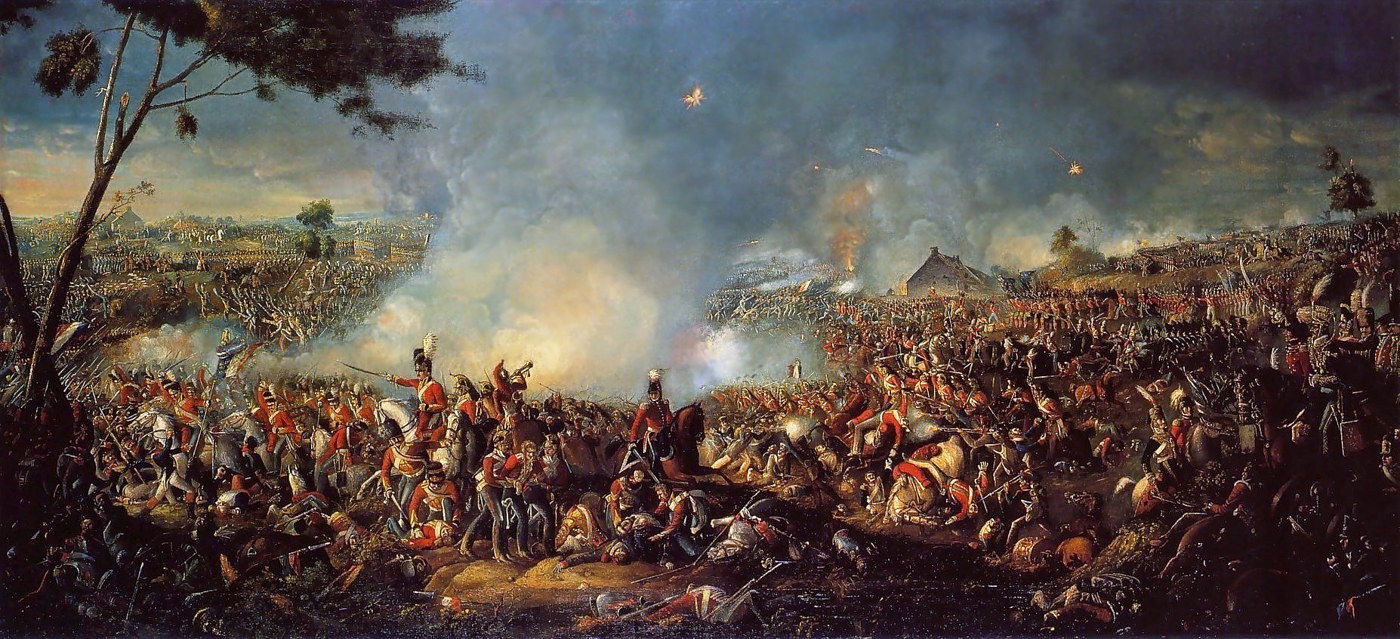
Battle of Waterloo
Napoleon Bonaparte's last major battle. He was exiled after suffering a decisive defeat against the Anglo-Prussian coalition.
Key Historical Facts
| Fact | Detail |
|---|---|
| Epic Battles | Battle of Waterloo |
| Date | 18 June 1815 |
| Location | Waterloo, Belgium (50.68, 4.41) |
| Belligerents, Commanders & Forces | French Empire: Napoleon Bonaparte (Strength: 73,000, Casualties: 41,000) · Seventh Coalition: Duke of Wellington & Blücher (Strength: 118,000, Casualties: 24,000) |
| Weather | Rainy, muddy terrain |
| Outcome | Coalition Victory |
Belligerents, Commanders & Forces
French Empire
- Commander
- Napoleon Bonaparte
- Stance
- Attacker
- Strength
- 73,000
- Casualties
- 41,000
Seventh Coalition
- Commander
- Duke of Wellington & Blücher
- Stance
- Defending
- Strength
- 118,000
- Casualties
- 24,000
Historical Significance
It ended the Napoleonic wars. He started a period of peace in Europe that would last 100 years.
Outcome
Coalition Victory
Chronological Phases of the Battle
-
1. 11:30
Artillery Duel and Siege of Hougoumont
Due to heavy rain overnight, the ground turned to mud, delaying Napoleon's artillery barrage. French troops launch a feint attack toward Hougoumont Chateau, which formed Wellington's right wing. However, the extraordinary resistance of the British guards defending the farm turned the place into a massive bloodbath that swallowed up French divisions, diverting the main objective.
-
2. 13:30
D'Erlon's Corps and the British Cavalry Counter-Charge
The First French Corps under the command of d'Erlon advances in massive infantry lines toward the Coalition's center-left. While fierce fighting continues, British heavy cavalry under the command of Lord Uxbridge launches a surprise charge from behind the ridge. French infantry are mown down, but the British horsemen, unable to check their momentum and advancing all the way to the French artillery batteries, are repulsed with heavy losses by enemy lancers.
-
3. 15:30
Ney' વિનાnya Unsuppported French Cavalry Charges
Mistaking Wellington's withdrawal of wounded troops for a retreat, Marshal Ney launched mass cavalry charges unsupported by infantry or artillery. Approximately ten thousand French horsemen slammed into the Coalition line in waves. Wellington's infantry formed impenetrable infantry squares; cavalry sabers could not pierce these human fortresses, and the French horsemen melted away.
-
4. 16:30
The Arrival of the Prussian Advance Lines from the East
One of the critical turning points of the day took place on the eastern flank. The Prussian IV Corps, under the command of Field Marshal Blücher and led by Bülow, emerged from the Paris Wood and began to threaten the French right flank. Napoleon was driven into a two-front war; to fend off the impending danger, he was forced to rapidly shift the Lobau Corps, which he had kept in reserve, to this line.
-
5. 18:00
The Fall of La Haie Sainte Farm
Ney finally launched an attack, accompanied by infantry support, on La Haye Sainte Farm, the key point of the battlefield. The King's German Legion, out of ammunition, was forced to abandon the farm. Capturing the farm, the French deployed forward artillery there and pounded Wellington's center line from point-blank range, opening a massive breach in the Allied front.
-
6. 18:30
Street Fighting in Plancenoit
Seeking to cut the French supply line, the Prussians fiercely attacked the village of Plancenoit. A relentless struggle began around the church cemetery, street by street, bayonet to bayonet. Napoleon dispatched the Young Guard and subsequently the Old Guard battalions to retake the vital village. Although the French recaptured the village with a bayonet charge, their strategic reserves were exhausted.
-
7. 19:30
Collapse of the Imperial Guard
Napoleon played his final trump card for victory: the Middle and Old Guard battalions, known as the Invincible, marched onto the Mont-Saint-Jean ridge. Wellington's prone British guards suddenly stood up and unleashed devastating volleys. Seeing the legendary guards retreat, cries of 'The Guard is fleeing!' rose within the French army, plunging the force into a general panic.
-
8. 21:00
General Rout and Night Pursuit
Wellington waved his hat, signaling a general advance across the entire Coalition line. As Blücher and Wellington met near La Belle Alliance, the French army fled southward in a disorderly rout. While the suicidal resistance of the Old Guard ensured Napoleon's escape, the relentless overnight pursuit by Prussian cavalry definitively brought the Napoleonic era to a close.
Frequently Asked Questions
When and where did Battle of Waterloo take place, and what was the outcome?
Battle of Waterloo took place on 18 June 1815 at Waterloo, Belgium and ended with Coalition Victory.
Who were the commanders and troop numbers in Battle of Waterloo?
French Empire: Napoleon Bonaparte (Strength: 73,000, Casualties: 41,000) · Seventh Coalition: Duke of Wellington & Blücher (Strength: 118,000, Casualties: 24,000)
Why is Battle of Waterloo historically significant?
It ended the Napoleonic wars. He started a period of peace in Europe that would last 100 years.