Naval Battle of Salamis
Critical naval victory in which the Greek navy destroyed the Persian navy in the narrow strait.
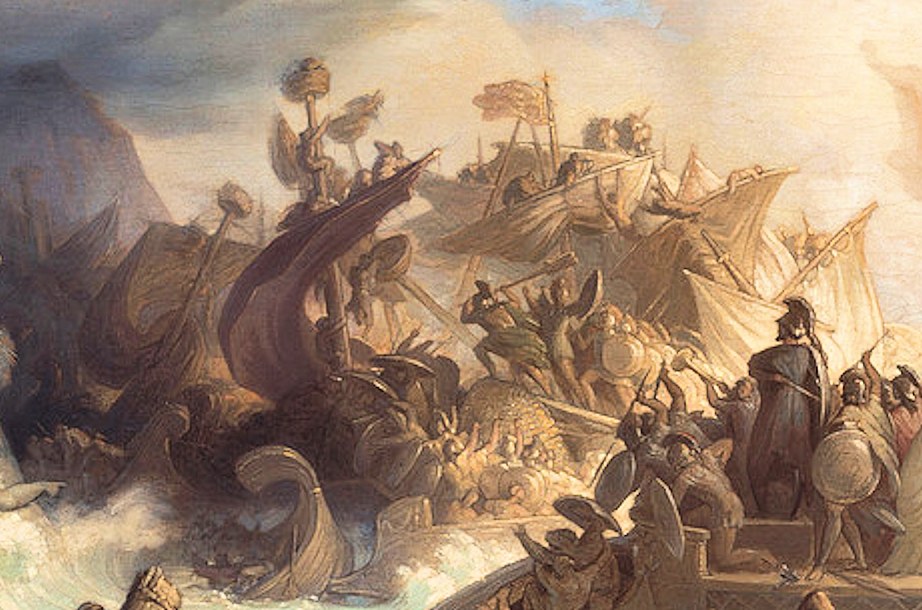
Key Historical Facts
| Fact | Detail |
|---|---|
| Epic Battles | Naval Battle of Salamis |
| Date | 480 BC, September |
| Location | Strait of Salamis, Greece (37.96, 23.49) |
| Belligerents, Commanders & Forces | Greek City States: Themistocles (Strength: 380, Casualties: 40) · Persian Empire: Xerxes I (Strength: 1,200, Casualties: 300) |
| Weather | Light wind |
| Outcome | Greek Victory |
Belligerents, Commanders & Forces
Greek City States
- Commander
- Themistocles
- Stance
- Defending
- Strength
- 380
- Casualties
- 40
Persian Empire
- Commander
- Xerxes I
- Stance
- Attacker
- Strength
- 1,200
- Casualties
- 300
Historical Significance
Persian occupation ended. The golden age of Athens began.
Outcome
Greek Victory
Chronological Phases of the Battle
-
1. 480 BC
Withdrawal to Salamis after Thermopylae and Artemision
To block the Persian advance, a small Greek force held the pass of Thermopylae, while the navy engaged the Persian fleet in the Artemision Strait. After the complete destruction of the Spartan rearguard at Thermopylae and heavy losses at Artemision, the allies withdrew. After the Persian invasion of Boeotia and Attica, while the allied forces were preparing to defend the Isthmus of Corinth, the fleet retreated to Salamis Island in order to evacuate the Athenian people and redeploy.
-
2. 480 BC
Corinth Isthmus Fortification and Fleet Strategy Debate
After the evacuation of Athens, the Persian land army entered Athens by burning the unyielding cities of Plataea and Thespiae. The Peloponnesian allies destroyed the only road across the Isthmus of Corinth and built a defensive wall across the isthmus. At the convened war council, the Corinthian commander Adeimantus suggested that the fleet gather off the Isthmus; But Themistocles ensured that the fleet remained on the shores of Salamis, arguing that fighting in narrow waters would be to the advantage of the allies.
-
3. 480 BC
Faleron War Council and Persian Offensive Plan
After capturing Athens, the Persian king Xerxes convened a war council with his naval commanders at the Port of Faleron. Queen Artemisia of Halicarnassus advised to wait, stating that going to war in the Salamis Strait was an unnecessary risk and that the allies would disperse sooner or later. However, Xerxes and his advisor Mardonius favored the attack in order to gain a decisive naval victory, and the navy was ordered to take action to close the entrance to the strait.
-
4. 480 BC
Themistocles' Feint Move and the Deployment of Mount Aigaleo
Themistocles sent a secret message to Xerxes through his servant Sikinnos, informing him that the Greeks were divided and that he would flee at night. Believing this misleading news, Xerxes dispatched his fleet at night to block the exits of the strait and landed troops on Psyttaleia Island at the mouth of the strait. Xerxes also had his throne set up on the slopes of Mount Aigaleo to watch the conflict from above and supervise the commanders. Realizing that there was no possibility of escape, the allies made preparations for the morning battle.
-
5. 480 BC
Morning Encounter and First Attack in the Straits of Salamis
At dawn, after Themistocles' speech, the Greek hoplites boarded the ships and the fleet set sail. Entering the congested waters, the huge Persian fleet had difficulty maneuvering in the narrow area and lost its order. The Greek fleet greeted them with a war chant and initially rowed back to wait for the right wind. However, when a ship rushed forward and spurred the nearest Persian boat, the entire allied line launched an organized attack towards the disorganized Persian ranks.
-
6. 480 BC
Spur in the Narrow Strait and the Defeat of the Persian Fleet
Once battle erupted in the narrow waters of the strait, the vanguard Persian line, driven back by Greek triremes, tangled with the second and third lines advancing from behind. Persian admiral Ariabignes fell early in the clash and the Phoenician squadron ran aground along the shore. Queen Artemisia escaped by ramming an allied vessel. Fleeing Persians trying to reach Phalerum were ambushed by Aeginetan ships while Aristides cleared the garrison on Psyttaleia.
-
7. 480–479 BC
Xerxes' Retreat and the Battle of Plataea
After the Salamis defeat, Xerxes retreated to Asia with most of his army, fearing that the bridges over the Hellespont would be destroyed. Mardonius, who was assigned to complete the conquest of Greece, destroyed Athens again in 479 BC after spending the winter with selected infantry and cavalry and withdrew his army to the vicinity of Plataea. In the Battle of Plataea that took place here, the Greek army destroyed Mardonius' forces and put an end to the Persian invasion attempt on the mainland.
Frequently Asked Questions
When and where did Naval Battle of Salamis take place, and what was the outcome?
Naval Battle of Salamis took place on 480 BC, September at Strait of Salamis, Greece and ended with Greek Victory.
Who were the commanders and troop numbers in Naval Battle of Salamis?
Greek City States: Themistocles (Strength: 380, Casualties: 40) · Persian Empire: Xerxes I (Strength: 1,200, Casualties: 300)
Why is Naval Battle of Salamis historically significant?
Persian occupation ended. The golden age of Athens began.