Siege of Vienna (1683)
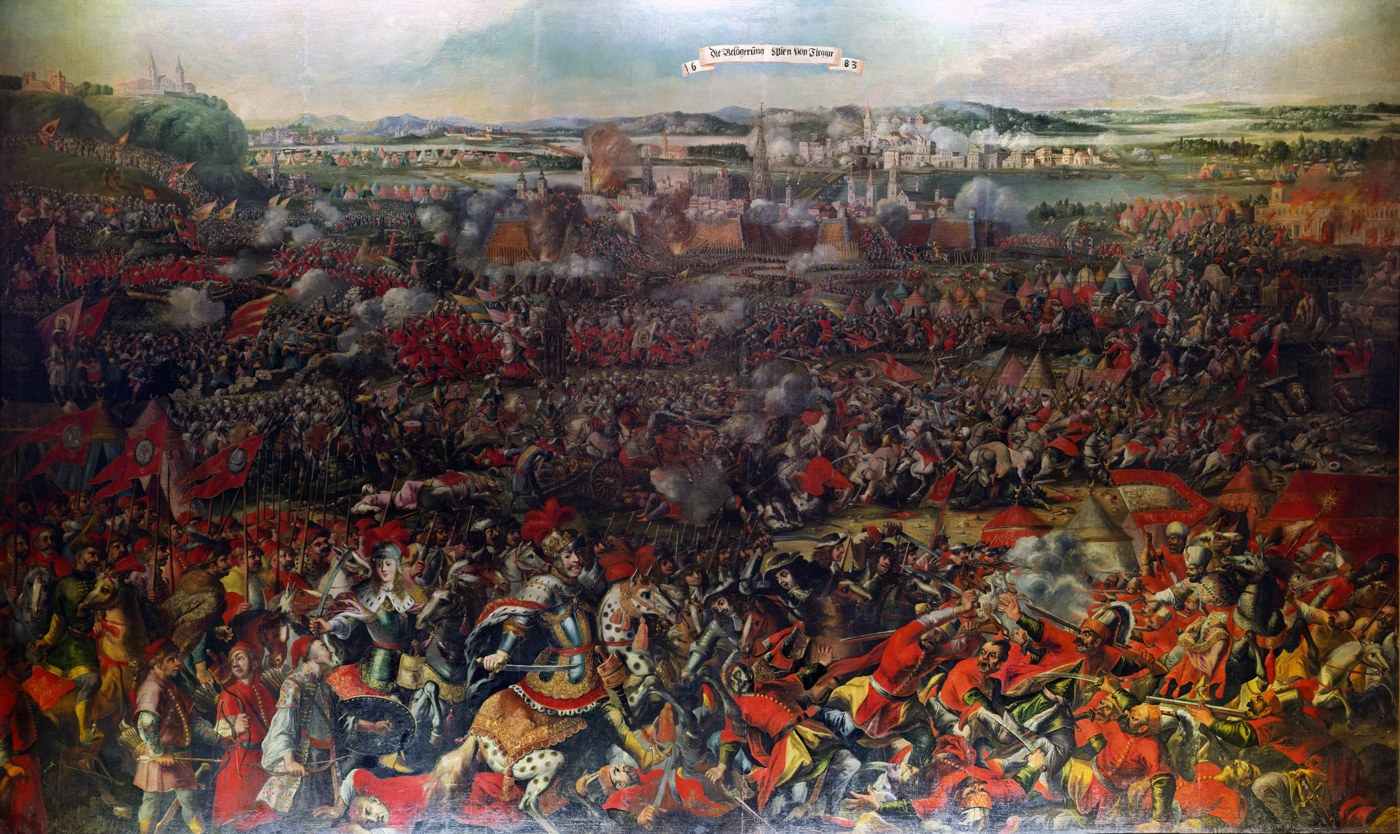
The Ottoman army surrounded Vienna, but the Holy Alliance repelled it.
Key Historical Facts
| Fact | Detail |
|---|---|
| Epic Battles | Siege of Vienna (1683) |
| Date | 14 July - 12 September 1683 |
| Location | Vienna (48.21, 16.37) |
| Belligerents, Commanders & Forces | Ottoman Empire: Kara Mustafa Pasha (Strength: 120,000, Casualties: 20,000) · Holy Rome and Poland: Jan Sobieski (Strength: 80,000, Casualties: 15,000) |
| Weather | Summer heat |
| Outcome | Holy Alliance Victory |
Belligerents, Commanders & Forces
Ottoman Empire
- Commander
- Kara Mustafa Pasha
- Stance
- Attacker
- Strength
- 120,000
- Casualties
- 20,000
Holy Rome and Poland
- Commander
- Jan Sobieski
- Stance
- Defending
- Strength
- 80,000
- Casualties
- 15,000
Historical Significance
Ottoman European advance came to a halt.
Outcome
Holy Alliance Victory
Chronological Phases of the Battle
-
1. 21 January 1682 – May 1683
Operation and Progress of the Ottoman Army from Edirne
The Ottoman army was mobilized on 21 January 1682 and war was declared on 6 August 1682. After the declaration of Grand Vizier Merzifonlu Kara Mustafa Pasha reached the Vienna Palace, the forces marched forward from Edirne in Rumelia on April 1, 1683. The troops reached Belgrade in early May, where they joined forces with Transylvania and Hungarian forces. Yanıkkale (Győr) was besieged, leaving 35,000 soldiers behind, while the remaining Ottoman army of 50,000 continued its operations towards Vienna along the Danube basin and main routes.
-
2. 14–17 July 1683
Beginning of the Siege of Vienna and its Defense Order
After Emperor Leopold left the city, the main Ottoman army reached Vienna on 14 July 1683. Grand Vizier Kara Mustafa Pasha wanted the city to surrender, but the garrison under the command of Count Starhemberg rejected this request. The defenders created an open field of fire by destroying the buildings around the walls, while the Ottomans began to dig trench lines extending directly to the walls and set up batteries 230 meters wide. The siege operation actually started on July 17 and the city was completely isolated from external supply routes.
-
3. 15 August 1683
Departure of King Jan Sobieski from Krakow
Polish King Jan Sobieski organized the aid expedition to Vienna in the summer of 1683 in order to fulfill his obligations under the Treaty of Warsaw. Sobieski, who collected intelligence on the maneuvers of the Ottoman troops, set out from Krakow on 15 August. Most of Polish territory remained defenseless and Lithuanian forces delayed the expedition. Advancing with his troops, Sobieski crossed the Danube River at Tulln on September 6 and united with the allied German imperial army to deploy to the Kahlenberg hills.
-
4. 8 September 1683
Siege of Burg Ravelini and Battles of the Sewers
In early September, approximately 5,000 experienced Ottoman sewers blew up the city walls between the Burg and Löbel redoubts, creating 12-meter-wide breaches. The Vienna garrison responded by digging counter sewers to prevent the planting of explosives. After intense underground fighting and explosions, Ottoman troops managed to capture the Burg ravelin and the low wall on 8 September. The city defenses reached a critical threshold and the remaining Vienna troops were positioned in the city in case the walls collapsed.
-
5. 12 September 1683, 04:00
Allied Left Wing Advance to Nussdorf and Heiligenstadt
At 04:00 on the morning of September 12, the Ottoman army launched an early attack to prevent the allied forces from positioning. German troops were the first to counterattack on the Allied flank. Duke Charles of Lorraine advanced the imperial army on the left flank and the forces in the center and captured the villages of Nussdorf and Heiligenstadt after fierce battles. By noon, the imperial army had opened serious breaches in the Ottoman defense, and the Ottomans' last sewer attempt under Löbelbastei was blocked by the garrison.
-
6. 12 September 1683, 15:30–17:00
Polish Infantry Attack and Türkenschanze Pressure
In the afternoon, the Polish infantry advanced towards the Ottoman right wing, took control of the village of Gersthof at 16:00 and gained a position for the cavalry attack. German troops renewed the attack on the left front at 15:30 and captured the Unterdöbling and Oberdöbling positions as of 17:00. A reconnaissance attack by a cavalry unit of 120 people revealed the weakness in the Ottoman lines. As the Allies approached Türkenschanze from three directions, the Grand Vizier had to leave this position and retreat to his main camp in the south.
-
7. 12 September 1683, 18:00
The Great Cavalry Charge and the Breaking of the Siege
At around 18:00, King Jan Sobieski ordered a general cavalry attack from four columns, three Polish and one Holy Roman Empire. This mass of 18,000 horsemen, led by Sobieski at the head of 3,000 Winged Hussars, attacked down from the hills and carried out the largest cavalry attack in history. The exhausted Ottoman lines were quickly broken and the troops retreated towards the camp. As a result of this final attack, in which the Vienna garrison participated in the Huruç operation, the Ottoman army was dispersed and the siege ended definitively in less than three hours.
Frequently Asked Questions
When and where did Siege of Vienna (1683) take place, and what was the outcome?
Siege of Vienna (1683) took place on 14 July - 12 September 1683 at Vienna and ended with Holy Alliance Victory.
Who were the commanders and troop numbers in Siege of Vienna (1683)?
Ottoman Empire: Kara Mustafa Pasha (Strength: 120,000, Casualties: 20,000) · Holy Rome and Poland: Jan Sobieski (Strength: 80,000, Casualties: 15,000)
Why is Siege of Vienna (1683) historically significant?
Ottoman European advance came to a halt.