Battle of Verdun
The longest battle of World War I. It is referred to as 'Hell'.
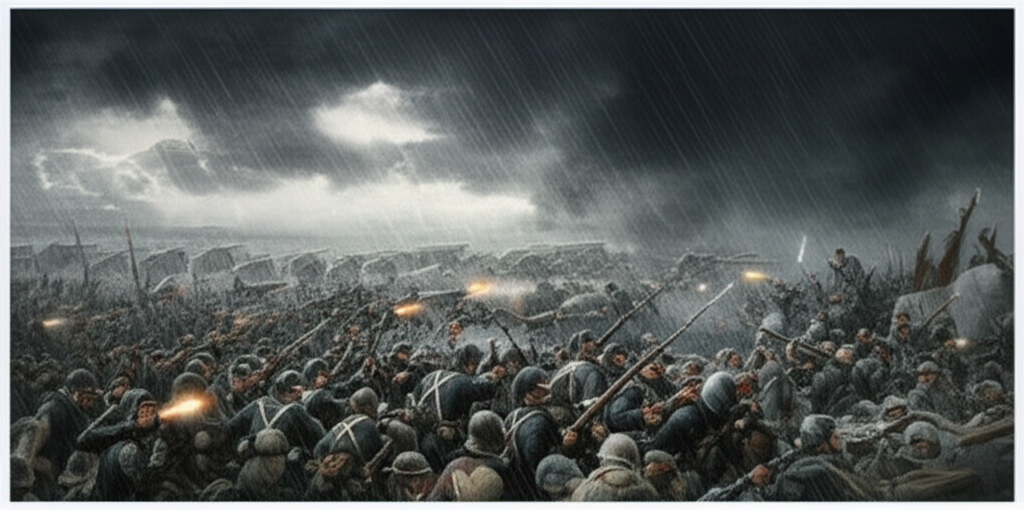
Key Historical Facts
| Fact | Detail |
|---|---|
| Epic Battles | Battle of Verdun |
| Date | 21 February - 18 December 1916 |
| Location | Verdun, France (49.16, 5.38) |
| Belligerents, Commanders & Forces | France: Philippe Pétain (Strength: 500,000, Casualties: 377,000) · German Empire: Erich von Falkenhayn (Strength: 500,000, Casualties: 337,000) |
| Weather | Variable between winter and summer |
| Outcome | French Defensive Victory |
Belligerents, Commanders & Forces
France
- Commander
- Philippe Pétain
- Stance
- Defending
- Strength
- 500,000
- Casualties
- 377,000
German Empire
- Commander
- Erich von Falkenhayn
- Stance
- Attacker
- Strength
- 500,000
- Casualties
- 337,000
Historical Significance
France's symbol of resistance.
Outcome
French Defensive Victory
Chronological Phases of the Battle
-
1. 21–26 February 1916
Fall of Fort Douaumont and Collapse of Defenses
The German 5th Army launched the Unternehmen Gericht offensive, which was postponed due to weather conditions, on the morning of 21 February. Following heavy artillery bombardment concentrated on the east bank of the Meuse River, German infantry and assault detachments advanced. Fort Douaumont, the largest fortification of the region whose defenses were weakened, was surprisingly captured by German troops on the fourth day of the attack. French attempts to retake the castle failed. Thereupon, General Philippe Pétain ordered the existing lines to be fortified, no further counter-attacks to be made, and other redoubts to be rearmed and reinforced in case of being surrounded.
-
2. 6–14 March 1916
Battles of Le Mort Homme on the West Bank of the Meuse
In line with German Chief of General Staff Falkenhayn's plan to silence the French batteries on the west bank, the attack was expanded to the west of the Meuse. On 9 March, a new German attack was launched from the direction of Béthincourt towards Le Mort Homme hill. The Bois des Corbeaux forest was recaptured at the cost of fierce fighting and heavy losses. On 14 March, German troops managed to capture the Côte 265 elevation at the western end of Le Mort Homme. However, the Côte 295 position at the eastern end was defended and held by the French 75th Infantry Brigade, and the German advance remained limited.
-
3. 20–22 March 1916
Avocourt and Malancourt Forests Offensive
The German command aimed to consolidate its gains on the western bank by focusing on limited targets instead of wide-fronted attacks. On 20 March, after an intense bombardment using 13,000 trench mortar rounds, the 11th Bavarian and 11th Reserve divisions attacked the Bois d'Avocourt and Bois de Malancourt positions. German forces easily reached their initial objectives. General Gossler ordered a short break in the operation in order to fortify the captured positions and prepare for new bombardment the next day.
-
4. 22–24 May 1916
Counteroffensive to Retake Fort Douaumont
General Nivelle, commander of the French Second Army, ordered General Mangin, commander of the 5th Division, to plan a counteroffensive to retake Fort Douaumont. Although Mangin wanted preliminary attacks to secure the approach lines, reinforcements were not given due to the Somme operation. In the attack that started on May 22, French forces entered the western and southern parts of the castle and by the evening, approximately half of the structure was taken back. However, the 34th Division, which was dispatched to reinforce the castle the next day, failed. German reserves surrounded the French inside the castle and captured 1,000 soldiers.
-
5. 30 May – 7 June 1916
Siege of Fort Vaux and Surrender of the Defenses
German attacks were directed at key points south of Douaumont and Fort Vaux, at the northeastern end of the French line. On June 1, around 10,000 German soldiers launched the final attack on the redoubt, which was pounded with approximately 8,000 bullets a day, and on June 2, the upper part of the structure was occupied. The French garrison continued to resist in the underground galleries. However, due to depletion of water resources, the 574 surviving defenders had to surrender on June 7. When news of the fall of Fort Vaux reached Verdun, the Panic Line was held on the city's edge and new trenches were dug.
-
6. 22–25 June 1916
Fleury and Chapelle Attack on Sainte-Fine
German artillery fired more than 116,000 diphosgene gas shells on 22 June to neutralize French batteries. On the morning of June 23, the Germans attacked on a 5 km wide front, captured the Thiaumont blockhouse and entered the villages of Fleury and Chapelle Sainte-Fine; On the other hand, the Ouvrage de Froideterre garrison managed to hold its position despite intense pressure. General Nivelle issued the order to his troops: 'You will not let them pass'. Chapelle Sainte-Fine was quickly retaken and the German advance was halted due to the disruption of water supply and fire from three directions.
-
7. 9–15 July 1916
German Assault on Fort Souville Peak
The German command rained more than 300,000 shells on Fort Souville and the approach roads in an attempt to capture the high hills overlooking Verdun. The attack launched by three German divisions on July 11 broke up when the infantry gathered on the road to the redoubt encountered French artillery fire. 60 French machine gunners positioned themselves on the superstructure of the redoubt and took the remaining troops under fire. On July 12, 30 German soldiers from the 140th Infantry Regiment reached the top of the redoubt and saw the city of Verdun, but were forced to retreat or surrender as a result of the counter-attack.
-
8. 18 August – 3 September 1916
Recapture of Fleury Village and French Counter-Operation
The French army began to gradually seize the initiative in the Fleury location, which changed hands 16 times during the summer. On 18 August, the village of Fleury was completely retaken by a French counter-attack. Falkenhayn was dismissed from the German General Staff and replaced by Hindenburg and Ludendorff. The French attack, launched from both flanks of Fleury on 3 September, moved the front line forward several hundred meters. The local counter-attacks of the German forces on September 4 and 5 were unsuccessful and the German offensive power in the region was completely destroyed.
-
9. 20 October – 2 November 1916
First Verdun Offensive: Liberation of Douaumont and Vaux
The French launched the First Verdun Offensive on October 20 to retake Fort Douaumont. Hundreds of thousands of shells were fired from more than 700 cannons and super-heavy 400 mm shells from railway batteries during the six-day preparatory bombardment. After the bombardment, advancing French troops captured Fort Douaumont and the village. French heavy artillery then targeted Fort Vaux. After a violent explosion caused by a 220 mm shell, the Germans evacuated the redoubt on 2 November. A French infantry company entered the redoubt without encountering resistance and took back the positions.
-
10. 15–17 December 1916
Second Verdun Offensive and Pushing Back German Lines
The Second Verdun Offensive under Mangin, planned by Pétain and Nivelle, began on 15 December after six days of artillery preparation. Four French divisions (126th, 38th, 37th and 133rd divisions) attacked the German positions with coordinated double-echelon marching barrage fire support from aircraft. The German defense, which had two divisions short-staffed, was breached. The German positions closest to Verdun were pushed back 7.5 km and all dominant observation points fell into French hands. French forces ended the 1916 war with victory, capturing 11,387 prisoners and 115 cannons.
Frequently Asked Questions
When and where did Battle of Verdun take place, and what was the outcome?
Battle of Verdun took place on 21 February - 18 December 1916 at Verdun, France and ended with French Defensive Victory.
Who were the commanders and troop numbers in Battle of Verdun?
France: Philippe Pétain (Strength: 500,000, Casualties: 377,000) · German Empire: Erich von Falkenhayn (Strength: 500,000, Casualties: 337,000)
Why is Battle of Verdun historically significant?
France's symbol of resistance.