Battle of the Somme
One of the bloodiest battles of World War I. Tanks were used for the first time.
Key Historical Facts
| Fact | Detail |
|---|---|
| Epic Battles | Battle of the Somme |
| Date | 1 July - 18 November 1916 |
| Location | Somme River, France (50.01, 2.69) |
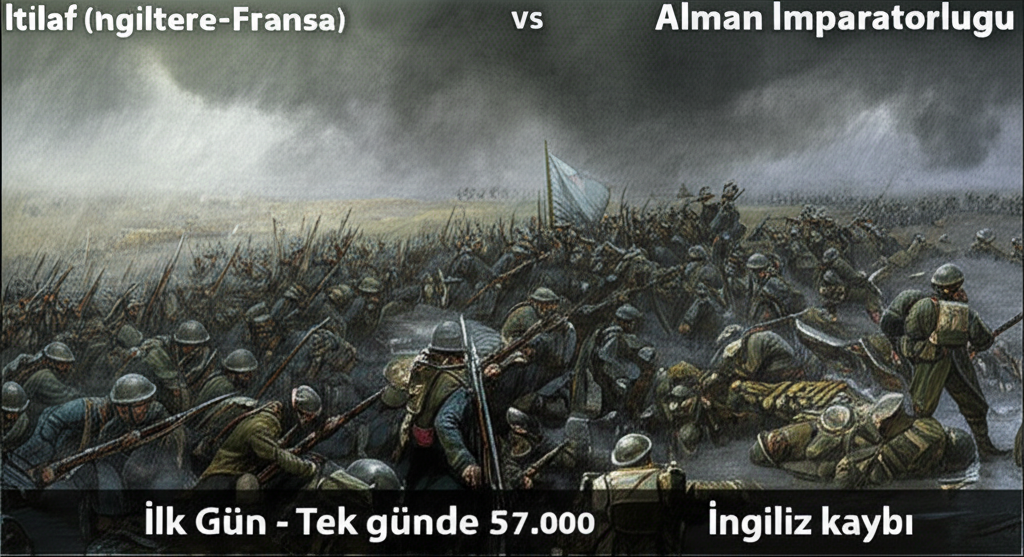
| Belligerents, Commanders & Forces | Entente (England-France): Douglas Haig (Strength: 1,500,000, Casualties: 620,000) · German Empire: Fritz von Below (Strength: 1,000,000, Casualties: 465,000) |
| Weather | Rainy, muddy |
| Outcome | Strategic Stalemate |
Belligerents, Commanders & Forces
Entente (England-France)
- Commander
- Douglas Haig
- Stance
- Attacker
- Strength
- 1,500,000
- Casualties
- 620,000
German Empire
- Commander
- Fritz von Below
- Stance
- Defending
- Strength
- 1,000,000
- Casualties
- 465,000
Historical Significance
Symbol of World War I. The brutality of modern warfare.
Outcome
Strategic Stalemate
Chronological Phases of the Battle
-
1. 1–13 July 1916
Battle of Albert and Defense of Fricourt
In the offensive that started with the Battle of Albert on July 1, 1916, Allied forces took action on the Somme front. The French Sixth Army and the right wing of the British Fourth Army advanced in the southern sector against the German Second Army under General Fritz von Below. As German defenses south of the Albert–Bapaume road largely collapsed, the evacuation of the Fricourt position on the north bank was ordered. However, German defenders positioned in the dominant terrain to the north of the road inflicted heavy losses on the British infantry. Following the disaster, the British command chose to halt the offensive in the north and focus on gains in the south.
-
2. 14–17 July 1916
Bazintin Ridge Offensive and Operation Longueval
At 03.25 on 14 July, the British Fourth Army launched the attack against the German second line of defense following a five-minute whirlwind artillery bombardment. Targets included Bazentin le Petit, Bazentin le Grand and the village of Longueval, which borders the Delville Forest. In the attack carried out by four divisions on a 5,500-meter front, the infantrymen, who closely followed the moving barrage fire, captured most of the targets. German defenses south of the Albert–Bapaume road came under heavy pressure; but communication gaps, casualties and disorganization on the British side prevented the continuation of the operation.
-
3. 23 July – 7 August 1916
Battle of Pozières and Thiepval Ridge
The Battle of Pozières began on 23 July, when the 1st Australian Division of the Reserve Army captured the village. While the general attack of the Allies in the south turned into individual attacks due to supply disruptions, communication gaps and adverse weather conditions, the capture of the village was the only success. German troops conducted intense artillery bombardments and counterattacks from 23 July to 7 August. As a result of fierce fighting, the Reserve Army captured the plateau to the north and east of the village, reaching a critical position overlooking the fortified village of Thiepval from behind.
-
4. 3–6 September 1916
Battle of Guillemont and Flanking Security
The British Fourth Army attacked the strategic village of Guillemont, located on the right flank of the British sector, on 3 September and captured the village on the first day. German defenses in the region were based on the second line and the fortified villages and farms supporting each other. The Guillemont position was a critical point, flanking the Delville Forest salient to the north and monitoring the French Sixth Army field to the south. While Joffre, Haig, Foch and Rawlinson's attempts to organize a coordinated attack with four armies were unsuccessful, the pause at the end of August witnessed the German army's largest counter-offensive on the Somme.
-
5. 25–28 September 1916
Battle of Morval and Gueudecourt Offensive
The Battle of Morval was fought by the British Fourth Army's attack on the positions of Morval, Gueudecourt and Lesboeufs under the control of the German 1st Army. The operation, which was postponed due to rain and coordination with the French Sixth Army's attack on Combles, aimed to prevent the defenders of Thiepval in the west from receiving reinforcements. In the afternoon of September 25, with the support of tanks, Gueudecourt, Morval and Lesboeufs were captured. The Fourth Army made its deepest advance since July 14, leaving the Germans facing a serious tactical crisis in the salient around Combles.
-
6. 1 October – 11 November 1916
Battle of Le Transloy and Operational Limitation
The Battle of Le Transloy began in favorable weather conditions and the village of Le Sars was captured on 7 October. However, due to heavy rains and the understanding that the German defense was recovering from previous defeats, forced breaks were taken in the operation for methodical bombardment. General Haig, meeting with army commanders on 17 October, canceled Third Army plans and reduced Fourth Army offensives to limited cooperation with the French Sixth Army. After partial advances on 23 October and 5 November, the Fourth Army ceased offensive operations except for minor attempts to recover positions.
-
7. 13–18 November 1916
Operation Ancre Valley and Beaumont-Hamel
In the Battle of the Ancre, the last major British operation of the year, the Fifth Army attacked the Ancre valley to take advantage of the exhaustion of German troops. Although the Serre attack failed in the clashes that started with the explosion of the sewer under the Hawthorn Ridge Bastion, significant gains were made in the southern line. South of Serre, Beaumont Hamel and Beaucourt-sur-l'Ancre were captured. South of the Ancre, Saint-Pierre-Divion was captured, while the Canadian 4th Division took Regina Trench and, on 18 November, Desire Support Trench. After this operation, both sides focused on enduring winter conditions and a pause began on the front.
Frequently Asked Questions
When and where did Battle of the Somme take place, and what was the outcome?
Battle of the Somme took place on 1 July - 18 November 1916 at Somme River, France and ended with Strategic Stalemate.
Who were the commanders and troop numbers in Battle of the Somme?
Entente (England-France): Douglas Haig (Strength: 1,500,000, Casualties: 620,000) · German Empire: Fritz von Below (Strength: 1,000,000, Casualties: 465,000)
Why is Battle of the Somme historically significant?
Symbol of World War I. The brutality of modern warfare.