Naval Battle of Preveza
The great naval victory in which Barbaros Hayreddin Pasha defeated the Crusader fleet.
Key Historical Facts
| Fact | Detail |
|---|---|
| Epic Battles | Naval Battle of Preveza |
| Date | 28 September 1538 |
| Location | Preveza, Greece (38.95, 20.75) |
| Belligerents, Commanders & Forces | Ottoman Empire: Barbaros Hayreddin Pasha (Strength: 122, Casualties: 400) · Holy Alliance: Andrea Doria (Strength: 162, Casualties: 3,000) |
| Weather | Autumn |
| Outcome | Ottoman Victory |
Belligerents, Commanders & Forces
Ottoman Empire
- Commander
- Barbaros Hayreddin Pasha
- Stance
- Defending
- Strength
- 122
- Casualties
- 400
Holy Alliance
- Commander
- Andrea Doria
- Stance
- Attacker
- Strength
- 162
- Casualties
- 3,000
Historical Significance
Ottoman Mediterranean dominance was finalized.
Outcome
Ottoman Victory
Chronological Phases of the Battle
-
1. 1537
Aegean Islands Campaign and Annexation of the Duchy of Naxos
In 1537, the large Ottoman fleet under the command of Hayreddin Barbarossa launched a large-scale operation against the Aegean and Ionian islands belonging to the Republic of Venice. Ottoman forces captured the islands of Syros, Aegina, Ios, Paros, Tinos, Karpathos, Kasos and Naxos and officially annexed the Duchy of Naxos. As a continuation of this operation, which shook the Venetian domination in the region, Barbarossa besieged the Venetian-controlled island of Corfu, but this siege ended in failure. The Ottoman navy also hit the coast of Calabria under Spanish control.
-
2. 1538
Landing Attempt in Front of Preveza Castle and Request to Corfu
Before the armada under the command of Andrea Doria arrived, the Papal fleet under the command of Patriarch Marco Grimani attempted to land troops near the Preveza Castle. However, the allied elements that landed were repelled, suffering heavy losses in the battle with the Ottoman forces under the command of Murat Reis. After this unsuccessful land operation, Grimani was forced to withdraw his troops and retreated to the island of Corfu, which was determined to be the main assembly point of the Holy Alliance navy.
-
3. 1538
Transfer of the Ottoman Navy and Deployment to Actium
Hayreddin Barbarossa, located in Kos (Kos) in the Aegean Sea, reached Preveza with the rest of the fleet after capturing the island of Kefalonia. Ottoman lieutenant Sinan Reis suggested that troops be deployed to the Aktium location, located at the entrance of the Narda (Arta) Gulf near Preveza. Although Barbarossa was initially opposed to the idea, his decision to station troops at Actium by fortifying the entrance to the gulf constituted a critical turning point in gaining final victory over the allied fleet.
-
4. 25 September 1538
Doria's Blockade Attempt at the Entrance to the Gulf of Arta
Andrea Doria, who located Barbarossa on 25 September 1538, deployed his armada in front of the mouth of the bay, leading the two sides to a stalemate. Because the narrow mouth of the bay created a bottleneck for ships, Doria could not storm directly inland; In addition, the sailing ships with the artillery power they relied on were in danger of being dragged ashore due to strong winds. Since the surrounding land was under Ottoman control, Barbarossa was able to wait safely in the bay. The only fighting of the day was coastal artillery fire, which prevented the Ottomans from establishing new fortifications.
-
5. On the night of 27 September 1538
Deployment to the South towards Sessola and Deployment in Y Formation
On the night of 27 September, Doria ordered his fleet to sail 30 miles south towards Sessola, near Leucade, and to attack Turkish positions around Lepanto, in order to force Barbarossa to leave the bay. Hearing the enemy's maneuver, Barbarossa quickly put his fleet into a Y-shaped battle formation. Along with Barbarossa, Sinan, Cafer, Şaban and Hasan Reis were in the center. While Seydi Ali Reis commanded the left wing and Salih Reis commanded the right wing, Turgut Reis took over the rear wing with the accompanying captains.
-
6. 28 September 1538
The Fall of the Sailboats and the Defense of Galeone di Venezia
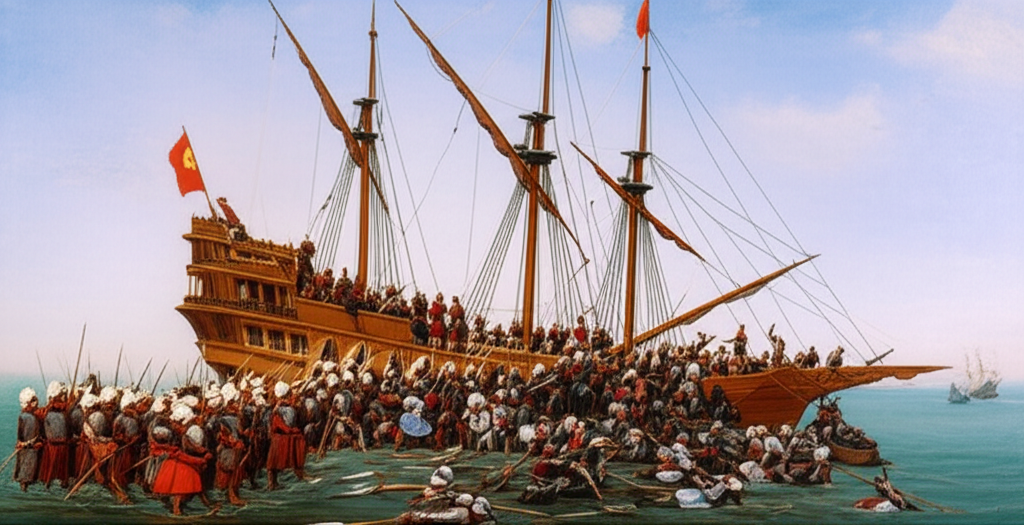
On September 28, 1538, a sudden cessation of the wind left the heavy sailing ships of the Holy League behind and immobilized them. The giant Venetian flagship Galeone di Venezia, commanded by Alessandro Condalmiero, which was left alone 4 miles from the coast and 10 miles from Sessola, was surrounded by dozens of Ottoman galleys. Condalmiero initially kept the Ottomans at bay with heavy artillery fire; However, the Ottoman galleys avoided broadside fire by moving into the ship's blind spots. The ship, which could not receive help from the Allied galleys, did not surrender even though it was severely damaged.
-
7. 28 September 1538
Tactical Disengagement in Allied Lines, Rain and Escape to Corfu
During the battle, deep mistrust and tactical differences between Doria, Grimani, and Cappello jammed allied maneuvers. Doria's feint offensive maneuvers to lure Barbarossa into the open sea proved ineffective, and the allied galleys were unable to launch a coordinated attack. Taking advantage of the rain that fell towards the evening, Doria ordered his armada to retreat to Corfu to save it from defeat. The allied fleet, which extinguished its lights in order to surprise the enemy, retreated in the dark; The damaged Venetian galleon followed the fleet.
Frequently Asked Questions
When and where did Naval Battle of Preveza take place, and what was the outcome?
Naval Battle of Preveza took place on 28 September 1538 at Preveza, Greece and ended with Ottoman Victory.
Who were the commanders and troop numbers in Naval Battle of Preveza?
Ottoman Empire: Barbaros Hayreddin Pasha (Strength: 122, Casualties: 400) · Holy Alliance: Andrea Doria (Strength: 162, Casualties: 3,000)
Why is Naval Battle of Preveza historically significant?
Ottoman Mediterranean dominance was finalized.