Battle of Poltava
Russian Carl Peter I defeated the Swedish army.
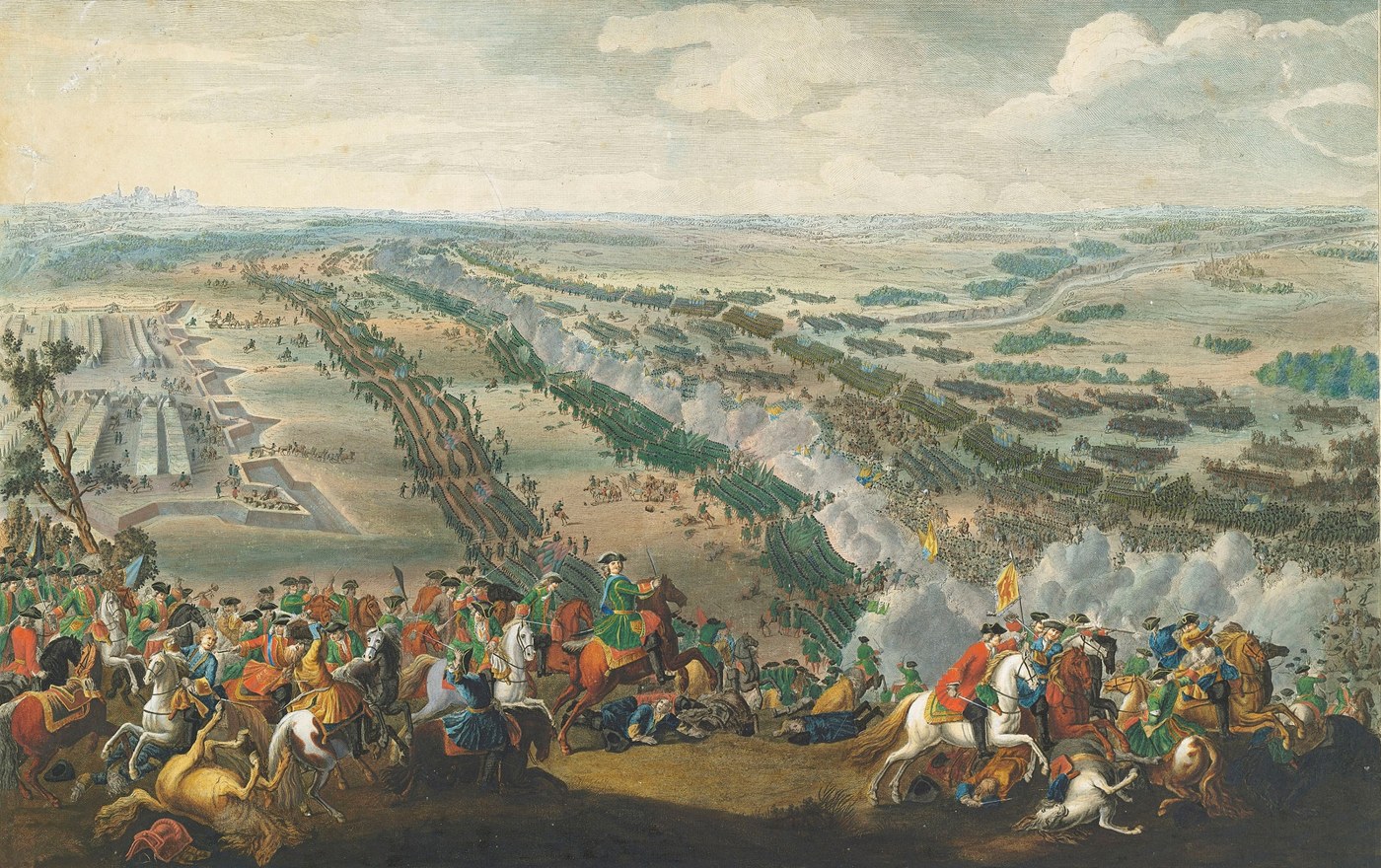
Key Historical Facts
| Fact | Detail |
|---|---|
| Epic Battles | Battle of Poltava |
| Date | 27 June 1709 |
| Location | Poltava (49.59, 34.55) |
| Belligerents, Commanders & Forces | Russian Carlism: Peter I (Strength: 42,000, Casualties: 5,000) · Kingdom of Sweden: XII. Karl (Strength: 14,000, Casualties: 9,000) |
| Weather | Hot |
| Outcome | Russian Victory |
Belligerents, Commanders & Forces
Russian Carlism
- Commander
- Peter I
- Stance
- Defending
- Strength
- 42,000
- Casualties
- 5,000
Kingdom of Sweden
- Commander
- XII. Karl
- Stance
- Attacker
- Strength
- 14,000
- Casualties
- 9,000
Historical Significance
Russia became a great power.
Outcome
Russian Victory
Chronological Phases of the Battle
-
1. 22 August 1707 – June 1708
Grodno Recruitment and Minsk Winter Headquarters
XII. The Swedish main army under the command of Karl left Saxony and headed east. Crossing the Vistula River, the royal forces advanced through Mazuria in harsh winter conditions and captured Grodno, which was evacuated by Russian troops. Taking advantage of the fact that Russian forces were busy with the Bulavin Uprising, the Swedes expanded the operation to Smorgon and Minsk and established a winter headquarters there. At this stage cavalry units were left behind for safety in western Poland. Due to bad weather and bad road conditions, the army had to wait around Minsk until June 1708.
-
2. Autumn 1708
Baturyn Raid and Destruction of Supply Lines
Instead of wintering in Livonia, Karl landed in the Ukraine and headed south to join up with Hetman Mazepa, who had rebelled against Peter. Having lost its supply lines in Lesnaya, the Swedish army moved to Baturyn, the center of Mazepa, with the need to find ammunition and supplies. However, Russian troops under the command of Aleksandr Menshikov arrived in the city before the Swedes. Anticipating the approach of the Swedish army, Menshikov razed the city to the ground, destroying or plundering all stocks of weapons, ammunition and food. This harsh preemptive maneuver led to Karl being deprived of vital logistical resources in the region.
-
3. 2 May 1709 – 20 June 1709
Siege of Poltava and Vorskla Fortification Line
Weakened by heavy winter conditions, Karl besieged the Poltava castle on the banks of the Vorskla River on May 2, 1709. Tsar Peter I came with his army of eighty thousand people in order to break the siege and established a fortified camp four kilometers north of the city. Karl, who was shot in the foot while inspecting Russian positions, lost his command ability and had to transfer his authority to Rehnskiöld. The Russians built a defensive line of ten T-shaped redoubts in the corridor between the Yakovetski and Budyschenski forests. Menshikov's cavalry units were placed behind these redoubts and the passage was closed against the Swedish attack.
-
4. 8 July 1709 (Gregorian)
Attack on the Bastions and Isolation of the Roos Column
Rehnskiöld launched an attack at dusk to overcome the redoubts. Although Swedish troops quickly captured the first two redoubts, the attack was blocked in the third redoubt. As they advanced around the Lewenhaupt redoubts on the right flank, six battalions under the command of Carl Gustaf Roos broke away from the main force and became isolated. Having suffered heavy losses, Roos withdrew to the Yakovetski forest in the east at 06:00 with the remaining 1,500 soldiers of his 2,600-man force. Roos, who took shelter in an abandoned castle towards Poltava against the two-way attack launched by ten Russian regiments, was forced to surrender at 09:30 and one-third of the Swedish infantry was lost.
-
5. 8 July 1709 (Gregorian)
Battle of the Main Lines and the Defeat of the Swedish Army
Tsar Peter went out to the plain from the fortification camp with the support of 22,000 infantry and artillery. They faced only 4,000 Swedish infantry and Creutz's cavalry behind. At 09:45, the Swedish line advancing under the command of Lewenhaupt broke through the first lines of the Russians; However, the delay in cavalry support and the fact that the Russian line was much wider changed the balance. Falling back, the Swedish left wing dispersed and fled. While the Russian infantry, infiltrating through the opened gap, took up square formations, Menshikov's cavalry surrounded the Swedes from behind. The Swedish offensive force completely disintegrated and the army dispersed towards the forests to the south.
-
6. 8 July 1709 – 11 July 1709
Dnieper Withdrawal and Perevolochna Capitulation
Gathering the last troops on the battlefield, Karl abandoned the siege of Poltava at 19:00 in the evening and retreated south with his forces. The surviving Swedish soldiers and their Cossack allies under Lewenhaupt moved towards the Dnieper River. However, Russian regular cavalry and three thousand Kalmyk auxiliary troops pursued the fleeing forces continuously. The remnants of the army, stuck on the river bank and unable to escape, completely surrendered to the Russians three days later, on July 11, 1709, in the village of Perevolochna. This surrender effectively destroyed the Swedish Empire's main military presence.
-
7. after 1709
Refuge in Bender and Exile in Ottoman Territories
XII, who crossed the Dnieper and left the pursuit behind. Karl and Ivan Mazepa took refuge in Bender, which was under Ottoman rule, with the forces that remained with them. The losses of the Swedish main army at Poltava and Perevolochna had shifted the weight of the war in favor of Russia. Karl's stay in Ottoman territory became a new arena for seeking support through diplomacy after the military disaster. The fact that the king reached a safe haven did not reverse the loss of the main army. The military outcome of Poltava was decisive, but the Great Northern War did not end with this battle.
Frequently Asked Questions
When and where did Battle of Poltava take place, and what was the outcome?
Battle of Poltava took place on 27 June 1709 at Poltava and ended with Russian Victory.
Who were the commanders and troop numbers in Battle of Poltava?
Russian Carlism: Peter I (Strength: 42,000, Casualties: 5,000) · Kingdom of Sweden: XII. Karl (Strength: 14,000, Casualties: 9,000)
Why is Battle of Poltava historically significant?
Russia became a great power.