Battle of Nicopolis
The victory in which Yıldırım Bayezid destroyed the great Crusader army.
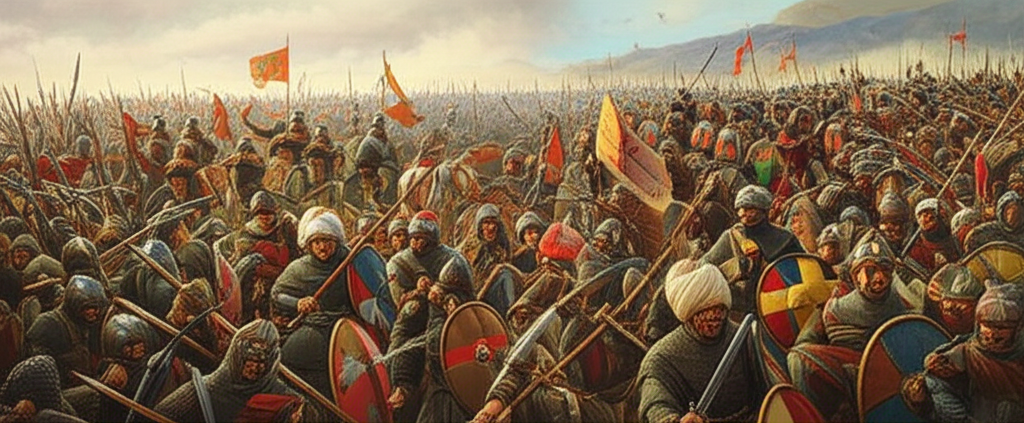
Key Historical Facts
| Fact | Detail |
|---|---|
| Epic Battles | Battle of Nicopolis |
| Date | 25 September 1396 |
| Location | Nicopolis, Bulgaria (43.7, 24.9) |
| Belligerents, Commanders & Forces | Ottoman Empire: Bayezid I (Thunderbolt) (Strength: 20,000, Casualties: 5,000) · Crusader Army: Sigismund (Strength: 100,000, Casualties: 40,000) |
| Weather | Autumn |
| Outcome | Ottoman Victory |
Belligerents, Commanders & Forces
Ottoman Empire
- Commander
- Bayezid I (Thunderbolt)
- Stance
- Defending
- Strength
- 20,000
- Casualties
- 5,000
Crusader Army
- Commander
- Sigismund
- Stance
- Attacker
- Strength
- 100,000
- Casualties
- 40,000
Historical Significance
The last great Crusade failed.
Outcome
Ottoman Victory
Chronological Phases of the Battle
-
1. 12–24 September 1396
The Siege of Nicopolis Castle and the Approach of the Ottoman Army
On September 12, the Crusader army arrived in front of Nicopolis Castle, which has a natural defense position on limestone cliffs. When the Crusaders, who did not bring siege machines, could not capture the castle by force, they decided to blockade the city and capture it by starvation. Castle guard Doğan Bey continued to defend with strong fortifications, confident that Sultan Bayezid would come to his aid. While the Crusaders were wasting their time without posting guards for two weeks, five hundred Hungarian cavalrymen sent to reconnoiter in the direction of Tarnovo reported that the Ottoman army was approaching. The news that Bayezid was rapidly advancing through the Şipka Pass caused chaos in the camp.
-
2. 25 September 1396
Discussion at the Allied War Council and Decision to Attack
In the army gathered under the banners at the dawn of September 25, the Hungarian King Sigismund reported that the scouts saw the Turkish pioneers and asked for the attack to be postponed for two hours. The proposal to wait until the enemy's equipment and presence was understood led to a harsh debate in the French council. Although Coucy and Jean de Vienne, two of the older knights, advocated following the king's advice to wait, D'Eu of Konnetab, France, claimed that Sigismund wanted to claim the glory of victory alone. D'Eu, who had the support of the young knights, refused to postpone. As a result of this uncompromising attitude, which described the precautionary recommendations as cowardice, D'Eu decided to attack immediately and headed the vanguard.
-
3. 25 September 1396
French Cavalry Advance towards the Southern Hills
The French knights, with their horse archers, turned their backs to Nicopolis Castle and rushed forward to meet the Ottoman forces coming down from the hills in the south. Nevers and Coucy led the main forces, while D'Eu led the vanguard; The Knights of Rhodes, the Germans, and other allies remained behind with Sigismund's Hungarian troops. As historian Tuchman relates, from this moment on the course of the conflict turned into a kaleidoscope due to conflicting sources and confusion of narratives. The French cavalry attack tried to advance by crushing the untrained Ottoman vanguard forces on the hillsides, but the tactical confusion in the field made the maneuvers of the parties uncertain.
-
4. 25 September 1396
Battle on the Plains and Dispersion of Allied Lines
After the hills were overcome, the battle spilled over into the plains, where fierce clashes occurred. Meanwhile, a stampede of riderless horses broke out in the plain. Historian Tuchman states that these horses may have escaped by breaking free from the places they were tied to. Seeing the stray horses running backwards in panic, the Transylvanian and Wallachian troops assumed that the Crusader army was defeated and the day was lost. This misperception on the Allied front led to a major disintegration; Wallachian and Transylvanian forces completely abandoned the battlefield. This mass retreat left the main Crusader body alone against the Ottoman troops, who continued to fight in the plains.
-
5. 25 September 1396
Encirclement Resistance by Hungarian and Allied Forces
After the escape of the Allied elements, the Hungarian King Sigismund, the Master of Rhodes and the German troops remained at the front and launched a desperate resistance to prevent the siege maneuver of the Ottoman forces. In this struggle to break the encirclement movement, both sides suffered terrible losses; Sources describe what happened as an indescribable massacre. Although the Christian forces, resisting the pressure of the Ottoman troops from the flanks, tried to regain the tactical superiority in the field, the defense line began to collapse under critical pressure due to heavy losses and decreasing combat power.
-
6. 25 September 1396
Serbian Heavy Cavalry Intervention and Surrender Agreement
At the breaking point of the battle, a fifteen hundred-man Serbian heavy cavalry unit under the command of Sultan Bayezid's vassal Stefan Lazarević joined the battle. This reinforcement brought a decisive victory for the Ottomans and completely destroyed Sigismund's troops. Persuaded to flee, Sigismund and the Master of Rhodes took refuge in a fishing boat on Venetian ships on the Danube, thanks to Hermann of Cilli's troops providing protection. With the compromise reached after the recognition of Nicholas II Garai among those who remained in the field, the Hungarian army surrendered. Thus, the Crusader alliance was completely destroyed in the field and suffered a decisive defeat.
-
7. 26 September 1396
Execution of Prisoners and Retreat Along the Danube
On the morning of September 26, Sultan Bayezid, out of anger at the massacre of Turkish captives in Rahova, ordered all captives to be brought before him. High nobles such as Nevers, Coucy, D'Eu and Boucicaut who could pay ransom were identified and separated, and those under the age of twenty were made slaves. The remaining thousands of captives were tied three by four and slaughtered by executioners by cutting off their heads or dismembering their limbs. The massacre lasted from morning to evening; According to sources, the number of people executed varied between 300 and 3,000. Most of those who tried to escape from the war and swim to the boats on the Danube River died as a result of the boats sinking or drowning in the river.
Frequently Asked Questions
When and where did Battle of Nicopolis take place, and what was the outcome?
Battle of Nicopolis took place on 25 September 1396 at Nicopolis, Bulgaria and ended with Ottoman Victory.
Who were the commanders and troop numbers in Battle of Nicopolis?
Ottoman Empire: Bayezid I (Thunderbolt) (Strength: 20,000, Casualties: 5,000) · Crusader Army: Sigismund (Strength: 100,000, Casualties: 40,000)
Why is Battle of Nicopolis historically significant?
The last great Crusade failed.