Battle of Mohács
The victory in which Suleiman the Magnificent destroyed the Hungarian army in just 2 hours.
Key Historical Facts
| Fact | Detail |
|---|---|
| Epic Battles | Battle of Mohács |
| Date | 29 August 1526 |
| Location | Mohacs, Hungary (45.95, 18.68) |
| Belligerents, Commanders & Forces | Ottoman Empire: Suleiman the Magnificent (Strength: 100,000, Casualties: 1,500) · Kingdom of Hungary: II. lajos (Strength: 25,000, Casualties: 20,000) |
| Weather | End of summer |
| Outcome | Ottoman Victory |
Belligerents, Commanders & Forces
Ottoman Empire
- Commander
- Suleiman the Magnificent
- Stance
- Attacker
- Strength
- 100,000
- Casualties
- 1,500
Kingdom of Hungary
- Commander
- II. lajos
- Stance
- Defending
- Strength
- 25,000
- Casualties
- 20,000
Historical Significance
Hungary became Ottoman territory for 150 years.
Outcome
Ottoman Victory
Chronological Phases of the Battle
-
1. August 29, 1526, 13:00
Encounter on the Mohács Plain and Establishment of Lines
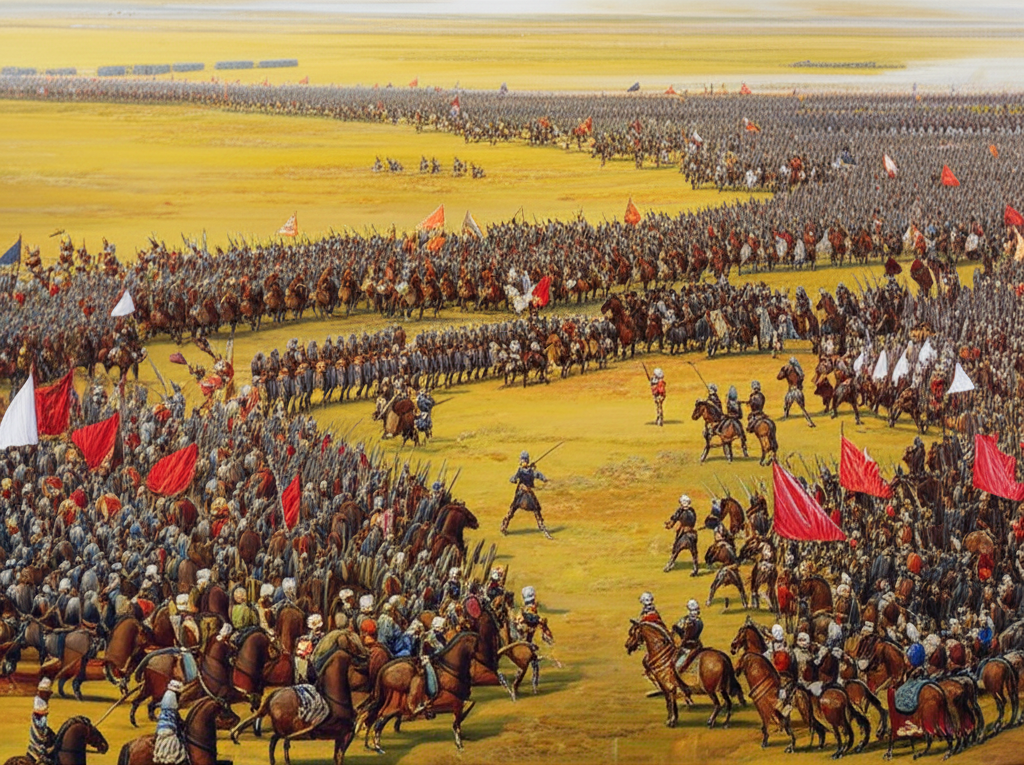
The Hungarian army formed for the attack on the Mohács Plain, concentrating its armored cavalry in the center. Sultan Suleiman the Magnificent deployed the Janissaries and artillery batteries in the center, entrusting the flanks to the Rumelian and Anatolian timariot cavalry. Believing that the Ottoman forces had not yet fully deployed, the Hungarians, commanded by Pál Tomori, decided to end the battle in a single stroke with a swift blow.
-
2. August 29, 1526, 15:00
The Hungarian Armored Cavalry Charge and the Breakthrough of the Vanguard
Archbishop Tomori's heavy armored cavalry charged into the Ottoman vanguard with a great roar. The troops under the command of Rumelian Beylerbegi Ibrahim Pasha reeled under this violent blow. The Hungarian knights broke through the Ottoman light cavalry and advanced rapidly. Intoxicated by victory, the Hungarian units began to surge uncontrollably toward the center of the Ottoman army.
-
3. August 29, 1526, 15:45
Feigned Retreat and Crescent Trap
Ibrahim Pasha's forces retreated in a tactical feigned withdrawal, luring the Hungarian cavalry into a deep trap. With the opening of the flanks, the Hungarian army entered the exact center of the crescent formation, within range of hundreds of chained field guns. Believing the enemy was retreating, King Louis and Tomori drove their troops directly toward the line where the Sultan's imperial tent (otağ-i hümayun) was located.
-
4. August 29, 1526, 16:15
Artillery Fire and Pincer Movement
As the crescent closed, Ottoman artillery opened a devastating crossfire. The janissaries' volleys of musket fire tore through the armored cavalry. Simultaneously, the sipahis of Anatolia and Rumelia completely enveloped the Hungarian army from the flanks. Trapped in the center and robbed of maneuverability, the Hungarian units panicked under intense fire and began to disintegrate rapidly.
-
5. August 29, 1526, 17:00
The Annihilation of the Hungarian Army and the Death of the King
The Hungarian army, failing to break the siege, was completely annihilated within two hours. King Louis II, attempting to flee, sank into the marsh of Csele Stream and drowned. The entire Hungarian nobility and statesman class, including Archbishop Tomori, lost their lives on the battlefield, and the Kingdom of Hungary was wiped off the historical stage.
Frequently Asked Questions
When and where did Battle of Mohács take place, and what was the outcome?
Battle of Mohács took place on 29 August 1526 at Mohacs, Hungary and ended with Ottoman Victory.
Who were the commanders and troop numbers in Battle of Mohács?
Ottoman Empire: Suleiman the Magnificent (Strength: 100,000, Casualties: 1,500) · Kingdom of Hungary: II. lajos (Strength: 25,000, Casualties: 20,000)
Why is Battle of Mohács historically significant?
Hungary became Ottoman territory for 150 years.