Naval Battle of Lepanto
The great naval battle in which the Ottoman navy was defeated by the Crusader navy.
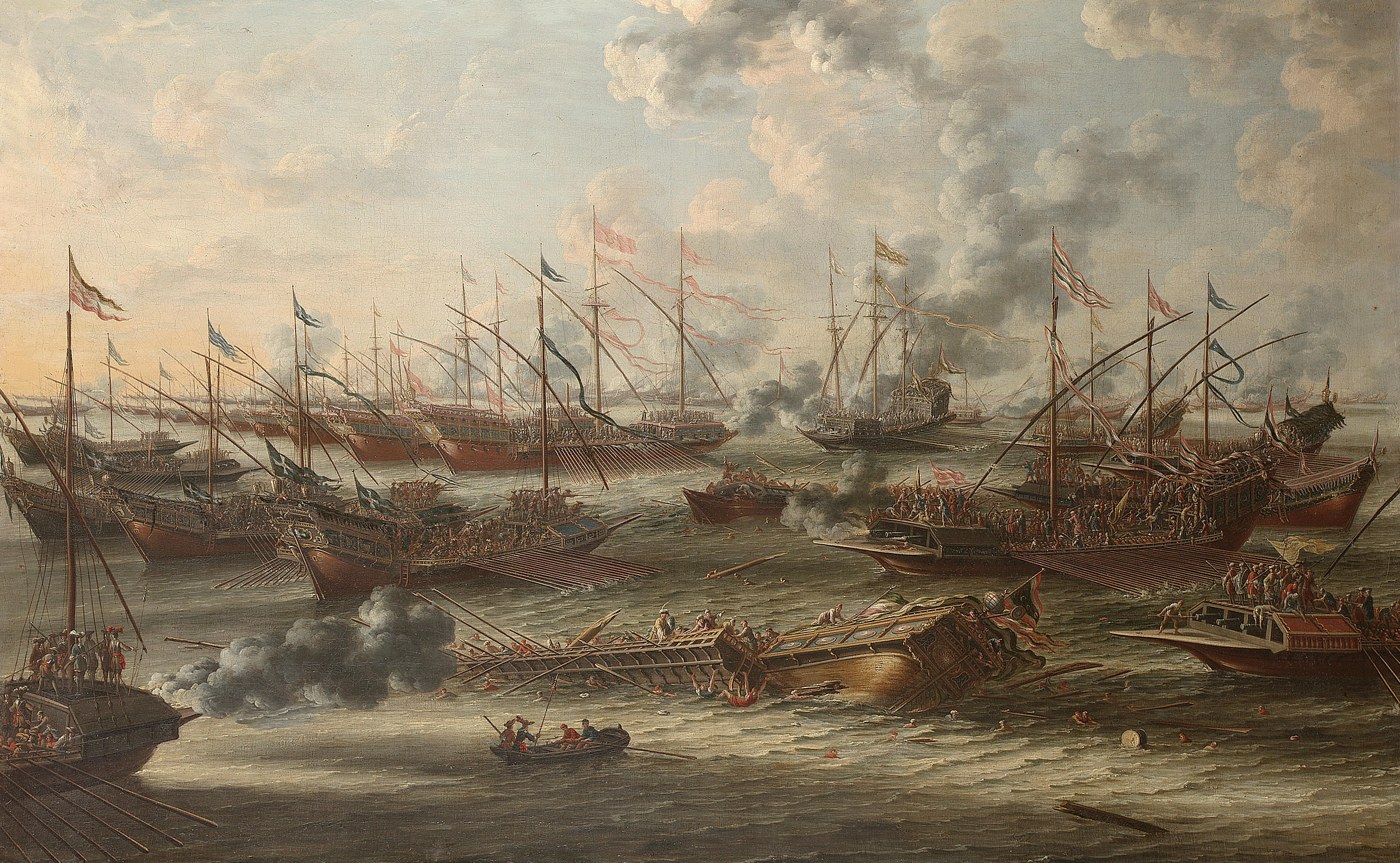
Key Historical Facts
| Fact | Detail |
|---|---|
| Epic Battles | Naval Battle of Lepanto |
| Date | 7 October 1571 |
| Location | Lepanto, Greece (38.38, 21.33) |
| Belligerents, Commanders & Forces | Ottoman Empire: Müezzinzade Ali Pasha (Strength: 230, Casualties: 30,000) · Holy League: Don Juan (Strength: 206, Casualties: 8,000) |
| Weather | Autumn |
| Outcome | Crusader Victory |
Belligerents, Commanders & Forces
Ottoman Empire
- Commander
- Müezzinzade Ali Pasha
- Stance
- Defending
- Strength
- 230
- Casualties
- 30,000
Holy League
- Commander
- Don Juan
- Stance
- Attacker
- Strength
- 206
- Casualties
- 8,000
Historical Significance
Ottoman naval dominance was shaken, but a new navy was built in a year.
Outcome
Crusader Victory
Chronological Phases of the Battle
-
1. July – 6 October 1571
Unification in Messina and Transfer to the Ionian Sea
After the fall of Nicosia and Famagusta in Cyprus, the Holy Alliance forces, established with the encouragement of Pope Pius V, gathered in Messina under the leadership of the Venetian and Spanish navies. The allied navy under the command of Don Juan was organized not in national blocks, but in mixed fleets with galleys from different nationalities. Christian galleys, which set sail from Messina in mid-September, crossed the Ionian Sea by traveling along the coast via Otranto and Corfu. Despite adverse weather conditions and the inability to meet d'Ávalos' sailing ships, the fleet reached Sami Port in Kefalonia on 6 October and completed its final preparations before the battle.
-
2. 6 – 7 October 1571
Council of War and Order of Battle in Front of the Gulf of Patras
When the Holy Alliance fleet headed to the Gulf of Patras on the morning of October 7, the Ottoman fleet was off the coast of Lepanto. Critical war councils were held on both sides. While Gianandrea Doria suggested that the navy not be put at risk, Don Juan insisted on entering the battle to preserve the integrity of the alliance. On the Ottoman side, although Mehmed Şuluk recommended taking shelter in Lepanto Castle, Sultan II. In line with Selim's strict orders, Müezzinzade Ali Pasha decided to attack. The Christian navy was lined up north-south in four main divisions; The Ottoman fleet also took a battle position at the entrance of the gulf with its center, wings and reserve formation.
-
3. 7 October 1571, noon
The Return of the Wind and the Opening Bombardment of the Kalyas
On the morning of the battle, Don Juan sailed around the lines in a fast sailboat, encouraging his soldiers, the rowing prisoners were unchained, and the banner was hoisted. Initially, the wind was blowing against the Christians and it was feared that the Ottomans would make contact before the line was established. However, towards noon, just before the first contact, the wind suddenly changed direction and turned in favor of the allies, allowing the fleet to settle in their assigned positions. Driven to the front of the Christian battle line, four large Venetian galleys opened intense cannon fire from very close range on the approaching leading Ottoman galleys, disrupting the Ottoman battle formation upon contact.
-
4. 7 October 1571
First Battle and Encounter of Flagships on the North Wing
At noon, the first fierce battle broke out on the northern coast between Barbarigo's left wing and the Ottoman right wing under the command of Mehmed Şuluk. Simultaneously, the La Real galley, on which Don Juan boarded, and the Sultana galley, on which Ali Pasha boarded, confronted each other in the center. Don Juan's central fleet included Marcantonio Colonna and Sebastiano Venier, while Spanish and Neapolitan galleys surrounded the flagship. A fierce infantry battle began on floating platforms with deck boarding. The arquebus and javelin tactics of the Spanish marines began to break the resistance of the Ottoman archers and the missing janissary units.
-
5. 7 October 1571
Tactical Maneuvers on the South Wing and Uluç Ali's Breakthrough
In the southern sector facing the open sea, 61 galleys and 32 galleys under the command of Uluç Ali encountered Gianandrea Doria's right wing of 53 galleys. When Doria expanded into the open to avoid being surrounded, a dangerous breach opened between the Christian center and the southern flank. Realizing this gap, Uluç Ali dived in with a masterful maneuver and dealt heavy blows to the flagship of the Knights of Malta and the surrounding ships. Uluç Ali, who captured the Maltese flag, managed to retreat with a significant part of his fleet, avoiding being surrounded when the general Ottoman line began to collapse and the Christian reserve came into play.
-
6. 7 October 1571, in the evening
The Last Stand of the Janissaries and the Collapse of the Ottoman Navy
Seizing the initiative in the center and the northern flank, the Holy Alliance broke through the Ottoman central line with the support of Álvaro de Bazán's reserve galleys. Although the battle turned against them, the janissary groups fought until the evening. By the end of the battle, the Christians had captured 117 Ottoman galleys and sunk or destroyed approximately 83 ships. However, the entire Ottoman navy was not destroyed; Having gained superiority on the southern flank, Uluç Ali Pasha captured the Malta flagship and managed to escape the siege and retreat to Istanbul with a significant part of the ships under his command.
-
7. 1572 – 1573
Battle of Cape Matapan and Final Dissolution of the Alliance
After the defeat of Lepanto, the Ottoman Empire quickly mobilized its shipyards and built more than one hundred and fifty galleys within six months. In July 1572, Uluç Ali set sail with 200 ships. The Holy Alliance fleet under Marcantonio Colonna engaged in a brief engagement with the Ottoman fleet off Cape Matapan on 10 August; Uluç Ali retreated when his left wing was damaged. However, due to disagreements among the allied leaders and Don Juan's timidity, the final blow to Navarino could not be dealt. In 1573, while Don Juan took Tunisia, Venice made a unilateral peace and left Cyprus to the Ottomans, and the Alliance was officially dissolved.
Frequently Asked Questions
When and where did Naval Battle of Lepanto take place, and what was the outcome?
Naval Battle of Lepanto took place on 7 October 1571 at Lepanto, Greece and ended with Crusader Victory.
Who were the commanders and troop numbers in Naval Battle of Lepanto?
Ottoman Empire: Müezzinzade Ali Pasha (Strength: 230, Casualties: 30,000) · Holy League: Don Juan (Strength: 206, Casualties: 8,000)
Why is Naval Battle of Lepanto historically significant?
Ottoman naval dominance was shaken, but a new navy was built in a year.