Battle of Kursk
The largest tank battle in history. Germany's last major offensive on the Eastern Front failed.
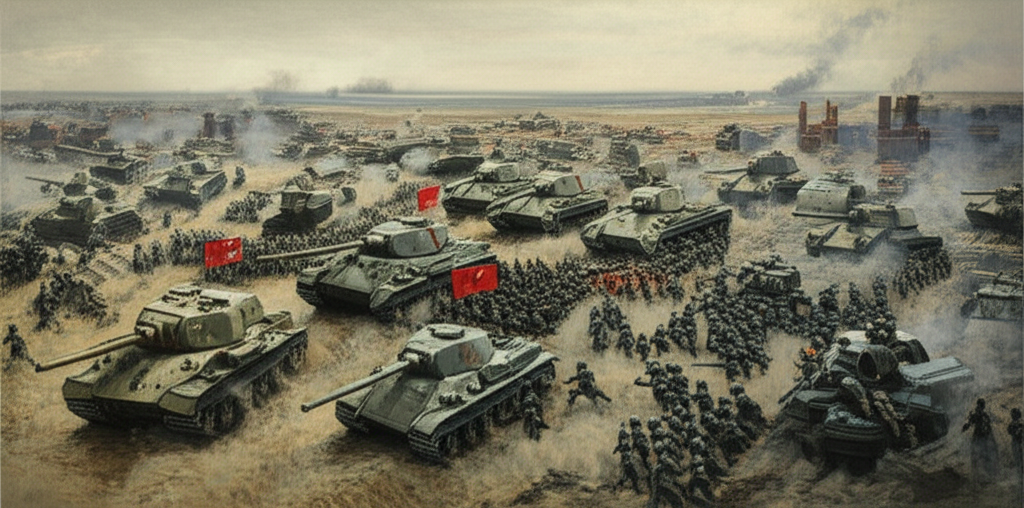
Key Historical Facts
| Fact | Detail |
|---|---|
| Epic Battles | Battle of Kursk |
| Date | 5 July - 23 August 1943 |
| Location | Kursk, Russia (51.73, 36.19) |
| Belligerents, Commanders & Forces | Soviet Union: Zhukov, Rokossovsky (Strength: 1,900,000, Casualties: 254,000) · Nazi Germany: Manstein, Model (Strength: 780,000, Casualties: 200,000) |
| Weather | Hot summer, dusty steppe |
| Outcome | Soviet Victory |
Belligerents, Commanders & Forces
Soviet Union
- Commander
- Zhukov, Rokossovsky
- Stance
- Defending
- Strength
- 1,900,000
- Casualties
- 254,000
Nazi Germany
- Commander
- Manstein, Model
- Stance
- Attacker
- Strength
- 780,000
- Casualties
- 200,000
Historical Significance
Germany could not attack again. The Soviet advance has begun.
Outcome
Soviet Victory
Chronological Phases of the Battle
-
1. February – March 1943
The Appearance of the Kursk Salient and Operational Plans
Following the Battle of Stalingrad, Kursk was retaken on February 8, 1943, with the general offensive of the Red Army in the south. However, the counter-attacks of the German forces under the command of Manstein and the subsequent spring rasputitsa period led to the cessation of operations. This created a large Soviet bulge inside German-controlled lines, extending 250 kilometers from north to south and 160 kilometers from east to west, with the city of Kursk at its center. The offensive against this salient was authorized by Operational Order No. 5, signed by Hitler on 13 March. The German command prepared the Operation Citadel plan, which aimed to cut off the Kursk salient from its base with a pincer operation as soon as the rasputitsa ended.
-
2. 4–5 July 1943
Preliminary Skirmishes and Artillery Duel on the South Wing
Before the main offensive of Operation Citadel, battles began on the southern front on the evening of July 4, 1943. German infantry launched an offensive to seize high ground to establish artillery observation posts; Elements of the Großdeutschland and the 3rd and 11th Panzer Divisions captured the villages of Butovo and Gertsovka. Thereupon, Voronezh Front commander Vatutin ordered the bombardment of the II SS Panzer Corps positions with 600 cannons, mortars and Katyusha rockets at around 22.30. In the north, Zhukov launched a preventive artillery bombardment at around 02:00 on July 5, in order to disrupt the German offensive preparations. Although these bombardments delayed the German troops, they could not completely disrupt the offensive calendar.
-
3. 5 July 1943
9th Army Offensive on the Northern Wing
On the northern flank, the German 9th Army under the command of General Model started the attack at 05.30 on July 5, after artillery preparation. In order to save the armored power of the panzer divisions for the actual breakthrough, the model carried out the first attack with infantry divisions reinforced with assault guns and heavy tanks. The XLVII Panzer Corps was stopped after advancing approximately 6 miles through the Soviet defenses. The XLI Panzer Corps, on the left flank, reached the fortified town of Ponyri, which controlled the vital road and rail lines extending south to Kursk. While the Soviet 13th Army and reinforced defense lines offered fierce resistance, German troops suffered significant losses on the first day.
-
4. 5–6 July 1943
Donets Pass and Kempf Detachment South of Belgorod
Kempf Detachment was tasked with protecting the right flank of the 4th Panzer Army and breaking through the defenses of the Soviet 7th Guards Army on the east bank of the North Donets river. On July 5, at the Mikhailovka bridgehead just south of Belgorod, eight infantry battalions of the 6th Panzer Division crossed the river under heavy Soviet bombardment. Part of a Tiger company from the 503rd Heavy Tank Battalion was able to cross the bridge before it collapsed; but traffic jams in the south left the remainder of the division stranded on the west bank. The troops crossing the river were blocked by minefields in the Stary Gorod direction, and the German corps, which suffered 2,000 casualties throughout the day, was forced to retreat to defense at night.
-
5. 6–7 July 1943
German Advance and Soviet Reserves on the Obojan Axis
As of the evening of July 6, the Voronezh Front had not been able to stop Hoth's 4th Panzer Army, although it had deployed almost all of its reserves into battle. Only the second line of defense remained in front of the XLVIII Panzer Corps, which was attacking along the Obojan axis, where the third defensive belt was largely empty, preventing it from penetrating the Soviet depths. Faced with the danger of this critical breakthrough, Stavka immediately advanced the 5th Guards Army of the Steppe Front and the 5th Guards Tank Army as a strategic reserve to reinforce the Voronezh Front. On July 7, the 5th Guards Tank Army under the command of Pavel Rotmistrov began to move towards Prokhorovka among clouds of dust.
-
6. 6–10 July 1943
Battle of Attrition Around Ponyri and Olhovatka
Rokossovsky ordered a counter-attack at dawn on July 6; However, due to lack of coordination, only the 16th Tank Corps attempted the attack and encountered the Tiger tanks of the 505th Heavy Tank Battalion, losing 69 tanks. Between 7 and 10 July, Model concentrated all the pressure of the 9th Army on the strategic positions of Ponyri and Olhovatka on the dominant hill. Fierce fighting took place in Ponyri, street by street, with the town changing hands several times; soldiers described it as a mini-Stalingrad. In the face of the fierce resistance of the Soviet defense by burying tanks in positions, the German advance front narrowed and as of July 10, the Red Army completely stopped the German advance in the north.
-
7. 11 July 1943
Night Attack on Donets and Capture of the Bridgehead
The most critical operational problem for Manstein and Hausser was that Kempf Detachment was unable to advance, leaving II SS Panzer Corps' eastern flank exposed. After days of obstruction, on July 11, Kempf Detachment finally managed to create a breach. The 6th Panzer Division captured a bridge over the Donets river intact with a surprise night raid. After gaining control of the bridge, General Breith focused on quickly moving his armored vehicles and troops across the river to attack Prokhorovka from the south. This move was intended to unite with the II SS Panzer Corps and completely surround the Soviet 69th Army.
-
8. 11–12 July 1943
Battle of Prokhorovka and Armored Engagement
II SS Panzer Corps came within 3 kilometers of the Prokhorovka settlement on the night of July 11. Hausser ordered the 3rd SS Panzer Division Totenkopf to advance northeast and hit the Soviet lines from the rear, while the 1st SS Division Leibstandarte was to attack positions on the southwestern slopes. That same night, Pavel Rotmistrov moved the 5th Guards Tank Army to the assembly area just behind Prokhorovka for a major counter-offensive. In the massive armored battle that took place on July 12, Soviet tank units suffered heavy losses and had to retreat to their starting positions. Neither the Soviet army nor the German corps could achieve their final goal; However, Soviet resistance definitively prevented the German breakthrough.
-
9. 12 July 1943
Kutuzov Counteroffensive on the Orel Salient
As the German offensive in the north lost momentum, the Red Army launched Operation Kutuzov on July 12 against Army Group Center stationed in the Orel salient just north of the Kursk salient. The Bryansk Front under the command of Popov attacked the eastern face of the salient, and the Western Front under the command of Sokolovski attacked from the north. The Soviet offensive, led by Bagramyan's 11th Guards Army, broke through German lines and cut off supply routes, despite heavy losses. This situation forced Model's 9th Army to retreat completely to the defensive, leaving it in danger of being surrounded. While the weak 2nd Panzer Army, which was responsible for holding the front, was forced to retreat, the operation paved the way for the liberation of Smolensk.
-
10. 3–23 August 1943
Operation Polkovodets Rumyantsev and the Liberation of Kharkov
On 3 August, the Red Army launched Operation Polkovodets Rumyantsev against German forces in the south. The Voronezh and Steppe Fronts attacked the northern flank of Army Group Southern, liberating Belgorod on 5 August and carrying out a large-scale breakthrough operation towards the south. By August 12, Soviet forces reached the outskirts of Kharkov; Here it was temporarily stopped by the harsh counter-attack of the 2nd and 3rd SS Panzer divisions and tank losses occurred. Following this disruption, the Soviet army focused its forces directly on the city and ended the Battle of Kursk with a final strategic victory by completely liberating Kharkov on August 23, 1943, after street clashes.
Frequently Asked Questions
When and where did Battle of Kursk take place, and what was the outcome?
Battle of Kursk took place on 5 July - 23 August 1943 at Kursk, Russia and ended with Soviet Victory.
Who were the commanders and troop numbers in Battle of Kursk?
Soviet Union: Zhukov, Rokossovsky (Strength: 1,900,000, Casualties: 254,000) · Nazi Germany: Manstein, Model (Strength: 780,000, Casualties: 200,000)
Why is Battle of Kursk historically significant?
Germany could not attack again. The Soviet advance has begun.