First Battle of Kosovo
Critical battle in which Murad I defeated the Serbian-Balkan alliance.
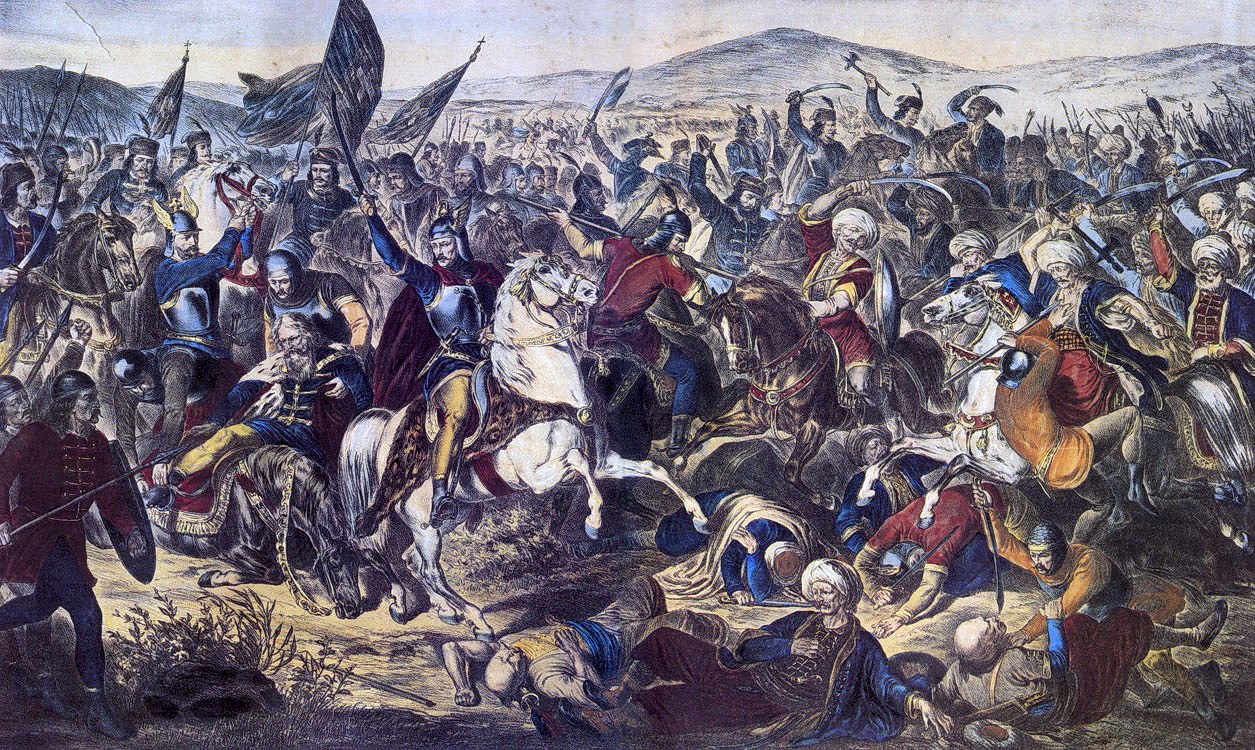
Key Historical Facts
| Fact | Detail |
|---|---|
| Epic Battles | First Battle of Kosovo |
| Date | 15 June 1389 |
| Location | Kosovo Plain (42.69, 21.17) |
| Belligerents, Commanders & Forces | Ottoman Empire: Murad I (Strength: 40,000, Casualties: 20,000) · Serbian-Balkan Alliance: Lazar Hrebeljanović (Strength: 30,000, Casualties: 25,000) |
| Weather | Early summer |
| Outcome | Ottoman Victory |
Belligerents, Commanders & Forces
Ottoman Empire
- Commander
- Murad I
- Stance
- Attacker
- Strength
- 40,000
- Casualties
- 20,000
Serbian-Balkan Alliance
- Commander
- Lazar Hrebeljanović
- Stance
- Defending
- Strength
- 30,000
- Casualties
- 25,000
Historical Significance
Ottoman rule began in the Balkans.
Outcome
Ottoman Victory
Chronological Phases of the Battle
-
1. spring 1388
Transfer of the Ottoman Army from Plovdiv to İhtiman
After the defeats at Pločnik and Bileća, Sultan Murad I transferred his army from Philippoupolis to Ihtiman in the spring of 1388. This strategic transfer initiated the Ottomans' attempt to regain the initiative in the Balkans. The Ottoman administration directed its forces westwards through Bulgaria against the resistance of Prince Lazar, the ruler of Moravian Serbia, and his allies, thus constituting the logistical and operational starting point of future attack lines.
-
2. 1388
Progress to Kosovo Junction via Velbužd and Kratovo
Ottoman forces, moving from Ihtiman, continued their advance through Velbužd and Kratovo. Although this transfer line was longer compared to the Sofia and Nishava Valley route, it directly transported the army to Kosovo, the key junction of the Balkans. Sultan Murad and his entourage found the opportunity to attack both Prince Lazar's land and Vuk Branković's domination area from here and kept their forces waiting in the Kratovo region for a while.
-
3. 1388–1389
Gathering of Lazarus in Niš and the Route to Prokuplje
Prince Lazar concentrated his forces against the approaching Ottoman expedition on the right bank of the South Morava, near Nish. The source considers it probable that these troops remained here until it became known that Murad was advancing on Velbužd; The details of the wait are not certain. Lazar's army then headed towards Kosovo via Prokuplje. The Kosovo area was a meeting area that allowed Murad to control the routes he could use. This narrative is not sufficient to determine the army's march time each day or its exact battle positions.
-
4. June 1389
Transfer from Preševo Line to Pristina
Sultan Murad and his army stayed in Kratovo for a certain period of time and marched through Kumanovo, Preševo and Gilan to reach Kosovo. The Ottoman transfer arm, which crossed these mountainous and strategic transition lines, arrived in Pristina on June 14. This forward operation gave the Ottoman command the opportunity to both suppress Branković's territory and engage in a decisive pitched battle with Prince Lazar's main coalition forces organized in the Kosovo Plain.
-
5. 14–15 June 1389
Establishing Order of Battle on the Kosovo Plain
Two armies were stationed in the Kosovo Plain, northwest of Pristina. While Prince Lazar commanded the Serbian center, Vuk Branković commanded the right wing, Vlatko Vuković commanded the left wing, and heavy Serbian cavalry settled on the front line. While Sultan Murad was in the Ottoman center, Bayezid and Evrenoz led the right wing, and Yakub led the left wing. The wings were strengthened with a thousand archers; Janissaries and the cavalry guards behind them fortified the center where the sultan was located.
-
6. 15 June 1389
Serbian Cavalry Breakthrough and Bayezid's Counterattack
The battle started with the fire of Ottoman archers. Serbian cavalry, attacking in wedge formation, broke through the Ottoman left wing held by Yakub Çelebi, causing heavy damage in the first phase and gaining superiority. However, when the cavalry attack ended, the light Ottoman troops counterattacked, putting the heavily armored Serbs in a difficult situation. The fierce Ottoman counter-attack under the command of Bayezid defeated the Serbian infantry and gained control later in the day.
-
7. 15 June 1389
Death of Murad and Lazar, Withdrawal After the Battle
At the end of the battle, both Sultan Murad and Prince Lazar lost their lives; The remaining forces of the two armies withdrew from the battlefield. Murad's murder is attributed to Miloš Obilić in later accounts; However, reports differ regarding how the assassination took place and at what moment of the conflict. Therefore, a single scene of sneaking up and stabbing cannot be established as a definitive sequence of events. The heavy losses and the deaths of the two leaders are the fundamental turning points for understanding the outcome of the battle and the political developments that followed.
Frequently Asked Questions
When and where did First Battle of Kosovo take place, and what was the outcome?
First Battle of Kosovo took place on 15 June 1389 at Kosovo Plain and ended with Ottoman Victory.
Who were the commanders and troop numbers in First Battle of Kosovo?
Ottoman Empire: Murad I (Strength: 40,000, Casualties: 20,000) · Serbian-Balkan Alliance: Lazar Hrebeljanović (Strength: 30,000, Casualties: 25,000)
Why is First Battle of Kosovo historically significant?
Ottoman rule began in the Balkans.