Conquest of Istanbul
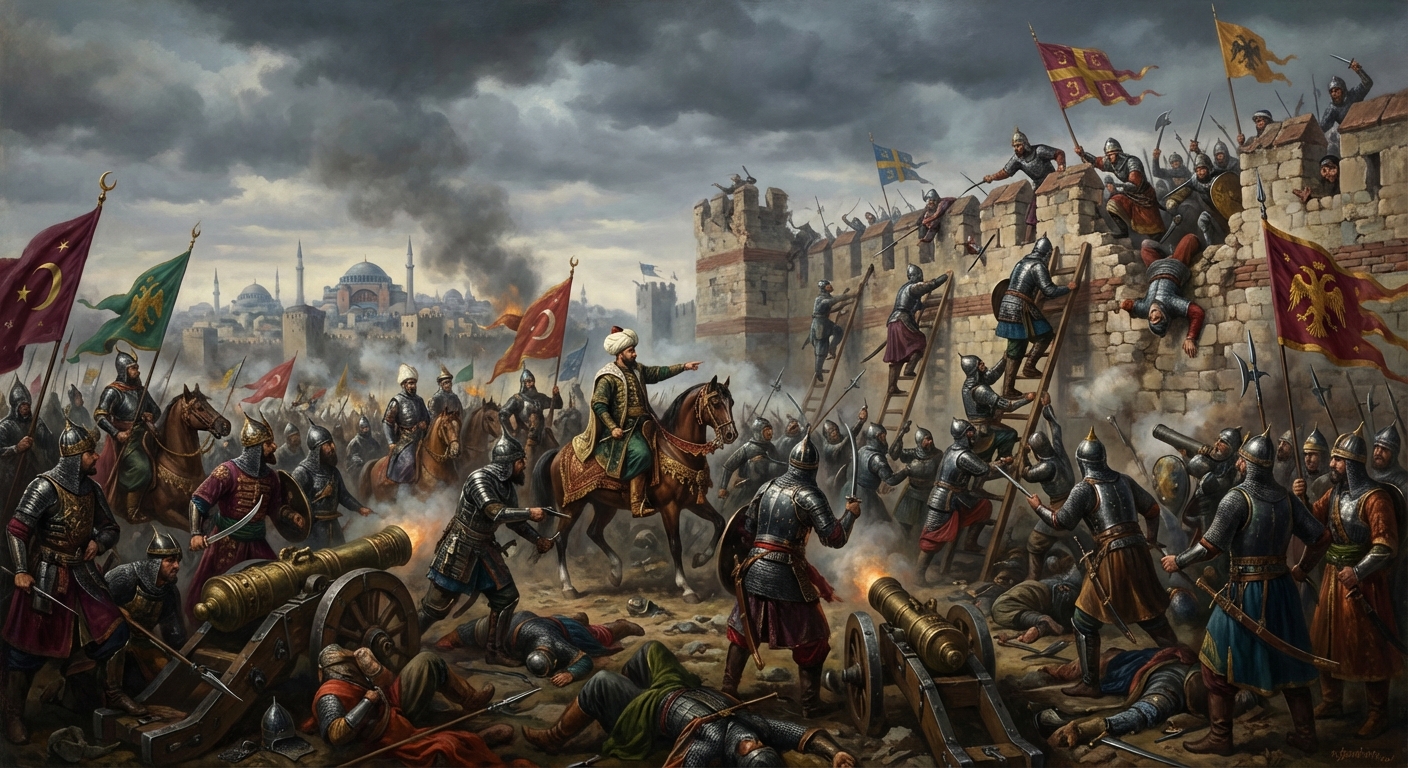
The historical siege in which Mehmet the Conqueror conquered Istanbul, putting an end to the Byzantine Empire.
Key Historical Facts
| Fact | Detail |
|---|---|
| Epic Battles | Conquest of Istanbul |
| Date | 29 May 1453 |
| Location | Constantinople (Istanbul) (41.0082, 28.9784) |
| Belligerents, Commanders & Forces | Ottoman Empire: Mehmed the Conqueror (Strength: 80,000, Casualties: 4,000) · Byzantine Empire: XI. Constantine (Strength: 7,000, Casualties: 4,000) |
| Weather | Spring weather, slightly cloudy |
| Outcome | Ottoman Victory |
Belligerents, Commanders & Forces
Ottoman Empire
- Commander
- Mehmed the Conqueror
- Stance
- Attacker
- Strength
- 80,000
- Casualties
- 4,000
Byzantine Empire
- Commander
- XI. Constantine
- Stance
- Defending
- Strength
- 7,000
- Casualties
- 4,000
Historical Significance
The end of the Middle Ages, the beginning of the Modern Age. The Ottoman became a world power.
Outcome
Ottoman Victory
Chronological Phases of the Battle
-
1. April - August 1452
Choking of the Straits and Construction of Rumelihisarı
Sultan Mehmed II rapidly constructed Rumelihisarı, known as Boğazkesen, with the aim of cutting off all types of provisions and naval support that could reach Byzantium from the Black Sea. Operating in coordination with Anadoluhisarı on the opposite shore, this fortification brought the Bosporus crossings completely under the control of Ottoman artillery, constituting the first strategic move of the impending major siege.
-
2. April 6, 1453
The Beginning of the Great Siege and the Fire of the Basilic Great Guns
The Ottoman land army took up positions before the Theodosian Walls, completely isolating the city by land. The giant Basilic cannons, manufactured by the Hungarian founder Urban, began pounding the walls. The triple land walls, which had remained unbreached for centuries, suffered their first serious shocks against this firepower far ahead of its time, and wide breaches began to appear along the wall line.
-
3. 20 April 1453
Naval Engagement Off the Golden Horn and the Relief Fleet
A small relief fleet consisting of Genoese and Papal ships caught a favorable wind and headed toward the entrance of the Golden Horn. Although Ottoman galleys under the command of Baltaoğlu Süleyman Bey launched a fierce assault to stop these ships, the high-sided enemy galleons broke the Ottoman line, bypassed the chain, and took refuge in the Golden Horn.
-
4. April 21 - 22, 1453
Transporting Ships Overland and the Golden Horn Maneuver
Following the failure at sea, Sultan Mehmed put a brilliant plan into action. Ottoman light ships were hauled overland on greased slipways from the slopes of Tophane and launched overnight into the inner waters of the Golden Horn from the heights of Kasımpaşa. This maneuver left the vulnerable sea walls facing the Golden Horn undefended and forced the Byzantine defense into a two-front war.
-
5. April 28, 1453
Repulse of the Counter-Assault in the Golden Horn
The Byzantine and Italian navies attempted to set fire to the Ottoman ships brought down into the Golden Horn using fire ships at night. However, having been tipped off in advance, Ottoman artillery and musketeers met the allied fleet attempting to maneuver in the narrow waters with intense fire. The raid ended in a disaster, cementing absolute Ottoman supremacy in the Golden Horn.
-
6. May 26 – 27, 1453
Council of War and the Decision for the Great Offensive
The prolongation of the siege and the prospect of a new Crusader fleet arriving from the West sparked heated debates in the encampment. While Çandarlı Halil Pasha advocated lifting the siege, Zaganos Pasha and the young Sultan insisted on an assault. Ultimately, it was definitively decided to execute a general, all-out final charge involving the entire army.
-
7. May 29, 1453, 01:30 - 05:00
Wave-upon-Wave Assault and the Wounding of Giustiniani
The final assault began at midnight. First, the irregular azabs and bashi-bozuks wore down the walls, followed by regular Anatolian troops surging into the breaches. Toward dawn, the Janissaries, the most elite force, went on the offensive by direct order of the Sultan. Meanwhile, as the backbone of the defense, Genoese commander Giovanni Giustiniani, was severely wounded and withdrew from the field, the rampart defense began to collapse.
-
8. May 29, 1453, 06:00
Infiltration via the Kerkoporta and Raising the Flag on the Walls
Realizing that the small Kerkoporta gate in the Blachernae district had been left open, Ottoman vanguard troops infiltrated inside and scaled the ramparts. At the same time, Ulubatlı Hasan and his comrades dashed through the Topkapı breach and planted the standard atop the walls. Seeing the banner fluttering, Byzantine soldiers panicked and scattered, and Emperor Constantine lost his life in the combat.
-
9. May 29, 1453, Noon
Advance Within the City and the Security of Hagia Sophia
With the total collapse of the city walls, the Ottoman regiments advanced along the main avenues toward the Augusteum Square. Thousands of Byzantine citizens, who had sought refuge in Hagia Sophia in terror, were in deep anxiety for their lives. The Ottoman troops entering the city secured the cathedral, and public order was established with the assurance that the lives of the people inside would be spared.
-
10. May 29, 1453, Afternoon
Fatih's Entry and the Reconstruction of the Capital
Sultan Mehmed II entered the city officially from Topkapı with his retinue and proceeded directly to Hagia Sophia as a symbol of the conquest. The first call to prayer was recited and a prayer of thanksgiving was performed. Granting freedom of religion and conscience to the populace, the young sovereign issued a decree halting the looting and declared the ruined city the new and eternal capital of the Ottoman Empire.
Frequently Asked Questions
When and where did Conquest of Istanbul take place, and what was the outcome?
Conquest of Istanbul took place on 29 May 1453 at Constantinople (Istanbul) and ended with Ottoman Victory.
Who were the commanders and troop numbers in Conquest of Istanbul?
Ottoman Empire: Mehmed the Conqueror (Strength: 80,000, Casualties: 4,000) · Byzantine Empire: XI. Constantine (Strength: 7,000, Casualties: 4,000)
Why is Conquest of Istanbul historically significant?
The end of the Middle Ages, the beginning of the Modern Age. The Ottoman became a world power.