Battle of Crécy
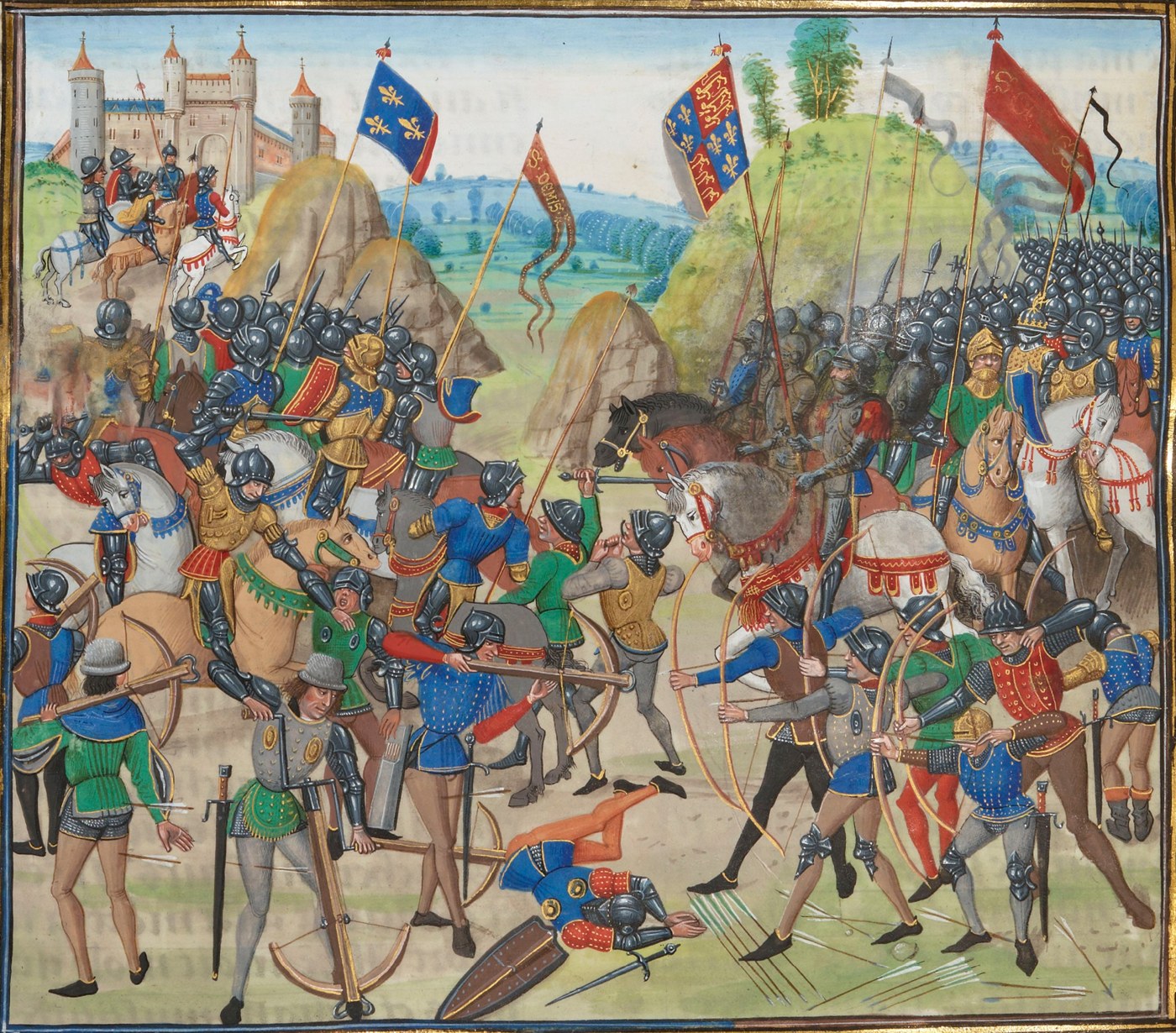
The first major battle in which English archers defeated French knights.
Key Historical Facts
| Fact | Detail |
|---|---|
| Epic Battles | Battle of Crécy |
| Date | 26 August 1346 |
| Location | Crécy, France (50.26, 1.85) |
| Belligerents, Commanders & Forces | England: King III. Edward (Strength: 12,000, Casualties: 300) · France: King VI. Philip (Strength: 30,000, Casualties: 13,500) |
| Weather | Rainy |
| Outcome | British Victory |
Belligerents, Commanders & Forces
England
- Commander
- King III. Edward
- Stance
- Defending
- Strength
- 12,000
- Casualties
- 300
France
- Commander
- King VI. Philip
- Stance
- Attacker
- Strength
- 30,000
- Casualties
- 13,500
Historical Significance
The Hundred Years' War began. The age of chivalry was shaken.
Outcome
British Victory
Chronological Phases of the Battle
-
1. 12:00 - 15:00
Establishment of the British Defensive Line
King Edward III deployed his army in a flawless defensive formation on the ridges of Crécy-en-Ponthieu. English and Welsh longbowmen were positioned in a V-shape along the slope, with ditches and stakes placed before them. Heavy armored knights dismounted and took positions alongside the infantry. With disciplined anticipation, the English were ready to meet the French vanguard.
-
2. 16:00 - 17:00
The Rout of the Genoese Crossbowmen
King Philip VI's Genoese mercenary crossbowmen opened the battle. However, a sudden downpour loosened their bowstrings and their shields had been left behind. The English longbowmen, with their superiority in range and rate of fire, overwhelmed the Genoese in a heavy storm of arrows. The Genoese quickly broke and began to retreat in panic.
-
3. 17:00 - 18:30
Chaotic Charge of the French Cavalry
Angered by the retreat of the Genoese, the French knights charged, trampling their own allies. The muddy ground slowed the horses' speed while the steep slope broke the momentum of the cavalry charge. Under the deadly arrow storm of English archers, hundreds of horses and knights crashed into one another and tumbled to the ground, and utter chaos ensued in the French ranks.
-
4. 18:30 - 20:00
Fierce Climax on the Central Line
The elite French knights, who managed to survive the rain of arrows, reached the British right wing under the command of Edward, the Black Prince of Wales. In this fierce hand-to-hand combat, the young prince was put in danger. King Edward refused to commit the reserves, wanting his son to earn his spurs, and the British armored line successfully held.
-
5. 20:00 - 23:00
Night Waves and the French Rout
Throughout the night, the French uncoordinatedly renewed their attacks a full fifteen times. Each wave of assault melted away under the sky darkened by English arrows. Numerous French noblemen, including the blind King John of Bohemia, lost their lives in these reckless attacks. The wounded King Philippe was forced to leave the battlefield.
-
6. Morning of August 27
Clearing of the Field and Decisive Victory
With the dawn, a horrific scene unfolded on the ridges of Crécy. French units attempting to reinforce amidst the morning mist were easily repulsed. Thousands of knights and nobles had perished at the hands of English archers. This historic victory ended the absolute supremacy of knights in medieval warfare doctrine and declared the dominance of the longbow.
Frequently Asked Questions
When and where did Battle of Crécy take place, and what was the outcome?
Battle of Crécy took place on 26 August 1346 at Crécy, France and ended with British Victory.
Who were the commanders and troop numbers in Battle of Crécy?
England: King III. Edward (Strength: 12,000, Casualties: 300) · France: King VI. Philip (Strength: 30,000, Casualties: 13,500)
Why is Battle of Crécy historically significant?
The Hundred Years' War began. The age of chivalry was shaken.