Battle of Cannae
The victory of the Carthaginian commander Hannibal Barca against the Roman army, which is considered the most brilliant maneuver in military history.
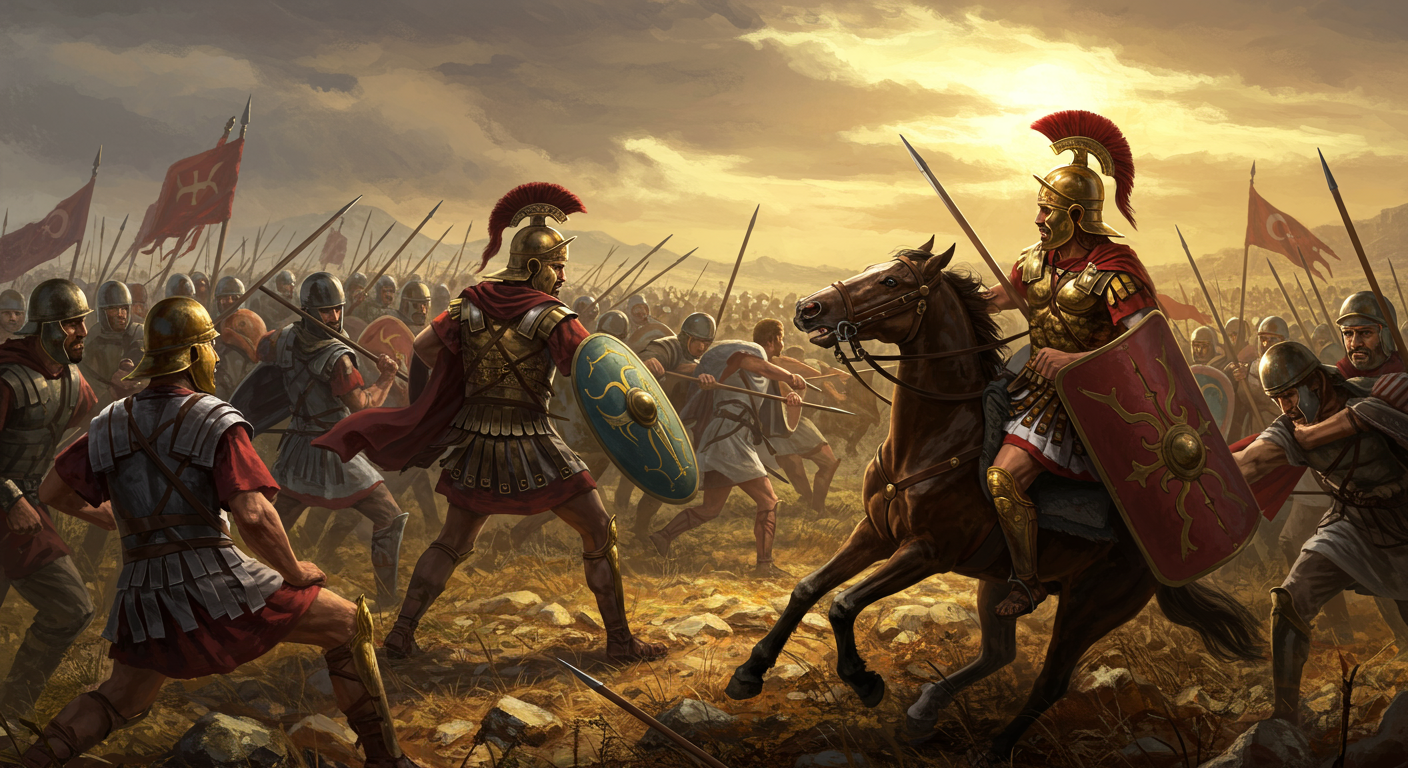
Key Historical Facts
| Fact | Detail |
|---|---|
| Epic Battles | Battle of Cannae |
| Date | 216 BC, 2 August |
| Location | Cannae, Italy - near the Ofanto River (41.305, 16.132) |
| Belligerents, Commanders & Forces | Carthage: Hannibal Barca (Strength: 50,000, Casualties: 6,000) · Roman Republic: Gaius Terentius Varro (Strength: 86,000, Casualties: 70,000) |
| Weather | Hot summer day, clouds of dust |
| Outcome | Carthaginian Victory |
Belligerents, Commanders & Forces
Carthage
- Commander
- Hannibal Barca
- Stance
- Attacker
- Strength
- 50,000
- Casualties
- 6,000
Roman Republic
- Commander
- Gaius Terentius Varro
- Stance
- Defending
- Strength
- 86,000
- Casualties
- 70,000
Historical Significance
It is referred to as the 'perfect war' in military history. The double flip tactic is still taught in military academies.
Outcome
Carthaginian Victory
Chronological Phases of the Battle
-
1. Spring 216 BC
The Fall of the Cannae Supply Depot
Hannibal captured the fortress of Cannae, Rome's vital grain and supply center in the Apulia region, by a surprise assault. This critical move directly severed Roman logistics in southern Italy. The Roman Senate decided to mobilize and dispatch the largest combined consular army in history to the south in order to destroy Hannibal through a definitive pitched battle.
-
2. August 1, 216 BC
Deployment and Tension on the Banks of the Aufidus
Over eighty thousand Roman soldiers deployed along the Aufidus River, establishing two camps. Hannibal sent Numidian cavalry to the river to cut off the Romans' water supply and provoke his adversary. Although the cautious Consul Paullus wanted to avoid conflict, when the pro-offensive Consul Varro took over command the following day, he decided to deploy the army in battle order.
-
3. Morning of August 2, 216 BC
Initial Contact and the Convex Carthaginian Line
Varro formed deep ranks within a narrow space and drove his massive infantry mass straight into the Carthaginian center. Hannibal, meanwhile, deployed his Iberian and Celtic infantry forward in a convex arc. The Carthaginian center was deliberately kept fragile. On the flanks, veteran African infantry remained hidden in reserve, while the powerful Celt-Iberian cavalry established overwhelming supremacy against the Roman cavalry by the riverbank.
-
4. Noon of August 2, 216 BC
Collapse of the Center and the Crescent Trap
As the heavy Roman infantry pressed forward with all their weight, Hannibal's weak center began a disciplined retreat. The convex arch gradually turned into a concave pocket. Believing they had won the victory, the Roman legionnaires poured into this trap in dense masses. As the ranks compressed, the soldiers found themselves trapped in an area so narrow they could not even draw their swords.
-
5. Afternoon of August 2, 216 BC
Double Envelopment and Extermination Circle
Carthusian flank cavalry completely routed the Roman cavalry and swung around behind the legions. Simultaneously, fresh African infantry on the flanks enveloped the Roman mass from the sides. The most flawless double envelopment in history was completed. Nearly seventy thousand Roman soldiers trapped within the circle were completely annihilated in a brutal and systematic slaughter lasting until sunset.
-
6. Late August 216 BC
Panic in Rome and Total Resistance
The news that tens of thousands of Romans, including Consul Paullus, had been massacred caused panic in Rome. Fearing that Hannibal would march on the city, sacrifices were offered in the Forum Boarium. Young Scipio prevented an escape at Canusium, making the officers swear an oath of allegiance to Rome. Refusing to surrender, Rome enlisted slaves and youths, transforming the war into a total struggle despite the defeat at Cannae.
Frequently Asked Questions
When and where did Battle of Cannae take place, and what was the outcome?
Battle of Cannae took place on 216 BC, 2 August at Cannae, Italy - near the Ofanto River and ended with Carthaginian Victory.
Who were the commanders and troop numbers in Battle of Cannae?
Carthage: Hannibal Barca (Strength: 50,000, Casualties: 6,000) · Roman Republic: Gaius Terentius Varro (Strength: 86,000, Casualties: 70,000)
Why is Battle of Cannae historically significant?
It is referred to as the 'perfect war' in military history. The double flip tactic is still taught in military academies.