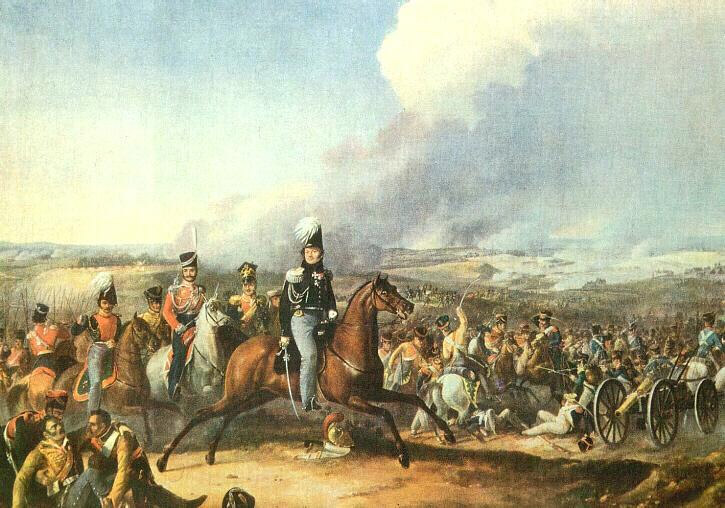
Battle of Borodino
Napoleon defeated the Russian army but could not destroy it.
Key Historical Facts
| Fact | Detail |
|---|---|
| Epic Battles | Battle of Borodino |
| Date | 7 September 1812 |
| Location | Borodino (55.53, 35.82) |
| Belligerents, Commanders & Forces | French Empire: Napoleon Bonaparte (Strength: 130,000, Casualties: 30,000) · Russian Carlism: Mikhail Kutuzov (Strength: 120,000, Casualties: 44,000) |
| Weather | Sunny |
| Outcome | Tactical French Victory |
Belligerents, Commanders & Forces
French Empire
- Commander
- Napoleon Bonaparte
- Stance
- Attacker
- Strength
- 130,000
- Casualties
- 30,000
Russian Carlism
- Commander
- Mikhail Kutuzov
- Stance
- Defending
- Strength
- 120,000
- Casualties
- 44,000
Historical Significance
The Russian army was not destroyed.
Outcome
Tactical French Victory
Chronological Phases of the Battle
-
1. 5–6 September 1812
Preliminary Battle of Shevardino Bastion
On 5 September 1812, French troops under the command of Marshal Murat encountered Pyotr Konovnitsyn's Russian forces in a major cavalry clash. Konovnitsyn retreated to the Shevardino Bastion when Beauharnais's 4th Corps threatened his flank. Murat against this pentagonal redoubt, which was defended in order to screen the Russian left wing and delay the French advance; He dispatched the cavalry corps of Nansouty and Montbrun and the Compans Division; From the south, Poniatowski's Polish infantry attacked. The Russians did not leave the position until Kutuzov himself gave the order to retreat. The fall of the redoubt with heavy losses shook the Russian defensive formation, and Russian forces were forced to retreat east to a makeshift line centered at Utitsa to protect the left flank.
-
2. 7 September 1812, 06:00 – 11:30
French Attack on Bagration Bastions
In the attack that started at 06:00 on the morning of September 7 with the fire of a 102-gun French battery, Napoleon rejected Davout's siege proposal and drove the 1st Corps directly to the Bagration redoubts. These three arrowhead trenches in front of the Koloça Stream were insufficient for defense due to their shallow ditches. As the Compans and Dessaix divisions advanced under intense Russian artillery fire, both commanders were wounded; Davout fell to the ground when his horse was shot. Despite the resistance of Vorontsov and Neverovsky divisions and a counter-attack by Russian cavalry, Barclay's reinforcements were dispersed by French artillery. At 11:30, Friant Division captured the positions. Bagration's serious injury led to a command crisis in the Russian 2nd Army, and Dokhturov assumed command.
-
3. 7 September 1812, around 08:00
Battle of Utitsa Forest and Old Smolensk Road
The village of Utitsa on the Old Smolensk Road was a critical position that threatened to surround the Russian defenses. In the dense bush and swamp forest terrain, half of General Tuchkov's 23,000-man force consisted only of militia armed with pikes and axes. Due to Russian hunter fire in the forest, Poniatowski's 10,000 soldiers went through Yelnya and dominated the village and the hill in the first attack. Tuchkov took back the village with a counter-attack at 08:00, but was mortally wounded. With Junot's Westphalian soldiers, the village was recaptured and set on fire by the Russians. The Poles' hope of breaking through the front faded when Barclay delivered reinforcements under the command of Baggovut to the left wing.
-
4. 7 September 1812
First Attacks on Borodino Village and Raevski Redoubt
Eugène de Beauharnais attacked and captured the village of Borodino from the Russian Guard Hunters; General Delzons was assigned to defend the village. Morand and Broussier's divisions crossed the Kolocha bridges and advanced towards the Raevski Redoubt, and the Bonnamy brigade managed to enter the redoubt. While Barclay personally rallied the dispersed Paskevich regiment, Yermolov, on Kutuzov's orders, brought three horse artillery batteries forward. The 3rd Battalion of the Ufa Regiment and two skirmish regiments attempted a bayonet charge, dislodged Bonnamy's brigade from the redoubt and took back the position. On the French side, General Sorbier brought in 36 cannons from the Imperial Guard artillery and 49 horse guns from the cavalry corps, setting the Russian lines in a relentless crossfire.
-
5. 7 September 1812, 07:30 – noon
Kolocha Pass and Russian Cavalry Raid
At around 07:30 in the morning, Platov's Don Cossacks found an unguarded pass on the Kolocha River. With the support of Colonel von Toll, Uvarov's 1st Cavalry Corps was added to the operation, and Kutuzov authorized the raid as a tactical feint. Approximately 8,000 cavalry without infantry and 12 cannons advanced southwest and fell behind Beauharnais's 4th Corps around noon. The cavalry approaching the headquarters and supply lines caused panic. Beauharnais, who was preparing to attack the Raevski Redoubt, was forced to stop the attack and withdraw his entire corps. Although the Russian raid did not achieve tactical success, it delayed the French attack for two critical hours, allowing Ostermann-Tolstoy reinforcements to arrive on Bagration's collapsed flank.
-
6. 7 September 1812, 14:00 – 18:00
The Fall of the Raevski Bastion and the Decision to Reserve the Guard
At 14:00, Broussier, Morand and Gérard divisions were charged to the Raevski Bastion from the front. General Likhachyov's 24th Division defended the redoubt to the last bullet. Watier's cavalry, dispatched by Caulaincourt, entered from behind the redoubt; Caulaincourt was killed by musket fire. When Thielmann's Saxon and Polish cavalry pushed their horses through the battlements, the defenses were broken and the redoubt fell at 15:30. Russian Guards Cavalry prevented the French from advancing further. At around 15:00, his generals asked Napoleon to lead the Imperial Guard into the field to crush the Russian line once and for all. However, Napoleon refused to sacrifice his last elite reserve so far from France and ordered a bombardment of Mortier with 400 cannons.
-
7. 8–13 September 1812
Fili Military Council and the Evacuation of Moscow
On September 8, the Russian army retreated southwards from Borodino in two arms. Kutuzov knew that his army had suffered very heavy losses; Although a renewed battle was planned around Poklonnaya Gora, defending Moscow at all costs was a great risk since there were not enough reinforcements. On the afternoon of September 13, 1812, a war council was held in the village of Fili. In a heated debate among the generals, the council was divided five to four in favor of continuing the war. After listening to both sides, Kutuzov approved the decision to withdraw in order to preserve the integrity of the army. This strategic decision, which resulted in the abandonment of Moscow, trapped Napoleon's forces in a burned city, paving the way for the recovery of the Russian army.
Frequently Asked Questions
When and where did Battle of Borodino take place, and what was the outcome?
Battle of Borodino took place on 7 September 1812 at Borodino and ended with Tactical French Victory.
Who were the commanders and troop numbers in Battle of Borodino?
French Empire: Napoleon Bonaparte (Strength: 130,000, Casualties: 30,000) · Russian Carlism: Mikhail Kutuzov (Strength: 120,000, Casualties: 44,000)
Why is Battle of Borodino historically significant?
The Russian army was not destroyed.