Battle of Belleau Wood
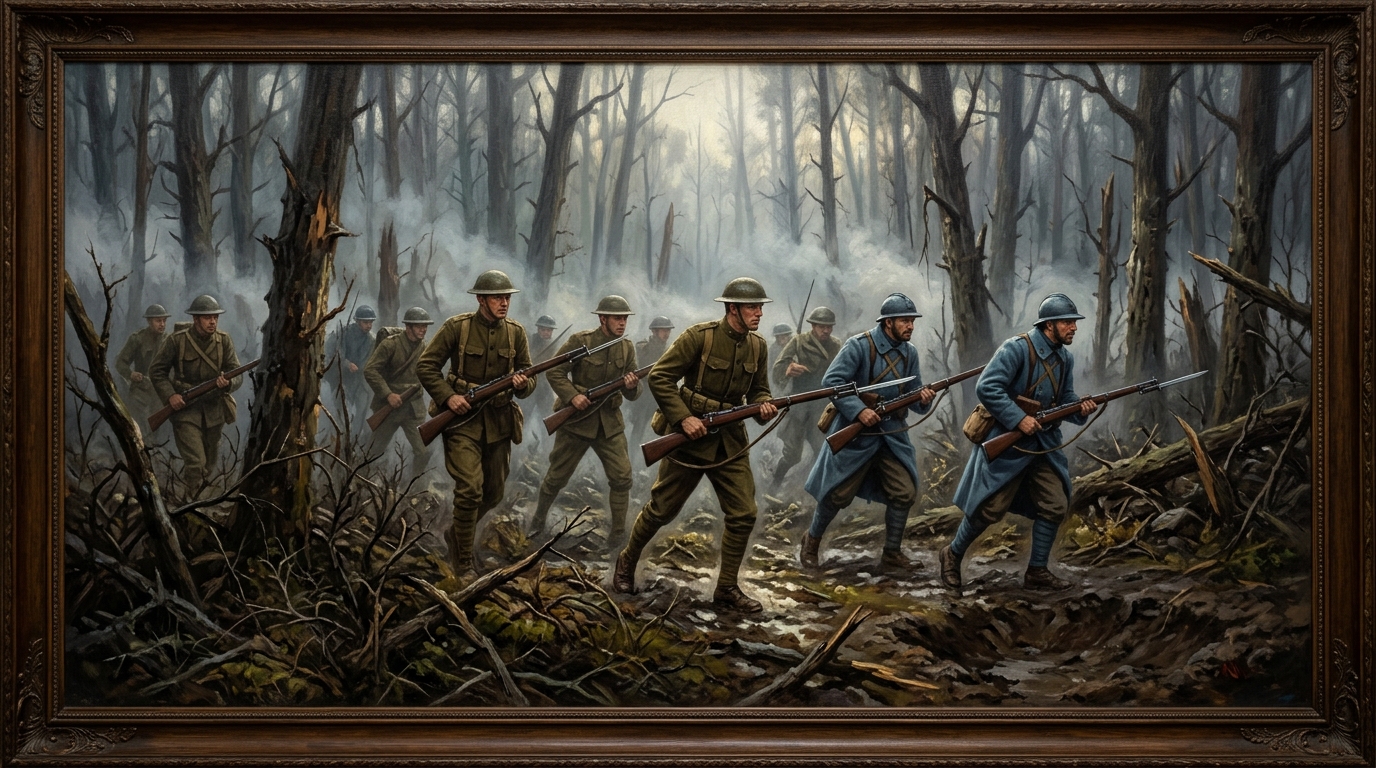
This is the legendary counter-offensive conducted by the U.S. Marine Corps and allied forces in Belleau Wood to halt the advancing German forces toward Paris during the German Spring Offensive of 1918. The bloody, hand-to-hand combat in the dense forest proved the capability of the American military to turn the tide of the war on the Western Front.
Key Historical Facts
| Fact | Detail |
|---|---|
| Epic Battles | Battle of Belleau Wood |
| Date | June 1 – 26, 1918 |
| Location | Belleau, Aisne, France (49.0742, 3.2925) |
| Belligerents, Commanders & Forces | Allies (USA and France): Major General John A. Lejeune and James Harbord (Strength: 30,000, Casualties: 9.777 zayiat (1.811 ölü, yaklaşık 8.000 yaralı)) · German Empire: General Bruno von Mudra (Strength: 25,000, Casualties: Yaklaşık 9.500 zayiat ve 1.600 esir) |
| Weather | The early summer heat, intermittent fog, and humid air weighted down with toxic gas clouds. |
| Outcome | Allied (American and French) victory; Belleau Wood was completely cleared of German forces. |
Belligerents, Commanders & Forces
Allies (USA and France)
- Commander
- Major General John A. Lejeune and James Harbord
- Stance
- Attacker
- Strength
- 30,000
- Casualties
- 9.777 zayiat (1.811 ölü, yaklaşık 8.000 yaralı)
German Empire
- Commander
- General Bruno von Mudra
- Stance
- Defending
- Strength
- 25,000
- Casualties
- Yaklaşık 9.500 zayiat ve 1.600 esir
Historical Significance
It is the U.S. Marine Corps' most iconic victory in modern history. It broke the German threat to Paris, boosted Allied morale, and led German soldiers to bestow upon the American Marines the title 'Teufelshunde' (Devil Dogs).
Outcome
Allied (American and French) victory; Belleau Wood was completely cleared of German forces.
Chronological Phases of the Battle
-
1. June 1 – 3, 1918
German Advance and Defense Line
Advancing rapidly on the road to Paris, German divisions take shelter in Belleau Wood near the Marne River. Replacing the retreating French units, the 4th American Marine Brigade refuses the order to evacuate and begins digging defensive positions. A line of resistance is established with Captain Lloyd Williams's words: 'Retreat? Hell, we just got here!'
-
2. June 6, 1918
The Wheatfield Charge
American Marines launched an assault from the open wheat fields toward the forest and the nearby hill. German Maxim machine guns spewed death from the wooded areas where they were concealed. Advancing without trench support, the Marines suffered heavy casualties. However, Sergeant Dan Daly urging his men forward with the cry, 'Come on, you sons of bitches, do you want to live forever?', prevented the line from collapsing.
-
3. June 7 - 11, 1918
Clashes in the Forest Labyrinth
The battle devolves into fierce close-quarters combat deep within forests featuring tree logs, rocky positions, and hidden bunkers. Visibility drops to a few meters amidst intense artillery salvos and the fog of German mustard gas. American soldiers attempt to systematically capture fortified positions using bayonets, hand grenades, and rifle butts.
-
4. 12 - 15 June 1918
Defense of Bouresches Village
The assault on the village of Bouresches to secure the eastern flank of the forest succeeds. Despite being heavily wounded, Lieutenant James Robertson manages to hold the town. Fierce German counterattacks throughout the night are shattered by machine gun and sniper fire, securing the forest's logistical support.
-
5. June 16 - 22, 1918
Artillery Pincer and Heavy Casualties
While American troops reinforced their depleted battalions, French and American heavy artillery subjected the forest to an incessant bombardment. Shrapnel bursting from tree branches turned the forest into a living hell. Although German troops launched counterattacks under starvation, thirst, and continuous shelling, they could not break the resolute defense of the Marines.
-
6. June 23 - 26, 1918
Final Bayonet Charge and Victory
Marines under the command of Major Maurice Shearer launch the final assault on the remaining German resistance pockets in the wood. A radio message transmitted on the morning of June 26 summarizes the situation: 'Woods entirely US Marine Corps.' Heavy costs have been paid, but the most dangerous gateway of the Germans leading to the capital Paris has been closed.
Frequently Asked Questions
When and where did Battle of Belleau Wood take place, and what was the outcome?
Battle of Belleau Wood took place on June 1 – 26, 1918 at Belleau, Aisne, France and ended with Allied (American and French) victory; Belleau Wood was completely cleared of German forces..
Who were the commanders and troop numbers in Battle of Belleau Wood?
Allies (USA and France): Major General John A. Lejeune and James Harbord (Strength: 30,000, Casualties: 9.777 zayiat (1.811 ölü, yaklaşık 8.000 yaralı)) · German Empire: General Bruno von Mudra (Strength: 25,000, Casualties: Yaklaşık 9.500 zayiat ve 1.600 esir)
Why is Battle of Belleau Wood historically significant?
It is the U.S. Marine Corps' most iconic victory in modern history. It broke the German threat to Paris, boosted Allied morale, and led German soldiers to bestow upon the American Marines the title 'Teufelshunde' (Devil Dogs).