Battle of Austerlitz
Napoleon decisively defeated the Russian and Austrian armies.
Key Historical Facts
| Fact | Detail |
|---|---|
| Epic Battles | Battle of Austerlitz |
| Date | 2 December 1805 |
| Location | Austerlitz (49.14, 16.74) |
| Belligerents, Commanders & Forces | French Empire: Napoleon Bonaparte (Strength: 68,000, Casualties: 1,300) · Russia-Austria Coalition: Alexander I (Strength: 90,000, Casualties: 27,000) |
| Weather | Foggy |
| Outcome | French Victory |
Belligerents, Commanders & Forces
French Empire
- Commander
- Napoleon Bonaparte
- Stance
- Defending
- Strength
- 68,000
- Casualties
- 1,300
Russia-Austria Coalition
- Commander
- Alexander I
- Stance
- Attacker
- Strength
- 90,000
- Casualties
- 27,000
Historical Significance
Napoleon's military genius was proven.
Outcome
French Victory
Chronological Phases of the Battle
-
1. September – November 1805
Siege of Ulm and Capture of Vienna
On 25 September 1805, Napoleon started a secret march across the Rhine River with his 200,000-man French army. Austrian General Mack concentrated most of his army in the castle of Ulm in Swabia. Napoleon turned south, carried out a maneuver that left the Austrian army behind, and pressured the Austrians by launching cavalry attacks through the Black Forest. As a result of the Ulm Maneuver, 23,000 Austrian soldiers surrendered on 20 October and a total of 60,000 Austrians were taken prisoner during the campaign. Following this success on land, French forces captured Vienna in November 1805, gaining one hundred thousand rifles and five hundred cannon.
-
2. 2 December 1805
Allied Offensive on the Telnitz and Sokolnitz Lines
The battle began at approximately 08:00 in the morning with the Allied lines attacking the village of Telnitz. Allied columns turned towards the French right flank, which Napoleon had weakened. The vanguard of the second column attacked the village of Sokolnitz, defended by the 26th Light Regiment and skirmishers. General Langeron ordered the bombardment of the village, forcing the French to retreat. The third column under General Przybyszewski attacked Sokolnitz Castle. III. The village was temporarily taken back with the counter-attack of the Friant division of the Corps. Sokolnitz changed hands throughout the day and witnessed the fiercest clashes of the battle.
-
3. 2 December 1805
French Breakthrough to the Pratzen Heights
As the fog began to clear at around 08.45 in the morning, Napoleon, seeing that the Allied center was weakened, ordered Soult to attack the Pratzen Heights. Emerging from the fog, St. As Hilaire's division climbed the hill, it encountered stunned Russian troops. After stubborn clashes, St. Hilaire's soldiers drove the Allies off the hill with a bayonet charge. In the north, General Vandamme's division attacked the Staré Vinohrady area and dispersed many Allied battalions. As French superiority became evident, Napoleon moved his command center from Žuráň Hill to St. Petersburg in the Pratzen Hills. He moved it to Anthony's Chapel.
-
4. 2 December 1805
Guard Skirmish at Staré Vinohrady
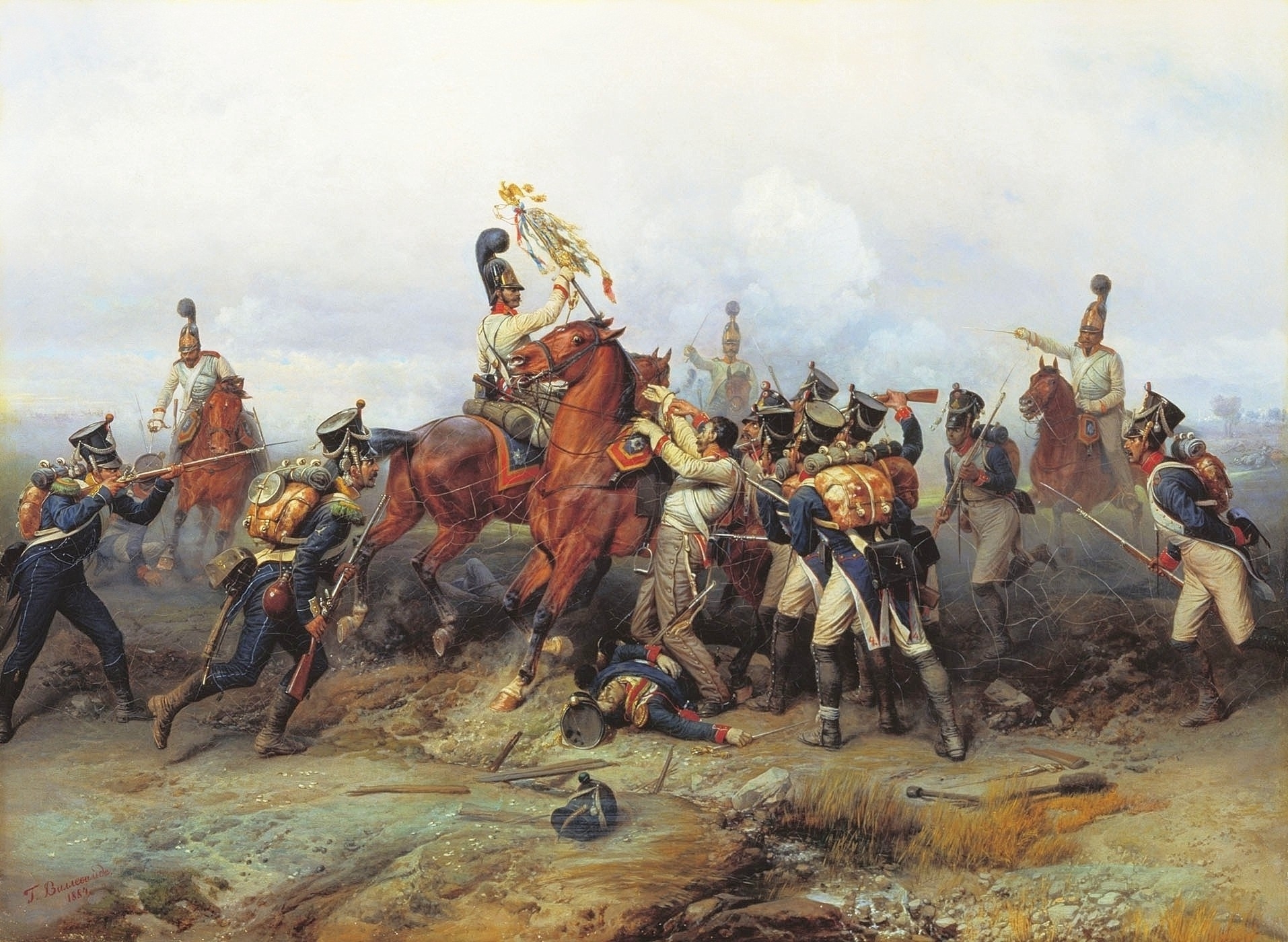
Faced with the critical situation of the Allies, the Russian Imperial Guard was thrown into battle. The Russian Guard, under the command of the Tsar's brother, Grand Duke Constantine, launched a bloody counter-attack on Vandamme's sector, defeating a battalion of the 4th Line Regiment and capturing a French standard. Seeing the seriousness of the situation, Napoleon brought forward his own heavy Guard cavalry. Mutual mass cavalry attacks took place. As a result of the Drouet division of Bernadotte's I Corps settling on the flank and the intense fire of the Guard horse artillery, the Russian cavalry and hunters were defeated and pushed back.
-
5. 2 December 1805
Cavalry Battle on the North Wing and the Charge of Lannes
In the northern part of the battlefield, Prince von Liechtenstein's heavy cavalry charged Kellermann's light cavalry. Faced with superior Russian numbers, Kellermann took refuge behind General Caffarelli's infantry division. Caffarelli's defense stopped the Russian attacks and enabled Murat to bring two armored cavalry divisions into battle. After a fierce and protracted fight, the French cavalry prevailed. Lannes then attacked Bagration's positions with his V Corps, forcing the Russian forces to retreat; However, Murat opposed the pursuit and the attack was stopped.
-
6. 2 December 1805
Siege of Sokolnitz and Retreat to the Frozen Ponds
Napoleon focused on his southern flank. St. Hilaire's division and Davout's III Division. The Corps' two-pronged assault on Sokolnitz shattered the Allied lines; Kienmayer and Langeron had to quickly withdraw. While the retreating Russian troops were trying to escape over the frozen ponds, the ice was broken by the fire of the French artillery. Although sources report between 200 and 2,000 casualties and Napoleon reported a mass drowning disaster, this is disputed; In fact, when the ponds were drained a few days after the battle, only two or three human corpses and approximately 150 horses were found.
-
7. December 1805
The Peace of Pressburg and the Dissolution of the Third Coalition
Following the defeat at Austerlitz, France and Austria signed an armistice on 4 December. Austria withdrew from the war with the Treaty of Pressburg, signed on 26 December. Austria had to recognize the French territories gained by the treaties of Campo Formio and Lunéville, cede territory to Bavaria, Württemberg and Baden, pay a war compensation of 40 million francs, and cede Venice to the Kingdom of Italy. While the Russian army was allowed to withdraw to its own territory, the Holy Roman Empire entered the process of disintegration. However, this victory did not force Russia or Britain to make peace, and lasting peace was not achieved on the continent.
Frequently Asked Questions
When and where did Battle of Austerlitz take place, and what was the outcome?
Battle of Austerlitz took place on 2 December 1805 at Austerlitz and ended with French Victory.
Who were the commanders and troop numbers in Battle of Austerlitz?
French Empire: Napoleon Bonaparte (Strength: 68,000, Casualties: 1,300) · Russia-Austria Coalition: Alexander I (Strength: 90,000, Casualties: 27,000)
Why is Battle of Austerlitz historically significant?
Napoleon's military genius was proven.