Battle of Amiens
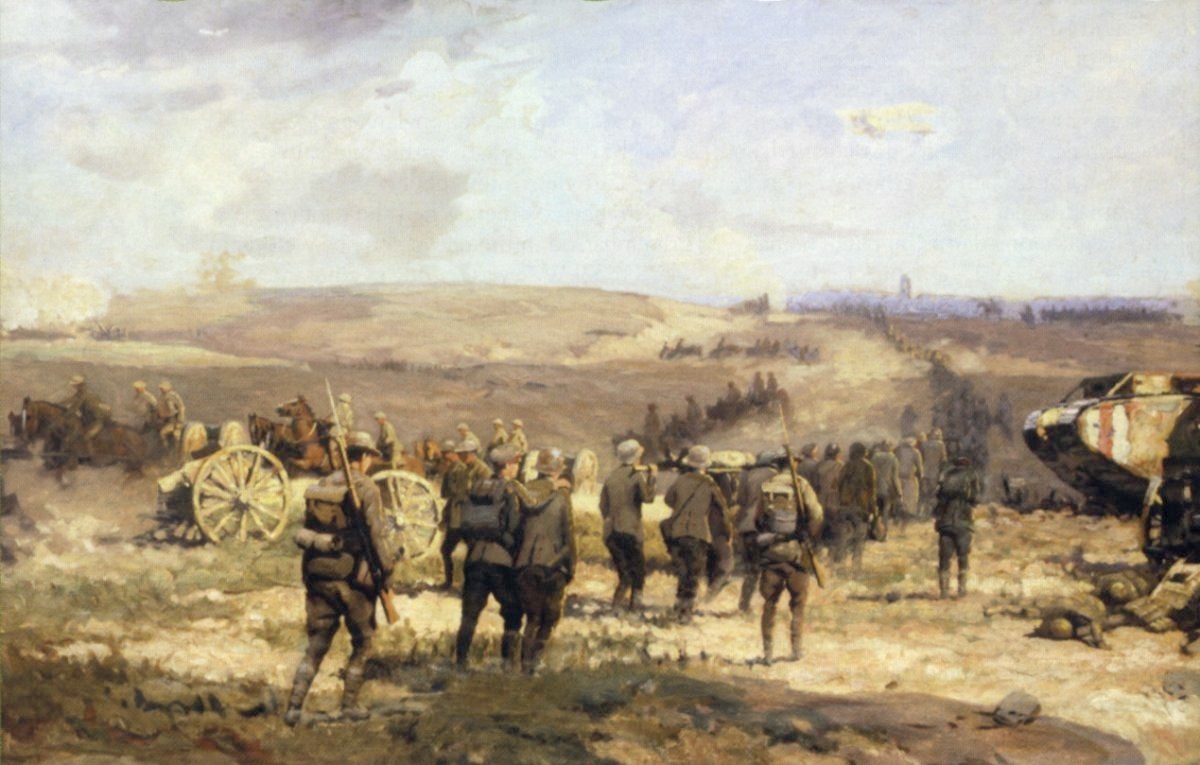
The Battle of Amiens was the opening stroke of the Allies' Hundred Days Offensive, which brought an end to World War I. British, Australian, Canadian, and French troops, supported by hundreds of tanks and a meticulously concealed artillery preparation, caught German lines by surprise and decisively broke the trench deadlock on the Western Front.
Key Historical Facts
| Fact | Detail |
|---|---|
| Epic Battles | Battle of Amiens |
| Date | August 8 - 12, 1918 |
| Location | Amiens, Picardy, France (49.8941, 2.2958) |
| Belligerents, Commanders & Forces | Allied Powers (British Empire, France, USA): Douglas Haig, Henry Rawlinson (Strength: 250,000, Casualties: 22.000 ölü, yaralı veya kayıp) · German Empire: Erich Ludendorff, Georg von der Marwitz (Strength: 150,000, Casualties: 30.000 ölü ve yaralı, 50.000 esir) |
| Weather | Dense fog and haze in the morning, partly cloudy and dry ground in the afternoon |
| Outcome | Decisive Allied Victory |
Belligerents, Commanders & Forces
Allied Powers (British Empire, France, USA)
- Commander
- Douglas Haig, Henry Rawlinson
- Stance
- Attacker
- Strength
- 250,000
- Casualties
- 22.000 ölü, yaralı veya kayıp
German Empire
- Commander
- Erich Ludendorff, Georg von der Marwitz
- Stance
- Defending
- Strength
- 150,000
- Casualties
- 30.000 ölü ve yaralı, 50.000 esir
Historical Significance
Described by General Erich Ludendorff as the 'Black Day' of the German Army, this battle completely shattered German military morale and made it certain that the Central Powers could not win the war.
Outcome
Decisive Allied Victory
Chronological Phases of the Battle
-
1. August 8, 1918, 04:20
Hidden Buildup and Smoke Screen
In the early morning hours, the Amiens plain was blanketed by a dense fog. Over the previous weeks, the British 4th Army had quietly deployed hundreds of tanks to the front line, masking their engine noises with aircraft sounds. Without preliminary artillery bombardment, over two thousand artillery shells suddenly began raining down on German positions. This surprise attack completely blinded German observers.
-
2. August 8, 1918, 06:00
Commencement of the Armored Assault
Mark V and Whippet light tanks suddenly appeared over the German trenches out of the dense fog screen. Australian and Canadian infantry advanced in flawless coordination right behind the tanks. The German soldiers were caught unprepared against these armored monsters; machine gun nests were crushed, and the forward defense line was breached with almost no casualties.
-
3. August 8, 1918, 09:30
Advance of the Australian and Canadian Corps
As the Australian Corps advanced rapidly south of the Somme River, the Canadians breached the enemy reserve lines. German command centers were shattered by bombardment and cavalry raids. With telephone lines severed, German generals lost control of their frontline troops. Trench warfare suddenly transformed into fluid open warfare.
-
4. August 8, 1918, 14:00
Terrestrial Cavalry and Air Support
As the fog lifted, RAF aircraft began low-level bombing runs on the retreating German lines. British Cavalry Brigades charged through the breached lines to intercept the fleeing German artillery. The joint operation of cavalry and Whippet tanks halted German supply trains and created absolute chaos behind the front lines.
-
5. August 8, 1918, 19:00
Ludendorff's Black Day
By the end of the day, Allied troops had advanced up to twelve kilometres deep in places. Thousands of German soldiers laid down their arms and surrendered. General Erich Ludendorff went into shock at the surrender and disintegration displayed by his troops, declaring this historic event the 'Black Day of the German Army' and whispering to his staff that the war was lost.
-
6. August 9 - 10, 1918
Second Line Resistance and Logistical Slowdown
The offensive continued in the following days, though its momentum slowed. The number of available tanks dropped rapidly due to mechanical breakdowns and enemy hits. The Germans attempted to mount a stubborn defense by occupying the old 1916 Somme trenches. As the Entente artillery struggled to keep pace with the front lines, the fighting began to devolve once again into positional warfare.
-
7. August 11 – 12, 1918
Completion of the Offensive and Outcome
Marshal Haig halted the Amiens offensive to prevent unnecessary casualties and ordered preparations for a new assault in the north of the sector. The Amiens operation broke the morale of the German army, secured the Paris-Amiens railway, and officially launched the Allies' march to ultimate victory.
Frequently Asked Questions
When and where did Battle of Amiens take place, and what was the outcome?
Battle of Amiens took place on August 8 - 12, 1918 at Amiens, Picardy, France and ended with Decisive Allied Victory.
Who were the commanders and troop numbers in Battle of Amiens?
Allied Powers (British Empire, France, USA): Douglas Haig, Henry Rawlinson (Strength: 250,000, Casualties: 22.000 ölü, yaralı veya kayıp) · German Empire: Erich Ludendorff, Georg von der Marwitz (Strength: 150,000, Casualties: 30.000 ölü ve yaralı, 50.000 esir)
Why is Battle of Amiens historically significant?
Described by General Erich Ludendorff as the 'Black Day' of the German Army, this battle completely shattered German military morale and made it certain that the Central Powers could not win the war.