Battle of Alma
The Battle of the Alma was the first major pitched battle of the Crimean War, won by the allied British, French, and Ottoman armies against Russian forces during their advance toward Sevastopol. The Russians, under the command of Prince Menshikov, had established a defensive line deployed on the steep hills south of the Alma River. The French scaling the steep slopes to turn the Russian left flank, combined with the superior firepower provided by British riflemen using Minié balls, broke the Russian defense and opened the road to Sevastopol.
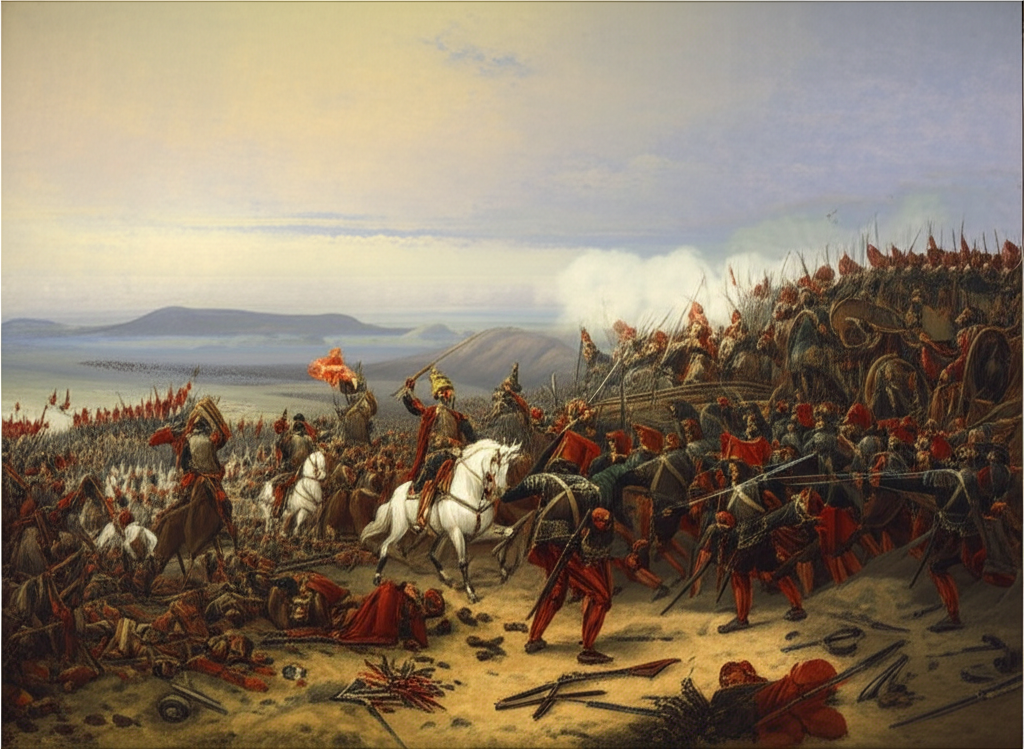
Key Historical Facts
| Fact | Detail |
|---|---|
| Epic Battles | Battle of Alma |
| Date | September 20, 1854 |
| Location | Alma River, Crimea, Russian Empire (44.8286, 33.6019) |
| Belligerents, Commanders & Forces | Allies (France, Britain, Ottoman Empire): Lord Raglan, Marshal Saint-Arnaud (Strength: 63,000, Casualties: Yaklaşık 3.300 ölü ve yaralı (İngiliz: 2.000, Fransız: 1.300)) · Russian Empire: Prince Alexander Menshikov (Strength: 36,000, Casualties: Yaklaşık 5.700 ölü, yaralı ve esir) |
| Weather | A sunny, clear, and warm autumn day |
| Outcome | Allied (Franco-Anglo-Ottoman) victory |
Belligerents, Commanders & Forces
Allies (France, Britain, Ottoman Empire)
- Commander
- Lord Raglan, Marshal Saint-Arnaud
- Stance
- Attacker
- Strength
- 63,000
- Casualties
- Yaklaşık 3.300 ölü ve yaralı (İngiliz: 2.000, Fransız: 1.300)
Russian Empire
- Commander
- Prince Alexander Menshikov
- Stance
- Defending
- Strength
- 36,000
- Casualties
- Yaklaşık 5.700 ölü, yaralı ve esir
Historical Significance
It is the first major battle demonstrating the devastating effect of modern rifle technology (the Minié ball) and tactical maneuvers on traditional line infantry. It paved the way for the Siege of Sevastopol.
Outcome
Allied (Franco-Anglo-Ottoman) victory
Chronological Phases of the Battle
-
1. 09:00
Advance and Deployment of the Allied Army
In the early morning hours, Allied forces advanced in orderly ranks southward from the Black Sea coast toward the Alma River. The French formed the right flank, protected by naval gunfire, while the British troops constituted the left flank advancing across the open plain. The Russian army under the command of Prince Menshikov was deployed on the hills across the river, awaiting the approaching massive enemy line.
-
2. 11:30
The French Scaling of the Cliffs
The French division under the command of General Bosquet began scaling the steep rivermouth cliffs that the Russians deemed unassailable. Allied ship artillery firing from the sea provided critical cover for the infantry by shelling the Russian left flank. Crossing the rocky terrain like light mountain troops, the French soldiers reached the summit, taking Menshikov's left flank by surprise and throwing it into panic.
-
3. 13:15
The British Crossing of the Alma River
The British Light Division and the Guards regiments entered the Alma River under heavy artillery fire from the Russian redoubts on the opposite bank. Fighting through blinding smoke and fire, the troops crossed the river and clutched to the steep, muddy slopes of the far shore. As Russian batteries poured down shrapnel and cannon fire, the British lines continued their advance without breaking, despite suffering heavy casualties.
-
4. 14:30
The Great Redoubt Charge
British troops launched a bloody assault on the Great Redoubt, the heart of the Russian defense. Although British infantry succeeded in entering the redoubt despite heavy casualties, they were momentarily forced to pull back by a Russian counter-bayonet charge. However, the long-range and lethal accuracy of the Minié rifles decimated the advancing Russian infantry in tight formations, deeply shaking their defensive strength.
-
5. 15:30
The Royal Guard's Counterattack
The Highland Brigade and the Coldstream Guards launched a second assault up the hill in ordered ranks. The Highlanders under Colin Campbell displayed impeccable rifle-fire discipline. The elite Russian Vladimir regiments melted away under this intense hail of lead. With the French bringing up artillery to the heights, Menshikov's center line came to the verge of complete dissolution.
-
6. 16:45
Russian Retreat and Victory
Prince Menshikov, whose defensive line had collapsed, ordered a general retreat for his remaining forces toward Sevastopol. The Russian army fled south in disarray, leaving behind their heavy equipment. Lord Raglan did not pursue the fleeing enemy due to a lack of cavalry and the exhaustion of his French allies. Thus, the allies achieved the first major victory that opened the gates of Sevastopol.
Frequently Asked Questions
When and where did Battle of Alma take place, and what was the outcome?
Battle of Alma took place on September 20, 1854 at Alma River, Crimea, Russian Empire and ended with Allied (Franco-Anglo-Ottoman) victory.
Who were the commanders and troop numbers in Battle of Alma?
Allies (France, Britain, Ottoman Empire): Lord Raglan, Marshal Saint-Arnaud (Strength: 63,000, Casualties: Yaklaşık 3.300 ölü ve yaralı (İngiliz: 2.000, Fransız: 1.300)) · Russian Empire: Prince Alexander Menshikov (Strength: 36,000, Casualties: Yaklaşık 5.700 ölü, yaralı ve esir)
Why is Battle of Alma historically significant?
It is the first major battle demonstrating the devastating effect of modern rifle technology (the Minié ball) and tactical maneuvers on traditional line infantry. It paved the way for the Siege of Sevastopol.