Battle of Aljubarrota
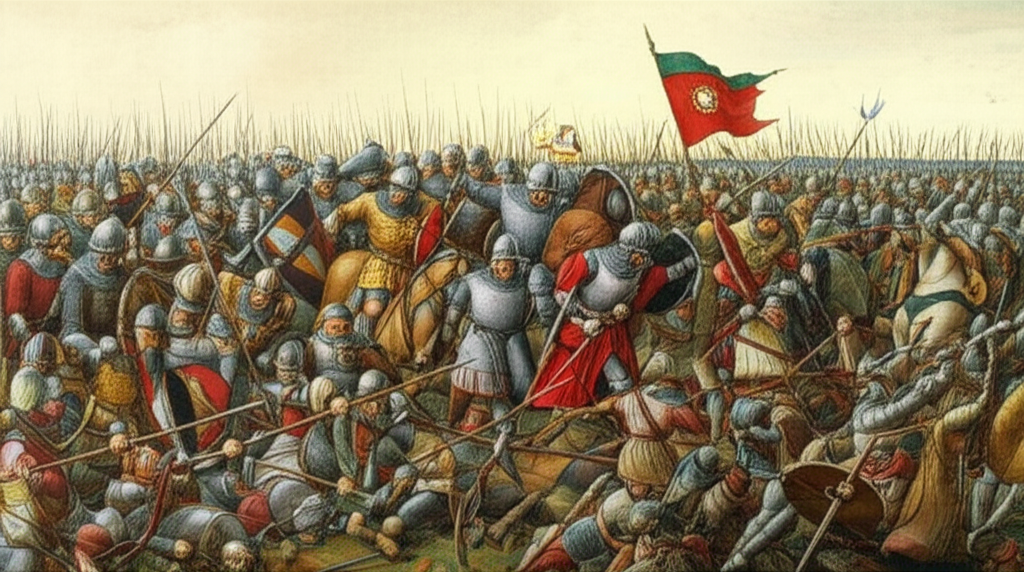
In the battle that decided the fate of the 1383–1385 Portuguese Interregnum, the Anglo-Portuguese alliance under the command of King John I and the brilliant commander Nuno Álvares Pereira decisively defeated the more than twice as numerous Castilian-French army led by King John I of Castile near Aljubarrota.
Key Historical Facts
| Fact | Detail |
|---|---|
| Epic Battles | Battle of Aljubarrota |
| Date | 14 August 1385 |
| Location | São Jorge, near Leiria, Portugal (39.6397, -8.8472) |
| Belligerents, Commanders & Forces | The Kingdom of Castile and its French Allies: King John I (Strength: 31,000, Casualties: 10.000'den fazla ölü veya esir) · Kingdom of Portugal and English Allies: King John I and Nuno Álvares Pereira (Strength: 6,600, Casualties: Yaklaşık 1.000 ölü) |
| Weather | A scorching, dry, and dusty summer afternoon in the August heat |
| Outcome | Decisive Anglo-Portuguese Victory |
Belligerents, Commanders & Forces
The Kingdom of Castile and its French Allies
- Commander
- King John I
- Stance
- Attacker
- Strength
- 31,000
- Casualties
- 10.000'den fazla ölü veya esir
Kingdom of Portugal and English Allies
- Commander
- King John I and Nuno Álvares Pereira
- Stance
- Defending
- Strength
- 6,600
- Casualties
- Yaklaşık 1.000 ölü
Historical Significance
prevented the annexation of Portugal by Castile, cemented the legitimacy of the House of Aviz, and established the Anglo-Portuguese Treaty (Treaty of Windsor), recognized as the world's oldest diplomatic alliance still in force.
Outcome
Decisive Anglo-Portuguese Victory
Chronological Phases of the Battle
-
1. 10:00 - 13:00
Strategic Positioning and Fortification
Portuguese Commander-in-Chief Nuno Álvares Pereira secured the narrow hill between two stream beds on the ridge of Aljubarrota. The outnumbered forces constructed a lethal defensive square protected by trenches, stakes, and brush obstacles. English allied archers were deployed on the flanks.
-
2. 13:00 - 17:30
Castilian Advance and Exhausting March
Avoiding a direct attack on Portugal's strong northern front, King John I of Castile flanked his army around to the less-defended southern slope. However, this lengthy maneuver exhausted the heavily armored Castilian and French knights in the scorching August heat and shattered their morale.
-
3. 18:00
The Vanguard Charge of the French Heavy Cavalry
Seeking the intoxication of victory, the French knights launched a reckless charge without waiting for the Castilian infantry. Trapped in the bottleneck, the heavy cavalry tumbled into concealed ditches. Stripped of mobility under the hail of arrows from English longbowmen, the French vanguard was entirely cut down.
-
4. 18:30
Charge of the Castilian Main Body
King John I drove his massive main army toward the Portuguese squares. The clash between the two lines was extremely bloody. Although the Portuguese royal banner was briefly in jeopardy, King John I personally fought in the front rank and succeeded in preventing the line from breaking.
-
5. 19:15
The Spread of Panic and the Fall of the Royal Standard
The balance of power shifted when Nuno Pereira's reserves crushed the Castilian flanks. When the Castilian royal standard-bearer lost his life and the royal banner went down, the rumor 'The king is dead' spread through the Castilian ranks, and an uncontrollable panic broke out across the army.
-
6. 19:45 - 22:00
Rout and Relentless Pursuit
The routed Castilian forces began to flee in desperation. As King John I fled, Portuguese cavalry and local villagers hunted down the fugitives throughout the night. Portuguese independence, which was to be crowned with the Monastery of Batalha, was sealed by this decisive victory.
Frequently Asked Questions
When and where did Battle of Aljubarrota take place, and what was the outcome?
Battle of Aljubarrota took place on 14 August 1385 at São Jorge, near Leiria, Portugal and ended with Decisive Anglo-Portuguese Victory.
Who were the commanders and troop numbers in Battle of Aljubarrota?
The Kingdom of Castile and its French Allies: King John I (Strength: 31,000, Casualties: 10.000'den fazla ölü veya esir) · Kingdom of Portugal and English Allies: King John I and Nuno Álvares Pereira (Strength: 6,600, Casualties: Yaklaşık 1.000 ölü)
Why is Battle of Aljubarrota historically significant?
prevented the annexation of Portugal by Castile, cemented the legitimacy of the House of Aviz, and established the Anglo-Portuguese Treaty (Treaty of Windsor), recognized as the world's oldest diplomatic alliance still in force.