Battle of Agincourt
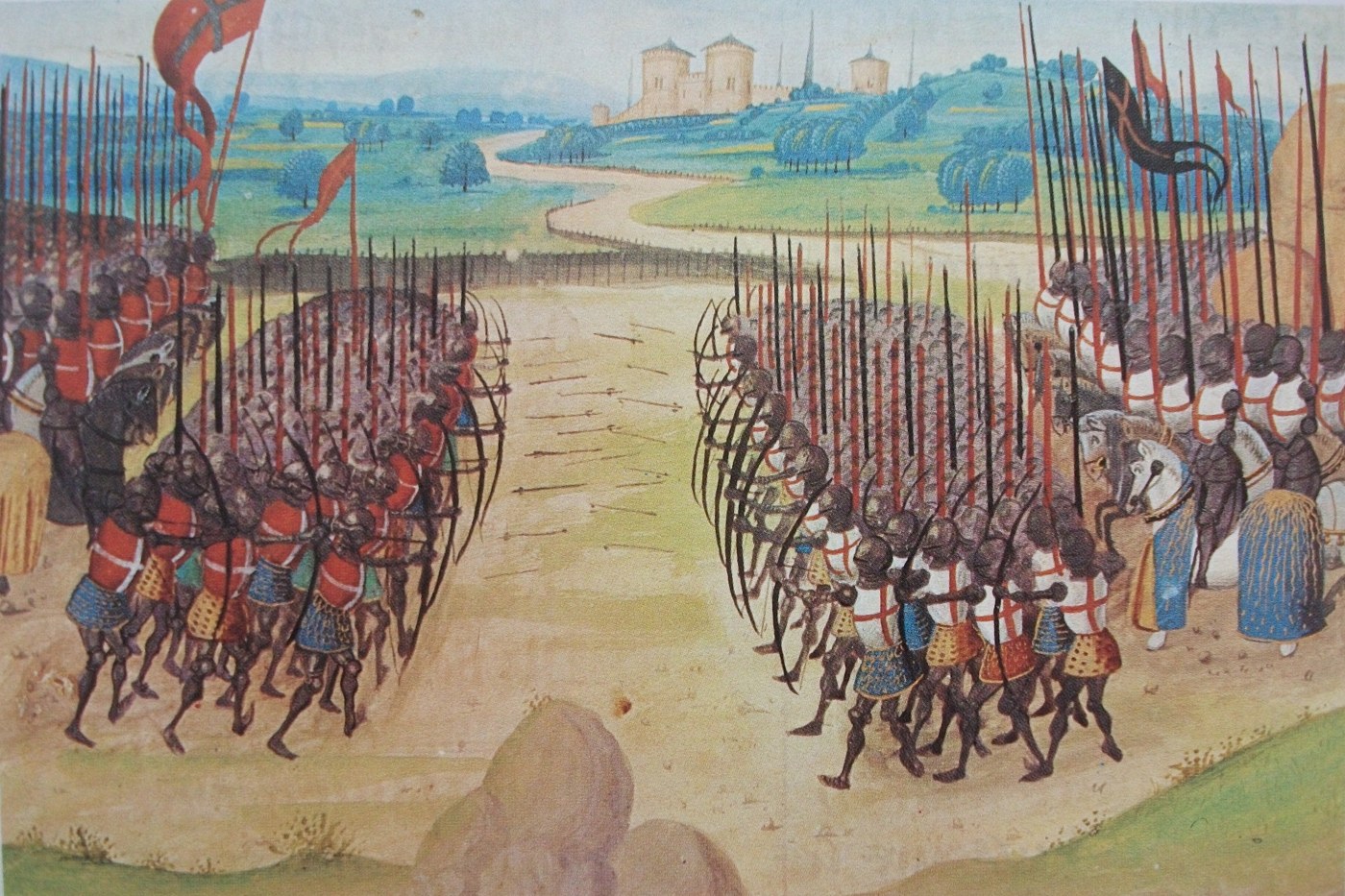
Iconic battle in which English longbow archers defeated French knights.
Key Historical Facts
| Fact | Detail |
|---|---|
| Epic Battles | Battle of Agincourt |
| Date | 25 October 1415 |
| Location | Azincourt, France (50.46, 2.14) |
| Belligerents, Commanders & Forces | England: King Henry V (Strength: 9,000, Casualties: 450) · France: Charles d'Albret (Strength: 36,000, Casualties: 10,000) |
| Weather | Muddy land |
| Outcome | British Victory |
Belligerents, Commanders & Forces
England
- Commander
- King Henry V
- Stance
- Attacker
- Strength
- 9,000
- Casualties
- 450
France
- Commander
- Charles d'Albret
- Stance
- Defending
- Strength
- 36,000
- Casualties
- 10,000
Historical Significance
Victory of the longbow archers. The turning point of the Hundred Years' War.
Outcome
British Victory
Chronological Phases of the Battle
-
1. October 24, 1415
The Somme March and Encounter
Emerging battered from the siege of Harfleur, the English army under the command of King Henry V made an arduous march along the Somme River to reach the port of Calais. The French army blocked the path of the numerically depleted and dysentery-racked English forces at the narrow defile between Agincourt and Tramecourt. Heavy rain continuing throughout the night turned the freshly plowed fields into a deep sea of mud.
-
2. October 25, 1415, 09:00
Order of Battle and the British Advance
The two armies deployed opposite each other in the narrow defile early in the morning. As the French chose to wait, confident in their numerical superiority, King Henry took the initiative and made a risky maneuver, advancing his lines within enemy archer range. English longbowmen, supported by the protective woodlands on either flank, drove sharpened wooden stakes into the ground in front of them and unleashed the first lethal volleys of arrows upon the French lines.
-
3. October 25, 1415, 10:30
French Cavalry Charge and Rout
Provoked by the harassing fire of British archers, the undisciplined French cavalry charged prematurely. Heavily armored horses bogged down in the mud failed to gain momentum and panicked under the dense volley of arrows. Unable to pass the wooden stakes, the cavalry was pushed back uncontrollably onto their own advancing infantry divisions. This caused immense confusion and congestion in the French assault line.
-
4. October 25, 1415, 11:30
Infantry Clash in Heavy Mud
The main body of French infantry, encumbered by their heavy armor, struggled through the deep mud to reach the English lines. In the narrowing terrain, thousands of soldiers piled up on top of one another and completely lost their mobility. Out of arrows, the English archers joined the close combat with swords, axes, and maces. Bogged down in the mud, the French knights perished, crushed under their own weight or struck down.
-
5. October 25, 1415, 13:00
Threat to the Encampment and Execution of Prisoners
Upon local French forces attacking the English encampment from the rear and scattered French units showing signs of regrouping, King Henry issued a critical order. Concerned that the thousands of French prisoners waiting in the rear lines might arm themselves and strike the army from behind, the king ordered the immediate execution of the majority of the captives. This harsh decision completely shattered French morale.
-
6. October 25, 1415, 16:00
Declaration of Victory and the Withdrawal from Calais
As the remaining units of the French army fled the battlefield, the English achieved a decisive tactical victory. A very large proportion of the French nobility and military command cadre perished on the battlefield. Securing the night, King Henry V gathered his army the next day, continued his march toward the port of Calais, and was received as a great conqueror in England.
Frequently Asked Questions
When and where did Battle of Agincourt take place, and what was the outcome?
Battle of Agincourt took place on 25 October 1415 at Azincourt, France and ended with British Victory.
Who were the commanders and troop numbers in Battle of Agincourt?
England: King Henry V (Strength: 9,000, Casualties: 450) · France: Charles d'Albret (Strength: 36,000, Casualties: 10,000)
Why is Battle of Agincourt historically significant?
Victory of the longbow archers. The turning point of the Hundred Years' War.