Naval Battle of Actium
Battle in which Octavian defeated Mark Antony and Cleopatra, establishing the Roman Empire.
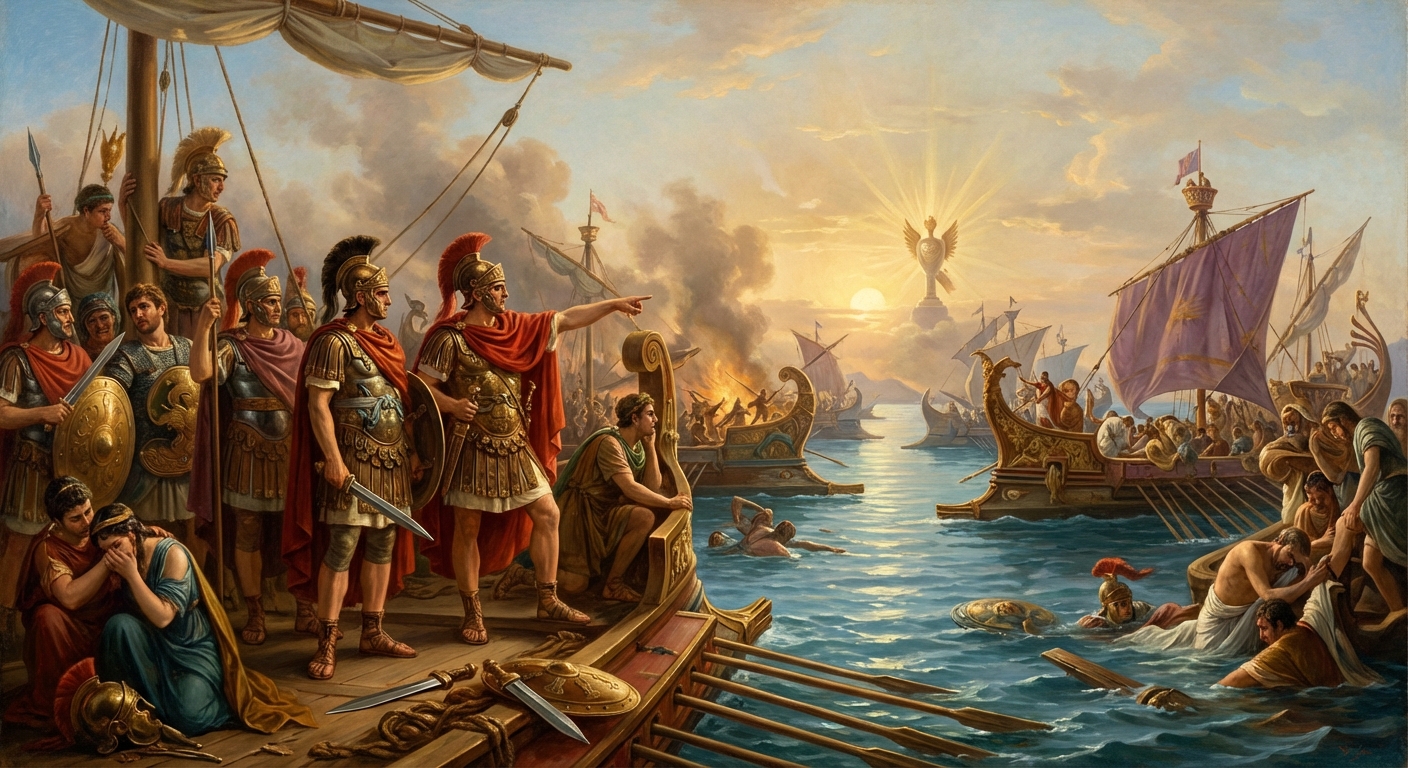
Key Historical Facts
| Fact | Detail |
|---|---|
| Epic Battles | Naval Battle of Actium |
| Date | 31 BC, 2 September |
| Location | Cape Actium, Greece (38.95, 20.76) |
| Belligerents, Commanders & Forces | Octavian (Rome): Agrippa (Strength: 400, Casualties: 2,500) · Antony-Egypt: Mark Antony (Strength: 500, Casualties: 5,000) |
| Weather | Calm sea |
| Outcome | Victory of Octavian |
Belligerents, Commanders & Forces
Octavian (Rome)
- Commander
- Agrippa
- Stance
- Attacker
- Strength
- 400
- Casualties
- 2,500
Antony-Egypt
- Commander
- Mark Antony
- Stance
- Defending
- Strength
- 500
- Casualties
- 5,000
Historical Significance
The Roman Republic ended. Augustus became Roman Emperor.
Outcome
Victory of Octavian
Chronological Phases of the Battle
-
1. 32 BC
Mobilization of Eastern Forces in Ephesus and Athens
After the consuls in Rome joined him and divorced Octavia, Marcus Antonius immediately went to Ephesus with Cleopatra. A huge naval force was assembled here from all over the East, a significant part of which was the Egyptian fleet. After staying in Samos with his allies, Antony headed for Athens. The land troops in Armenia were also landed on the Asian shores and put on ships under the command of Publius Canidius Crassus. This strategic accumulation formed the main logistical and operational backbone of the campaign against Octavian.
-
2. Late 32 BC
Corfu Initiative and Patrae Winter Deployment
Antony aimed to seize the initiative and carry the war into his rival's territory by making a sudden landing on the Italian coast towards the end of 32 BC. In this direction, he advanced with his fleet as far as Corcyra (modern Corfu). However, when he saw that the sea was guarded by a flotilla of Octavian's fleet, he abandoned this plan of attack. Retreating to Patrae for the winter, Antony stationed the bulk of his fleet in the sheltered Gulf of Ambrakia; He transferred his land forces to the Cape of Actium and erected a defense tower across the strait.
-
3. Early 31 BC
Cutting of Peloponnesian Supply Lines and Siege of Patrae
In early 31 BC, Octavian crossed the Adriatic Sea, landed opposite Corcyra, and moved southwards overland. Commanding 400 ships and 80,000 infantry, Octavian quickly captured Patrae and Corinth with the support of his general Agrippa. This critical maneuver completely severed the southern supply and communication lines that Antony, who had encamped in Actium with 500 ships and 70,000 infantry, had established with Egypt via the Peloponnese. Antonius was trapped by both land and sea and was dragged into a logistical bottleneck.
-
4. August 31 BC
Position and Attrition Operation Around the Ambrakia Strait
In August, Octavian's troops landed on the northern shore of the strait and settled near Antony's camp. While Antony refused to abandon his position, Agrippa continued his attacks against the coastal cities. As a result of the successful clashes of Octavian's cavalry units, Antony was forced to evacuate the northern side of the strait between the Gulf of Ambracia and the Ionian Sea and withdraw all his soldiers to the southern camp. In the face of epidemics, desertions and a narrowing circle, Cleopatra suggested that the main fleet return to Alexandria.
-
5. 2 September 31 BC
Order of Battle and First Contact Outside the Strait of Actium
On the morning of September 2, the two fleets met at the exit of Actium Bay. Antony drove his heavy galleys equipped with towers through the strait and into the open sea. In Octavian's navy waiting beyond the strait, Agrippa was commanding the left wing, Arruntius was commanding the center, and Lurius was commanding the right wing; Statilius Taurus was watching the operation from the shore. Antony and Poplicola moved to the right wing, and Sosius to the left wing. The conflict began with the first attack launched by Sosius from the left wing. Octavian's highly maneuverable ships inflicted heavy casualties on enemy personnel with ranged fire.
-
6. 2 September 31 BC
Line Breaking in the Ionian Sea and Antony's Escape
While the battle continued in the afternoon without a definitive result, Cleopatra's fleet, which was waiting in the back line, fled to the open sea with the wind behind it, without engaging in combat. When Antony saw this retreat, he abandoned his flagship, switched to a smaller ship, and broke through Octavian's lines with several escort ships and escaped. Antony's escape led to a sudden disintegration of the fleet; The remaining crew threw heavy weapons into the sea, and the ships, which could not be managed due to lack of personnel, were set on fire. After fighting throughout the night, Antony's fleet was completely eliminated.
-
7. 31 July – 12 August 30 BC
Final Defeat and Collapse Before Alexandria
While Octavian's troops were advancing on Egypt, Cornelius Gallus attacked from Paraetonium, and Octavian reached the fronts of Alexandria via Pelusium. On 31 July 30 BC, Antony gained temporary and minor success against Octavian's exhausted vanguard; However, their forces were critically weakened due to intense desertions. Antonius suffered a decisive defeat in the general attack he launched with the courage of this small success. Unable to escape the sea and believing the rumor that Cleopatra had committed suicide, Antony stabbed himself. With the suicide of Cleopatra on August 12, Egypt came under Roman rule.
Frequently Asked Questions
When and where did Naval Battle of Actium take place, and what was the outcome?
Naval Battle of Actium took place on 31 BC, 2 September at Cape Actium, Greece and ended with Victory of Octavian.
Who were the commanders and troop numbers in Naval Battle of Actium?
Octavian (Rome): Agrippa (Strength: 400, Casualties: 2,500) · Antony-Egypt: Mark Antony (Strength: 500, Casualties: 5,000)
Why is Naval Battle of Actium historically significant?
The Roman Republic ended. Augustus became Roman Emperor.