Battle of Manzikert
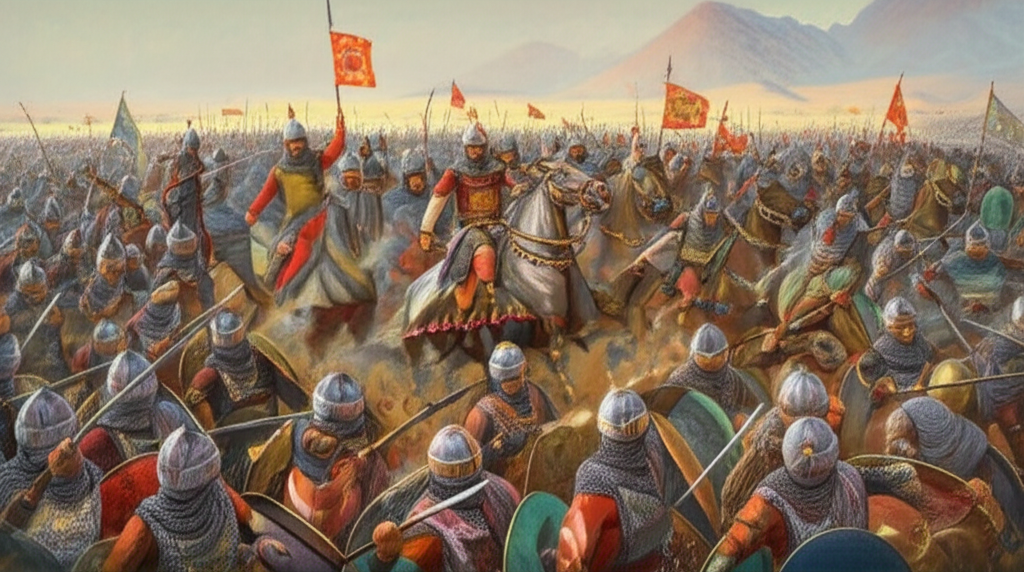
The war in which the Seljuk Sultan Alparslan defeated the Byzantine Emperor Romanos Diogenes and opened the gates of Anatolia to the Turks.
Key Historical Facts
| Fact | Detail |
|---|---|
| Epic Battles | Battle of Manzikert |
| Date | 26 August 1071 |
| Location | Manzikert, Muş (39.14, 42.53) |
| Belligerents, Commanders & Forces | Great Seljuk: Sultan Alp Arslan (Strength: 40,000, Casualties: 4,000) · Byzantine Empire: Romanos IV Diogenes (Strength: 70,000, Casualties: 50,000) |
| Weather | Hot summer day |
| Outcome | Seljuk Victory |
Belligerents, Commanders & Forces
Great Seljuk
- Commander
- Sultan Alp Arslan
- Stance
- Defending
- Strength
- 40,000
- Casualties
- 4,000
Byzantine Empire
- Commander
- Romanos IV Diogenes
- Stance
- Attacker
- Strength
- 70,000
- Casualties
- 50,000
Historical Significance
The beginning of Anatolia becoming the Turkish homeland.
Outcome
Seljuk Victory
Chronological Phases of the Battle
-
1. June 1071
Theodosiopolis Deployment and Forward Operation Decision
Byzantine Emperor Romanos Diogenes went on an expedition to save the castles in the east and eliminate the Seljuk threat. The army, which crossed Anatolia with a large supply convoy, advanced through Sebasteia along the Kızılırmak and reached Theodosiopolis in June 1071. Differences of opinion emerged among the generals at the war council gathered here. Nikephoros Bryennios and some commanders offered to stop and fortify their positions and remain on the defensive, while other generals advocated advancing deep into Seljuk territory while Alp Arslan was unprepared. As a result of the negotiations, it was decided that the imperial army would continue to advance.
-
2. August 1071
Transfer of Lake Van Basin and Division of Byzantine Forces
Emperor Romanos, thinking that Sultan Alp Arslan was away or would not come to the region, went to the Lake Van basin with the aim of quickly taking back the Manzikert and Ahlat castles. However, Alp Arslan; He arrived in the region with the support units sent by Nizamüddin, the emir of Aleppo, Mosul and Mervani, and was monitoring every move of the Byzantines thanks to his scouts. Unaware of the proximity of his enemies, Romanos sent regular troops, Varangians, Franks and Pechenegs under the command of Joseph Tarchaneiotes towards Ahlat. With the division of the army into two, half of the men under the emperor's command were separated from the main body and the balance of power was disrupted.
-
3. 23–24 August 1071
Capture of Manzikert Castle and Pioneering Cavalry Battles
Romanos, who was unaware of the fate of the forces under the command of Tarchaneiotes, came to Manzikert Castle and captured it easily on 23 August. After the fall of the castle, Seljuk horse archers started harassing attacks. The next day, the troops under the command of Bryennios, who were looking for food, were forced to retreat to the castle when they detected the main Seljuk army. The emperor, who did not believe that the opposing force was Alp Arslan's main army, sent the Armenian general Basilakes forward with his cavalry for reconnaissance and attack. This ambushed cavalry force was destroyed and Basilakes was taken prisoner; The left wing of Bryennios, who was sent to support, also retreated with the danger of being surrounded.
-
4. 25–26 August 1071
Battle Organization and Crescent Order in the Manzikert Plain
On August 25, some of the Turkish mercenaries in the Byzantine army sided with the Seljuks; Romanos rejected the peace envoy, desiring a decisive victory. On the morning of August 26, the Byzantine army entered battle formation on the plain. While the emperor was in the center, Bryennios was on the left wing, and Theodoros Alyates was on the right wing, the command of the rear reserve forces was given to Andronikos Doukas. Seljuk cavalry and horse archers, who lined up in a crescent shape at a distance of approximately four kilometers, fake retreated towards the center by continuously shooting arrows as the Byzantine army approached, and performed a maneuver to surround the Byzantine lines with their wings.
-
5. 26 August 1071
Dissolution of Byzantine Lines and Capture of the Emperor
When the Byzantine troops, who captured the Seljuk camp in the afternoon, could not force the fugitive steppe cavalry to fight a decisive battle of destruction, Romanos ordered to retreat as dusk fell. The right wing's misunderstanding of the order and Andronikos Doukas's deliberate refusal to protect the army and his return to the camp caused great panic and chaos in the Byzantine lines. The Seljuks took advantage of the opportunity and launched an attack; First the right wing and then the left wing dispersed. Emperor Romanos, who was surrounded in the center with Armenian infantry and Varangian Guards, was wounded and captured by Seljuk troops.
-
6. after 1071
Diplomatic Negotiations and the Way Back to the Capital
Romanos, who was brought before Sultan Alp Arslan, was subjected to diplomatic negotiations during his one-week captivity. In accordance with the agreement, it was decided to deliver the castles of Antakya, Urfa, Hierapolis and Manzikert, and to pay a large ransom and annual taxes. The Sultan allocated two emirs and a hundred Mamluk guards to accompany the freed emperor on the road to Constantinople, along with various gifts. However, Romanos, who tried to return to the capital, was dethroned after being defeated three times in a row in his struggles with the Doukas family, who had seized the throne, and was blinded and exiled.
-
7. 1071–1077
Roussel de Bailleul Revolt and the Raid of Chrysopolis
After the defeat at Manzikert, the power gap within Byzantium deepened. Mercenary commander Roussel de Bailleul attempted to establish an independent kingdom in the Galatia region with his unit consisting of 3,000 Frankish, Norman and Germanic soldiers. De Bailleul, who defeated John Doukas at the head of the imperial army sent to suppress him, advanced to the Bosphorus shore opposite the capital and destroyed the Khrysopolis (Üsküdar) location. In the face of this threat, the Byzantine administration had to ask for military support from the Seljuks to crush the rebel, and Turkish troops were dispatched and the Bailleul forces were suppressed.
Frequently Asked Questions
When and where did Battle of Manzikert take place, and what was the outcome?
Battle of Manzikert took place on 26 August 1071 at Manzikert, Muş and ended with Seljuk Victory.
Who were the commanders and troop numbers in Battle of Manzikert?
Great Seljuk: Sultan Alp Arslan (Strength: 40,000, Casualties: 4,000) · Byzantine Empire: Romanos IV Diogenes (Strength: 70,000, Casualties: 50,000)
Why is Battle of Manzikert historically significant?
The beginning of Anatolia becoming the Turkish homeland.