Battle of Kadesh
The first major pitched battle known in history. Between Egypt and Hittite.
Key Historical Facts
| Fact | Detail |
|---|---|
| Epic Battles | Battle of Kadesh |
| Date | 1274 BC |
| Location | Kadesh, Syria (34.56, 36.52) |
| Belligerents, Commanders & Forces | Egypt: II. ramses (Strength: 20,000, Casualties: 5,000) · Hittite Empire: II. muwatalli (Strength: 37,000, Casualties: 6,000) |
| Weather | Hot desert |
| Outcome | Draw |
Belligerents, Commanders & Forces
Egypt
- Commander
- II. ramses
- Stance
- Attacker
- Strength
- 20,000
- Casualties
- 5,000
Hittite Empire
- Commander
- II. muwatalli
- Stance
- Defending
- Strength
- 37,000
- Casualties
- 6,000
Historical Significance
The first known peace treaty was signed.
Outcome
Draw
Chronological Phases of the Battle
-
1. May 1274 BC
Egyptian Expeditionary March from Pi-Ramesses to Gaza
Egyptian Pharaoh II. In the fifth year of his reign, Ramses launched a comprehensive military campaign from his capital, Pi-Ramesses, in order to regain dominance over Amurru and break Hittite influence. Pharaoh; He assembled his infantry, chariots, and captured Sherden warriors and marched them beyond the Tjaru fortress on the Horus Military Road. Following the coastline, the Egyptian army continued to advance northwards through Gaza and into the Levant, overcoming difficult straits. The expeditionary force, consisting of four main divisions, left the strategic passes behind and began a long march towards the Syrian geography.
-
2. Year 5 III Shemu day 9
Misleading Intelligence South of the Orontes Pass and Shabtuna
II. With Amon's leading division, Ramses crossed the ford of the Orontes River and crossed the mountain ranges south of Kadesh. Two Shasu nomads, who appeared before the pharaoh in the south of the town of Shabtuna, claimed that the Hittite king was in the lands of Aleppo and far away. Ramses, who was fooled by this false report, quickly advanced towards Kadesh without waiting for the divisions of Re, Ptah and Set behind him to arrive. However, two captured Hittite spies revealed that the huge Hittite army under the command of Muvatalli was actually waiting in battle formation just behind the Old Kadesh location.
-
3. Year 5 III Shemu day 9
Hittite Chariot Raid on Re Division
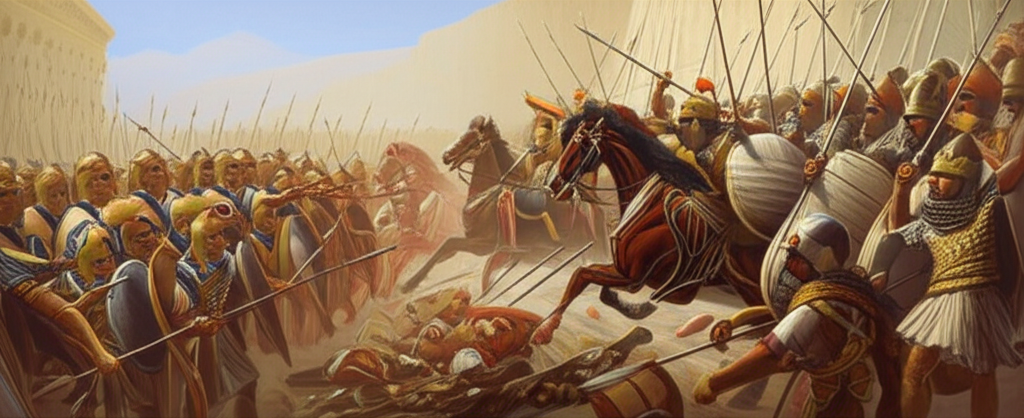
While Ramses was discussing with his princes in his camp the negligence of the authorities in concealing the true position of the Hittite army, Hittite chariots suddenly appeared from the opposite bank of the river and attacked. The Re division, which was advancing through open terrain to reach the camp, was heavily attacked by Hittite chariots while on the march. Caught completely unprepared, the division dispersed and some of the soldiers fled north in panic towards the Amon camp. Hittite chariots, relentlessly chasing the fleeing Egyptians, broke through the Amon shield wall and entered the pharaoh's camp, creating great chaos.
-
4. May 1274 BC
II. Ramses' Counter-Offensive and Camp Defense
Hittite warriors entered the Egyptian camp, thinking that the enemy was completely defeated, and began to disrupt their order and plunder the camp. While the Hittite chariots hitting the obstacles in the camp weakened the momentum of the attack, II. was surrounded and alone. Ramses personally counterattacked with his personal guard, the remaining chariots from the Amon division, and the soldiers gathered from the dispersed Re division. Pharaoh took the initiative in the battle, attacked the Hittite ranks one after another, repelled the enemy who was busy plundering, and forced them to retreat towards the Orontes River.
-
5. May 1274 BC
Ne'arin's Intervention and Counteroffensive in Egyptian Narrative
According to Egyptian narratives, II. As Muvatalli's reserve chariots approached the camp again, Ne'arin forces from Amurru caught the Hittites by surprise. It is reported that the Ptah division, which rose from the south, also threatened the Hittites' rear. Ramses' counterattacks and the pushing of some Hittite troops towards the Orontes are presented in Egyptian texts as the salvation and superiority of the pharaoh. However, it is not correct to turn this palace narrative into an unequivocal picture of destruction: Hittite records convey a different outcome, and the overall outcome of the battle is treated in most assessments as a stalemate rather than a decisive victory.
-
6. After May 1274 BC
Withdrawal towards Damascus and Loss of Upi Province
Although the parties faced each other again the day after the battle, the conflict ended in an inconclusive deadlock. Logistically unable to sustain a long-term siege of the fortified Kadesh castle, II. Ramses decided to gather his troops and retreat south, towards Damascus and then towards Egypt. Hittite King II took advantage of this retreat. Muvatalli continued his campaign towards the south and captured the Upi province under Egyptian control and handed over the management of this place to his brother Hattusili. Egypt's influence in Asia was limited to the Canaan region.
-
7. 8th, 9th, 10th and 21st years of the reign
Siege of Dapur and Northern Expeditions
After the Battle of Kadesh, II faced vassal rebellions in the Levant. Ramses organized new expeditions to the north in the eighth and ninth years of his reign. Egyptian army, III. He besieged and captured the Hittite-ruled cities of Dapur and Tunip, which Egyptians had not set foot on since the time of Thutmose. However, when this narrow strip of land between Amurru and Kadesh could not be held and fell under Hittite control again within a year, Ramses marched on Dapur again in his tenth year. As a definitive superiority could not be achieved, an eternal peace treaty was signed with Hattusili in the twenty-first year.
Frequently Asked Questions
When and where did Battle of Kadesh take place, and what was the outcome?
Battle of Kadesh took place on 1274 BC at Kadesh, Syria and ended with Draw.
Who were the commanders and troop numbers in Battle of Kadesh?
Egypt: II. ramses (Strength: 20,000, Casualties: 5,000) · Hittite Empire: II. muwatalli (Strength: 37,000, Casualties: 6,000)
Why is Battle of Kadesh historically significant?
The first known peace treaty was signed.