Battle of Hittin
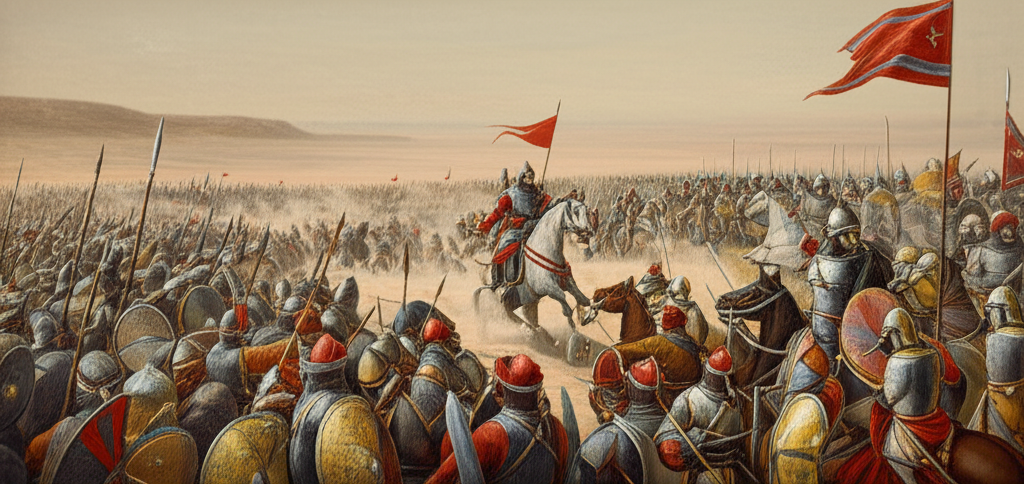
The great victory in which Saladin completely destroyed the Crusader army.
Key Historical Facts
| Fact | Detail |
|---|---|
| Epic Battles | Battle of Hittin |
| Date | 4 July 1187 |
| Location | Horns of the Line (32.8, 35.46) |
| Belligerents, Commanders & Forces | Ayyubids: Saladin Ayyubi (Strength: 30,000, Casualties: 3,000) · Kingdom of Jerusalem: Guy of Lusignan (Strength: 20,000, Casualties: 12,000) |
| Weather | Dry and very hot |
| Outcome | Ayyubid Victory |
Belligerents, Commanders & Forces
Ayyubids
- Commander
- Saladin Ayyubi
- Stance
- Attacker
- Strength
- 30,000
- Casualties
- 3,000
Kingdom of Jerusalem
- Commander
- Guy of Lusignan
- Stance
- Defending
- Strength
- 20,000
- Casualties
- 12,000
Historical Significance
He opened the way for the fall of Jerusalem.
Outcome
Ayyubid Victory
Chronological Phases of the Battle
-
1. 30 June 1187
Saladin's Crossing of the Jordan River
Saladin crossed the Jordan River on June 30 after inspecting his army of approximately 40,000 people gathered in the Golan Heights at the Tell-Astara location. The Ayyubid army was organized in a center and two wings; Gökbörü commanded the left wing, Al-Muzaffar Umar commanded the right wing, and Selahaddin himself was in the center. This maneuver, which aimed to draw the Crusader field forces from their fortified and watery positions in La Saphorie to open ground, was planned to start the war under the conditions desired by the Muslim army.
-
2. 2 July 1187
Decision to Advance Taken at La Saphorie Headquarters
The Crusader army gathered in La Saphorie, a location rich in water resources. In the war council convened on the night of July 2, Raymond of Tripoli argued that Saladin's main goal was to remove them from this protected position and not to march on Tiberias. However, after Gerard de Ridefort and Renaud de Châtillon accused Raymond of cowardice, King Guy decided to counter-attack towards Tiberias. Thus, the Crusaders left strategic water resources behind and marched towards the trap set by Saladin.
-
3. 3 July 1187
Siege of the Crusaders on the Meskene Plateau
The Crusader army, advancing towards Tiberias on July 3, was constantly harassed by Muslim archers. Since the Turan Springs were inadequate, Raymond and Guy decided to change direction and head towards the Kefr Hattin Springs. However, Ayyubid troops came between the Crusaders and the water sources, forcing them to spend the night on the arid plateau near the village of Meskene. The Muslim army completely surrounded the camp; The smoke of dry grass burned throughout the night, the sound of drums and hymns completely destroyed the morale of the thirsty Crusaders.
-
4. 4 July 1187
Direction to the Springs of Hattin and the Breakthrough of Raymond of Tripoli
On the morning of July 4, the Crusaders were left under the smoke of the fires and the intense arrow rain of the horse archers under the command of Gökbörü. The troops, exhausted from thirst, packed up their tents and marched to reach the Hattin springs, but their way and retreat were blocked by the Ayyubids. Raymond of Tripoli, commanding the first line, made two successive cavalry attacks in an attempt to reach the water source at the Sea of Tiberias. Raymond, who managed to break the siege with the second attack, reached the lake and retreated to the city of Sur from there.
-
5. 4 July 1187
The Last Stand at the Horns of Hattin and the Destruction of the Royal Tent
Following Raymond's departure, most of the Crusader infantry abandoned the battle, took refuge on the Horns of Hattin hill and withdrew from the conflict. King Guy had tents set up on the hill again to prevent the Ayyubid cavalry. The Crusader knights launched three desperate attacks against Saladin's center line, but they could not break the siege. Eventually Saladin's troops climbed the hill and broke the resistance; With the overthrow of Guy's royal tent, the Crusader army was completely dispersed, and King Guy and the high-ranking barons with him were taken prisoner.
-
6. 5 July 1187
Capture of the Citadel of Tiberias
Immediately after the decisive victory at Hattin, on Sunday, July 5, Saladin marched six miles with his forces towards Tiberias. Countess Eschiva, who was in the besieged inner castle, surrendered the castle after there was no hope of help. In accordance with the agreement reached, the Countess and her entourage were allowed to go to Tripoli safely with all their property and families. The fall of this castle was the first concrete step in the general collapse that would begin with the disappearance of the Crusader military power in the region.
-
7. 2 October 1187
Siege of Jerusalem and Treaty of Surrender
After the heavy defeat at Hattin, the garrisons of the Crusader castles were almost completely emptied; for while the army was gathering, the guards of the cities were called to the campaign. After capturing many castles on the coast and inland by mid-September, Saladin headed towards Jerusalem. City; It was defended by Queen Sibylla, Patriarch Heraclius and Balian. Following the negotiations, Balian signed the agreement that delivered the city to Saladin on October 2, thus returning the city to Muslim rule.
Frequently Asked Questions
When and where did Battle of Hittin take place, and what was the outcome?
Battle of Hittin took place on 4 July 1187 at Horns of the Line and ended with Ayyubid Victory.
Who were the commanders and troop numbers in Battle of Hittin?
Ayyubids: Saladin Ayyubi (Strength: 30,000, Casualties: 3,000) · Kingdom of Jerusalem: Guy of Lusignan (Strength: 20,000, Casualties: 12,000)
Why is Battle of Hittin historically significant?
He opened the way for the fall of Jerusalem.