First Battle of Bull Run
It is the first major land battle of the American Civil War. Union General Irvin McDowell departed Washington and attacked Confederate positions near Manassas Junction. Following a chaotic clash of inexperienced troops, Confederate reinforcements changed the course of the battle, and the Union army retreated in a panicked and disorganized rout toward the capital.
Key Historical Facts
| Fact | Detail |
|---|---|
| Epic Battles | First Battle of Bull Run |
| Date | July 21, 1861 |
| Location | Manassas, Virginia, United States of America (38.8147, -77.5222) |
| Belligerents, Commanders & Forces | Union (North): Irwin McDowell (Strength: 35,000, Casualties: 460 ölü, 1.124 yaralı, 1.312 esir veya kayıp) · Confederate (South): P.G.T. Beauregard, Joseph E. Johnston (Strength: 32,000, Casualties: 387 ölü, 1.582 yaralı, 13 kayıp) |
| Weather | An extremely hot, stifling, and dusty summer day |
| Outcome | Confederate victory |
Belligerents, Commanders & Forces
Union (North)
- Commander
- Irwin McDowell
- Stance
- Attacker
- Strength
- 35,000
- Casualties
- 460 ölü, 1.124 yaralı, 1.312 esir veya kayıp
Confederate (South)
- Commander
- P.G.T. Beauregard, Joseph E. Johnston
- Stance
- Defending
- Strength
- 32,000
- Casualties
- 387 ölü, 1.582 yaralı, 13 kayıp
Historical Significance
It served as a bitter warning for both sides, who believed the war would end easily in a few months. It confirmed that the conflict would turn into a long, bloody, and costly civil war.
Outcome
Confederate victory
Chronological Phases of the Battle
-
1. 05:30 - 09:30
Northern Flank Envelopment Operation
General McDowell marched his troops covertly toward the Sudley Springs ford in order to turn the Confederate left flank. The movement of the green troops along dusty roads progressed slower than anticipated. The Confederate observation tower alerted the southern forces, prompting Nathan Evans to dispatch his small force north to meet the Union assault.
-
2. 09:30 - 11:30
Engagement of Matthews Hill
Union divisions descended from the Sudley Road and violently attacked the Confederate line on Matthews Hill. Outnumbered, the Southerners began to disintegrate under heavy artillery fire. Suffering heavy casualties, the Confederate brigades were forced to retreat in disarray across the Warrenton Turnpike toward Henry House Hill in the south.
-
3. 11:30 - 13:30
Stonewall Jackson Takes the Stage
The Virginia brigade under the command of Thomas J. Jackson, positioned on Henry House Hill, formed a bulwark for the retreating Confederate units. General Bee's declaration, 'There is Jackson standing like a stone wall!', gave birth to the legend. Despite intense artillery bombardment, Jackson held his ground, buying crucial time and halting the Union assault.
-
4. 13:30 - 15:00
The Henry House Hill Dilemma
Union Captains Ricketts and Griffin brought their artillery batteries forward, engaging in a lethal duel. The similarity between blue and gray uniforms led to disaster; when Union officers mistook an approaching Confederate regiment for their own reinforcements, the Southerners opened fire at close range and completely neutralized the batteries.
-
5. 15:00 - 16:30
Shenandoah Railway Reinforcements
For the first time in history, troops were transported to the front by train. Fresh brigades brought by train from the Shenandoah Valley by Joseph E. Johnston were deployed directly onto the battlefield. The forces of Jubal Early and Kirby Smith struck the Union right flank unexpectedly, shattering the battered Federal line.
-
6. 16:30 - 19:00
The Great Escape and Rout
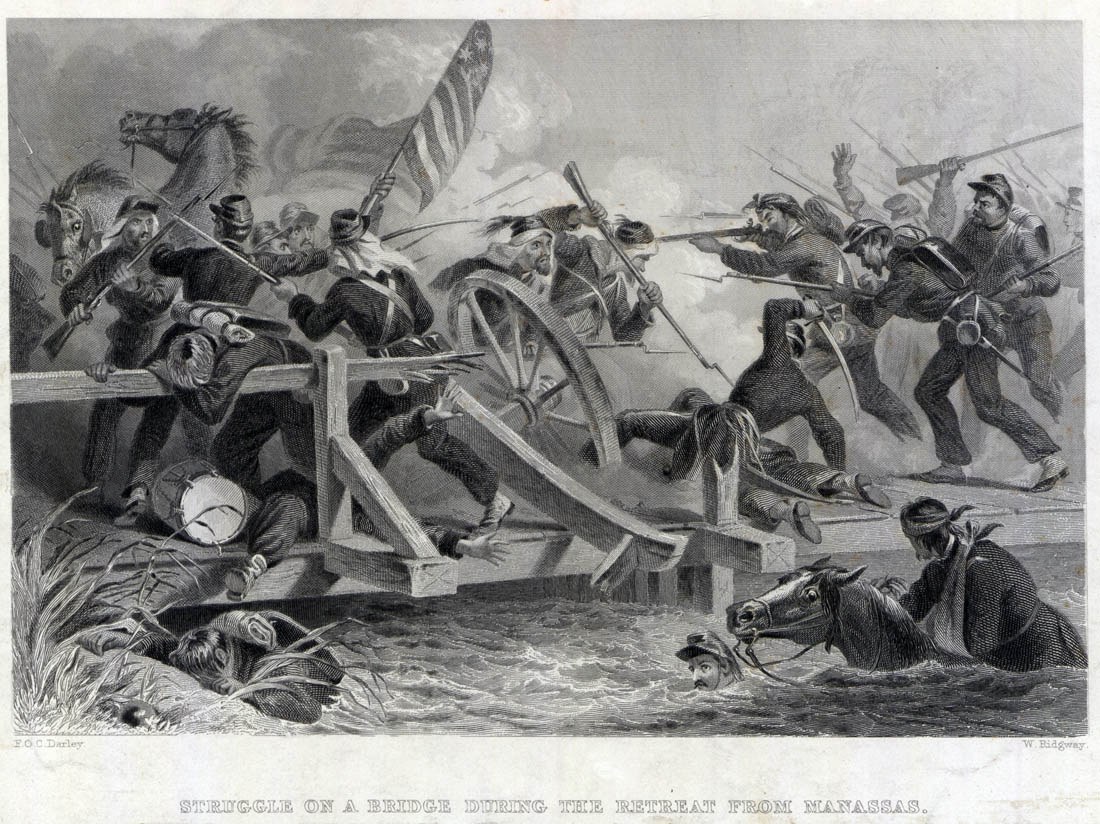
The panic that began within the Union ranks quickly grew like an avalanche. Civilians who had come to watch the battle like a picnic, carriages, and fleeing soldiers jammed the bridges of Bull Run. Harassed by Confederate artillery, the Union army abandoned its weapons and fled in disarray toward the fortifications of Washington.
Frequently Asked Questions
When and where did First Battle of Bull Run take place, and what was the outcome?
First Battle of Bull Run took place on July 21, 1861 at Manassas, Virginia, United States of America and ended with Confederate victory.
Who were the commanders and troop numbers in First Battle of Bull Run?
Union (North): Irwin McDowell (Strength: 35,000, Casualties: 460 ölü, 1.124 yaralı, 1.312 esir veya kayıp) · Confederate (South): P.G.T. Beauregard, Joseph E. Johnston (Strength: 32,000, Casualties: 387 ölü, 1.582 yaralı, 13 kayıp)
Why is First Battle of Bull Run historically significant?
It served as a bitter warning for both sides, who believed the war would end easily in a few months. It confirmed that the conflict would turn into a long, bloody, and costly civil war.