Battle of the Alamo
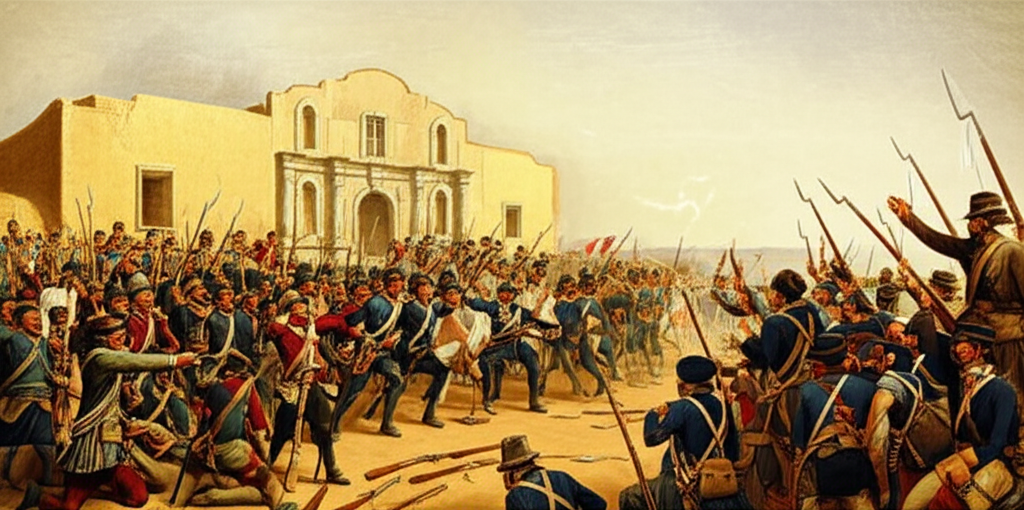
The Battle of the Alamo is the defining and legendary siege of the Texas Revolution. A Mexican army of thousands, led by Antonio López de Santa Anna, besieged approximately 200 Texian defenders entrenched in an old Spanish mission fortress in San Antonio. Led by William B. Travis, James Bowie, and Davy Crockett, the defenders refused to surrender, holding out against the massive army for 13 days. The final assault, launched on the morning of March 6, resulted in the death of all the defenders.
Key Historical Facts
| Fact | Detail |
|---|---|
| Epic Battles | Battle of the Alamo |
| Date | February 23 - March 6, 1836 |
| Location | San Antonio de Béxar, Texas (29.4258, -98.4861) |
| Belligerents, Commanders & Forces | The Mexican Army: Antonio López de Santa Anna (Strength: 2,400, Casualties: 400 - 600 ölü ve yaralı) · The Texan Defenders: William B. Travis & James Bowie (Strength: 200, Casualties: 189 - 257 ölü (tüm savaşçılar öldürüldü)) |
| Weather | Freezing winds blowing from the north and pitch-black, cold weather on the morning of the final assault. |
| Outcome | Tactical Mexican Victory (Strategic Texas Independence Catalyst) |
Belligerents, Commanders & Forces
The Mexican Army
- Commander
- Antonio López de Santa Anna
- Stance
- Attacker
- Strength
- 2,400
- Casualties
- 400 - 600 ölü ve yaralı
The Texan Defenders
- Commander
- William B. Travis & James Bowie
- Stance
- Defending
- Strength
- 200
- Casualties
- 189 - 257 ölü (tüm savaşçılar öldürüldü)
Historical Significance
The resistance of the defenders, lasting until their last breaths, became a powerful symbol of national vengeance for the Texas army. The battle cry 'Remember the Alamo!' enabled the forces under Sam Houston's command to decisively crush the Mexican army at the Battle of San Jacinto, paving the way for the establishment of the independent Republic of Texas.
Outcome
Tactical Mexican Victory (Strategic Texas Independence Catalyst)
Chronological Phases of the Battle
-
1. February 23, 1836
Arrival of the Mexican Vanguard and Commencement of the Siege
General Santa Anna's advance cavalry units reached the town of San Antonio much earlier than expected. At the ringing of the church bells, roughly one hundred and fifty militiamen under the command of William B. Travis and James Bowie withdrew behind the walls of the Alamo Mission. Santa Anna issued a call for surrender, raising the blood-red flag—signifying that no quarter would be given to those in the fort—at San Fernando Cathedral. Travis answered with a single cannon shot fired from the ramparts.
-
2. February 24, 1836
Call to Aid: Victory or Death
Following James Bowie's severe illness, Colonel Travis assumed full command of the fort. As enemy artillery began pounding the ramparts, Travis wrote his historic letter addressed to the people of America and all Texans around the world. Ending with the phrase 'Victory or Death', the letter was smuggled out of the siege lines by secret couriers. A volunteer relief force of thirty-two men from the town of Gonzales managed to slip into the fort despite knowing that certain death awaited them.
-
3. March 1–5, 1836
Tightening of the Siege Ring and Attrition
Mexican engineers moved their artillery batteries closer to the walls every night. The freezing cold and relentless bombardment left the low-on-ammunition Texans sleep-deprived and physically exhausted. Davy Crockett and his skilled Tennessee volunteers harassed enemy lines with rifle fire. Santa Anna decided to attack before the rest of the heavy siege guns arrived. On the night of March 5, a Mexican military band played the infamous Degüello march, signaling that no quarter would be given to those who surrendered.
-
4. March 6, 1836, 05:30
General Offensive Launched in the Darkness
Just before the first light of day, eighteen hundred Mexican infantry launched a bayonet charge from four separate columns. The weary Texans standing guard on the ramparts raised the alarm at the last moment. Mexican soldiers climbing the ladders against the northern wall of the fort were repulsed twice by intense volleys. However, numerical superiority tipped the scales in the third wave. Colonel Travis was among the first to fall, shot in the head while defending the north wall.
-
5. March 6, 1836, 06:15
Courtyard Clashes and Final Stand
With the breaching of the northern walls, Mexican troops flooded into the fort's expansive inner courtyard. The defenders withdrew into the chapel and barracks rooms, engaging in a desperate hand-to-hand last stand with rifle butts and hunting knives. Bedridden James Bowie was bayoneted after killing several enemies with his pistols. Davy Crockett and his men perished in front of the chapel. After roughly ninety minutes of harrowing combat, resistance ceased entirely.
Frequently Asked Questions
When and where did Battle of the Alamo take place, and what was the outcome?
Battle of the Alamo took place on February 23 - March 6, 1836 at San Antonio de Béxar, Texas and ended with Tactical Mexican Victory (Strategic Texas Independence Catalyst).
Who were the commanders and troop numbers in Battle of the Alamo?
The Mexican Army: Antonio López de Santa Anna (Strength: 2,400, Casualties: 400 - 600 ölü ve yaralı) · The Texan Defenders: William B. Travis & James Bowie (Strength: 200, Casualties: 189 - 257 ölü (tüm savaşçılar öldürüldü))
Why is Battle of the Alamo historically significant?
The resistance of the defenders, lasting until their last breaths, became a powerful symbol of national vengeance for the Texas army. The battle cry 'Remember the Alamo!' enabled the forces under Sam Houston's command to decisively crush the Mexican army at the Battle of San Jacinto, paving the way for the establishment of the independent Republic of Texas.