Battle of Gallipoli
The magnificent defensive victory of the Ottoman Empire against the Allied forces in World War I.
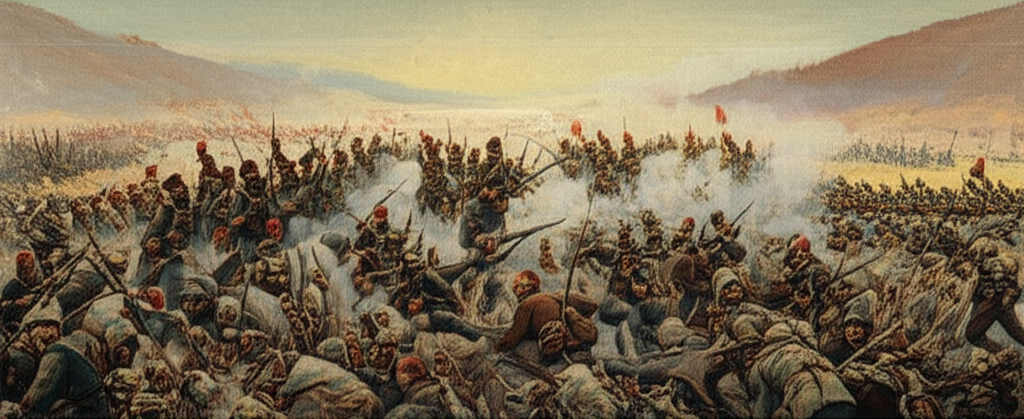
Key Historical Facts
| Fact | Detail |
|---|---|
| Epic Battles | Battle of Gallipoli |
| Date | 19 February 1915 - 9 January 1916 |
| Location | Gallipoli Peninsula (40.05, 26.41) |
| Belligerents, Commanders & Forces | Ottoman Empire: Mustafa Kemal, Enver Pasha (Strength: 315,000, Casualties: 253,000) · Allied Powers: Ian Hamilton (Strength: 489,000, Casualties: 252,000) |
| Weather | Variable, sometimes rainy |
| Outcome | Ottoman Victory |
Belligerents, Commanders & Forces
Ottoman Empire
- Commander
- Mustafa Kemal, Enver Pasha
- Stance
- Defending
- Strength
- 315,000
- Casualties
- 253,000
Allied Powers
- Commander
- Ian Hamilton
- Stance
- Attacker
- Strength
- 489,000
- Casualties
- 252,000
Historical Significance
Mustafa Kemal gained fame here. The last great victory of the Ottoman Empire.
Outcome
Ottoman Victory
Chronological Phases of the Battle
-
1. 19–25 February 1915
Bombardment of the Outer Bastions of the Dardanelles
The Allied Powers reached the Ottoman capital, Istanbul, and launched a naval operation against the Dardanelles in order to open the Straits and provide a supply route to Russia. On February 19, 1915, the British-French fleet, including the battleship HMS Queen Elizabeth, subjected the Ottoman coastal batteries at the entrance to the Dardanelles to long-range cannon fire. Although bad weather conditions slowed down the operation, by February 25 the outer redoubts were destroyed and the entrance to the Dardanelles was cleared of mines. While the Royal Marines who landed in Kumkale and Seddülbahir destroyed the cannons there, naval fire was directed towards the inner batteries. However, mobile Ottoman batteries continued to threaten the minesweepers.
-
2. 18 March 1915
18 March Dardanelles Operation and Naval Disaster
On the morning of March 18, 1915, the Allied fleet launched a major attack with 18 battleships, cruisers and destroyers in order to force the narrowest point of the Dardanelles. Proceeding under the fire of Ottoman coastal batteries, minesweepers tried to clear the mine lines. Even though the communication between the bastions was cut off around 14:00 and the defensive fire weakened, the mine line secretly laid by the Nusret minelayer determined the fate of the war. The French battleship Bouvet hit a mine and sank within two minutes. Then HMS Irresistible and HMS Inflexible hit mines; While Irresistible sank, Inflexible was heavily damaged and had to retreat. While attempting a rescue attempt, HMS Ocean also hit a mine and sank. After heavy losses, Admiral de Robeck stopped the operation.
-
3. 25 April 1915
Arıburnu and Anzac Cove Landings
On the morning of 25 April 1915, the ANZAC force of approximately 25,000 people under the command of Lieutenant General William Birdwood started a landing in Arıburnu and its surroundings on the Aegean coast of the Gallipoli Peninsula. The 3rd Australian Infantry Brigade came ashore as the lead covering force; The aim was to quickly advance inland, capture the Gun Ridge and Sarı Bayır lines, and cut off the supply lines of the Ottoman troops in Kilitbahir. However, the resistance of Captain Faik and the 27th Regiment on the Arıburnu ridge and the rugged nature of the terrain stopped the Allied advance. Due to the confusion and heavy losses suffered at the beginning of the landing, Birdwood considered withdrawing his forces; However, under the influence of submarine success reports, he decided to fortify the defense line by holding on to the shore.
-
4. 25–26 April 1915
Landings of Seddülbahir and Cape Helles
The British 29th Division, commanded by Major General Aylmer Hunter-Weston, launched landings on five separate beaches at Cape Helles, at the southern tip of the peninsula, on 25 April 1915. The main attack was directed towards V Beach and W Beach under Seddülbahir Castle. The Royal Munster and Hampshire battalions, which docked at V Beach with the coal ship SS River Clyde, suffered very heavy losses under intense machine gun and rifle fire from the Ottoman positions on the hills. The defense of the Ottoman squads under the command of Sergeant Yahya at the hill positions pinned the Allied soldiers on the beach. Seddülbahir village was captured only after major clashes on April 26. As the Allied command lost momentum on the beach, Ottoman reinforcements quickly consolidated the defensive line.
-
5. 28 April 1915
First Battle of Kirte
On April 28, 1915, Allied forces launched the First Battle of Kirte with the aim of capturing the village of Kirte. Hunter-Weston's attack plan was overly complex and could not be adequately communicated to unit commanders in the field. The 29th Division troops, who had suffered great losses in the coastal landings and Seddülbahir village clashes, were physically and morally worn out. The Allied forces tried to advance towards Kirte together with the French troops on the right wing. However, the well-positioned Ottoman defense definitely stopped the advance of the Allied troops between Cape Helles and the village of Kirte around 18:00. Having suffered approximately 3,000 casualties, the Allies' hopes for a quick victory were exhausted and the front turned into trench warfare.
-
6. 6–8 May 1915
Second Battle of Kirte
Allied Commander-in-Chief Hamilton, thinking that the Anzac region was safe, moved the Australian and New Zealand brigades to the Helles front and started the Second Battle of Kirte on 6 May. The goal of the 20,000-strong Allied force was to capture Kirte village and Alçıtepe (Achi Baba) elevation. British and French forces attempted to advance along ridges separated by deep valleys; but intense artillery and machine gun fire from the Ottoman trenches stopped the attack. On 8 May the New Zealanders advanced up the Krithia spur and reached just south of the village, with the Australian 2nd Brigade joining the attack. Despite this, the Ottoman defense could not be overcome and Alçıtepe could not be captured and the Allied forces retreated with heavy losses.
-
7. 19 May 1915
19 May Ottoman Counter-Offensive
On 19 May 1915, the 42,000-man Ottoman force launched a large-scale counter-attack to drive the 17,000-strong Australian and New Zealand contingent at Anzac Cove into the sea. The Ottoman plan was based on raiding and numerical superiority; However, British planes conducting reconnaissance on May 18 detected these preparations. As a result of the intense machine gun and rifle fire opened from the prepared Anzac trenches, the Ottoman troops had to stop the attack, suffering 13,000 casualties, including approximately 3,000 dead. Anzac losses were 160 dead and 468 wounded. A ceasefire was declared on May 24 in order to bury the thousands of corpses remaining in the neutral zone, and the two sides began to focus on trench warfare and fortification activities.
-
8. 4 June 1915
Third Battle of Kirte
On the front locked in the Helles sector by intense trench digging by both sides, the Allied army launched the Third Battle of Kirte on 4 June 1915 to capture Kirte and Alchitepe (Achi Baba). The 29th Division, the Royal Marine Division, the 42nd Division and two French divisions participated in the attack. The infantry attack, which started after intense artillery preparation, was defeated by Ottoman fortifications and counter-attacks. The British lost 4,500 out of 20,000 soldiers, the French 2,000 out of 10,000; Ottoman losses were around 9,000 to 10,000. The possibility of a decisive breakthrough was completely eliminated and the battle turned into an exhausting trench war where targets were measured by hundreds of meters.
-
9. 28 June – 5 July 1915
Battle of Zigindere and the Battle of Helles
In order to overcome the blockage on the Helles front, the Battle of Zığındere (Gully Ravine) was started on 28 June 1915 with the participation of the newly arrived 52nd (Lowland) Division. British troops gained local success on the left flank on the Aegean Sea coast, pushing the Ottoman positions back and moving the line forward. Sanders attributed the success in defense to Faik Pasha and Colonel Refet. On June 30, French commander Gouraud was injured and handed over command to Bailloud. Between 1 and 5 July, Ottoman troops repeatedly launched fierce counterattacks to retake the lost trenches, but were unable to break through the British defense lines. In the battles in July, both sides suffered heavy human casualties.
-
10. August 1915
Suvla Bay Landing
Wanting to overcome the deadlock in the south, General Hamilton planned the August Offensive in order to capture the Sari Bair ridges and take control of Chunuk Bair. As the main part of this plan, British IX. It was decided that two fresh infantry divisions of the Army Corps would be deployed to Suvla Bay, 8 km north of Anzac. It was envisaged that the forces landing at Suvla would advance from the northwest towards Sarı Bayır, support the attack at Anzac and surround the Ottoman defenses. The landing operation, which started on the night of August 6, 1915, encountered weak Ottoman resistance in the first stage. However, the hesitation of the Allied command and the slowness of the transfer allowed the Ottoman reinforcements to reach the region and hold the high hills.
-
11. August 1915
Battle of Chunuk Bair
As part of the August Offensive, the New Zealand Infantry Brigade launched an arduous climb and assault via Rhododendron Ridge, Apex and Farm to capture Chunuk Bair, a key peak in the Sari Bair mountain range. Simultaneously, the 3rd Light Horse Brigade charged towards Baby 700 via The Nek, while the 29th Indian Brigade and the Australian 4th Brigade headed towards Hill 971. Although the New Zealanders managed to reach the summit line, fierce resistance and counter-attacks by the Ottoman forces from the hills brought the situation to a critical point. As a result of the bayonet charge and attacks personally led by Lieutenant Colonel Mustafa Kemal, the Allied troops were completely wiped out from the Chunuk Bair summit and the Allied operation ended in a decisive defeat.
-
12. 8–9 January 1916
Evacuation of Helles and the End of the Gallipoli Campaign
As a result of the failure of the August offensive, harsh winter conditions and increasing diseases, the Allied army decided to withdraw from Gallipoli. After the evacuation of Anzac and Suvla, the last operation was carried out in the Helles sector. On the night of 8–9 January 1916, the last British and French troops were secretly evacuated from Cape Helles. During the withdrawal, 15 unusable British and 6 French cannons were destroyed, hundreds of horses were destroyed to prevent them from falling into Ottoman hands, and a large amount of ammunition was left behind. A sailor lost his life due to the debris of an ammunition depot that exploded prematurely. Just after dawn, Ottoman forces completely recaptured Helles, ending the Dardanelles campaign with a decisive victory.
Frequently Asked Questions
When and where did Battle of Gallipoli take place, and what was the outcome?
Battle of Gallipoli took place on 19 February 1915 - 9 January 1916 at Gallipoli Peninsula and ended with Ottoman Victory.
Who were the commanders and troop numbers in Battle of Gallipoli?
Ottoman Empire: Mustafa Kemal, Enver Pasha (Strength: 315,000, Casualties: 253,000) · Allied Powers: Ian Hamilton (Strength: 489,000, Casualties: 252,000)
Why is Battle of Gallipoli historically significant?
Mustafa Kemal gained fame here. The last great victory of the Ottoman Empire.