Great Offensive (Battle of the Commandership Square)
The victory in which the Turkish army under the command of Mustafa Kemal Pasha definitively defeated the Greek forces and saved Anatolia.
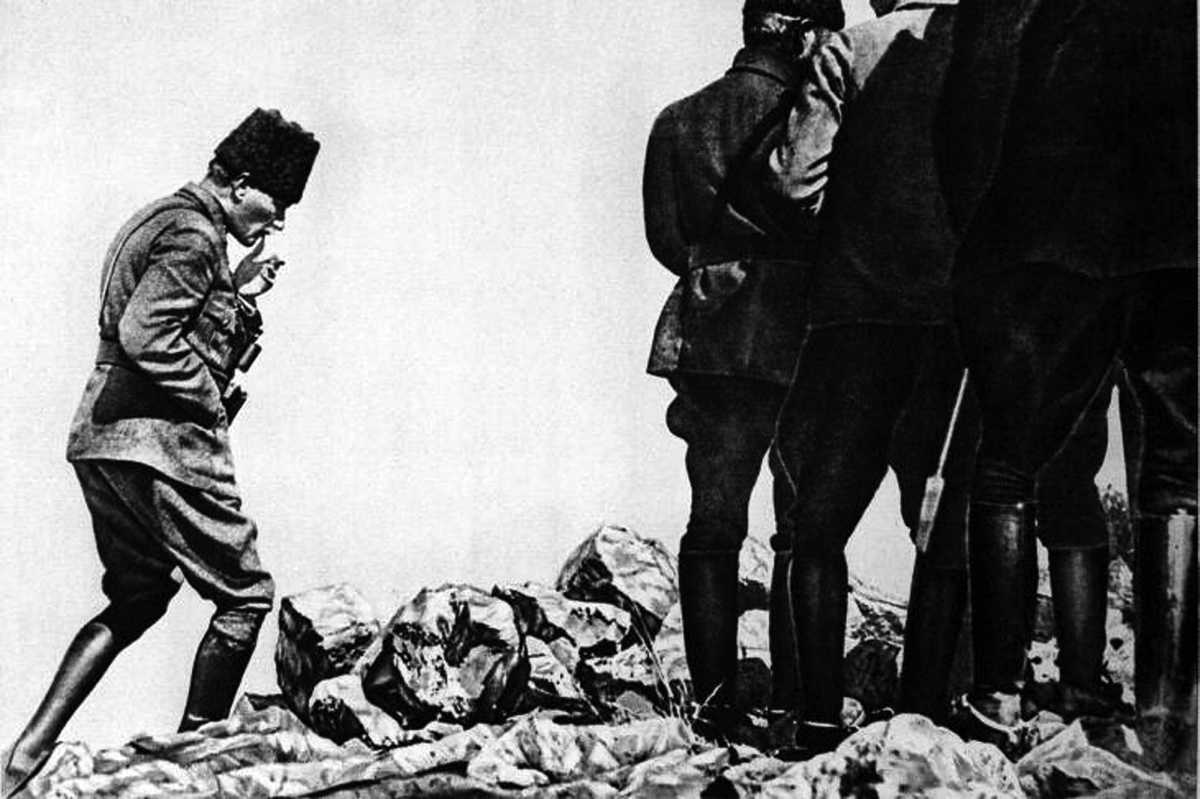
Key Historical Facts
| Fact | Detail |
|---|---|
| Epic Battles | Great Offensive (Battle of the Commandership Square) |
| Date | 26 August - 9 September 1922 |
| Location | Afyon-Dumlupınar (38.74, 30.55) |
| Belligerents, Commanders & Forces | Turkish Grand National Assembly Army: Mustafa Kemal Pasha (Strength: 200,000, Casualties: 9,000) · Greek Kingdom Army: Tricupis (Strength: 220,000, Casualties: 40,000) |
| Weather | Summer heat |
| Outcome | Turkish Victory |
Belligerents, Commanders & Forces
Turkish Grand National Assembly Army
- Commander
- Mustafa Kemal Pasha
- Stance
- Attacker
- Strength
- 200,000
- Casualties
- 9,000
Greek Kingdom Army
- Commander
- Tricupis
- Stance
- Defending
- Strength
- 220,000
- Casualties
- 40,000
Historical Significance
The last and definitive victory of the Turkish War of Independence. Izmir was liberated on September 9.
Outcome
Turkish Victory
Chronological Phases of the Battle
-
1. August 1922
Turkish Attack Plan and Afyonkarahisar Fortification
The Turkish General Staff, under the command of Mustafa Kemal Pasha, decided to direct the only major offensive opportunity on the Western Front to the Kara Hisar (Afyonkarahisar) salient. Sakallı Nureddin Pasha's First Army was secretly reinforced against the southern flank of the Greek positions. On the Greek side, the Asia Minor Army under the command of General Hacıanestis divided the front into three corps, and the 1st Corps under the command of General Trikupis was defending the Kara Hisâr positions. The Turkish plan aimed to cut off the railway connection and surround the enemy with the simultaneous attack of the First and Second Armies. Although leaving the Turkish right wing weak was a risky move, preparations for the attack were completed.
-
2. 26 August 1922
Kocatepe Bombardment and Front Attack
On the morning of 26 August 1922, the Turkish First and Second Armies launched a coordinated attack. Previously, the 5th Cavalry Corps under the command of Fahreddin Pasha had infiltrated through the Kırka Strait, cut off the Greek telegraph and railway lines, and paralyzed the communication between Izmir and Kara Hisâr. The devastating fire opened by Turkish heavy artillery in the morning hours caused heavy casualties to the Greek battalions in inadequate trenches and silenced the Greek batteries. Then, 7 infantry divisions of the 1st and 4th Corps were charged to the junction of the Greek 1st and 4th divisions. The Greek front was shaken and towards noon Turkish troops began to capture the Greek trenches.
-
3. 27 August 1922
Fall of Erkmentepe and Evacuation of Afyonkarahisar
On the morning of 27 August, Turkish artillery started firing again and the infantry attack was renewed at 06:00. The Turkish 4th Corps, under the command of Colonel Sami, captured the strategically important Erkmentepe location around 09:00 and made a decisive breakthrough in the Greek defense line. Following this development, the Greek 1st Corps ordered the line to be withdrawn 20 kilometers to the north and the evacuation of Kara Hisar at 10:30. However, due to the communication gap, this order did not reach the Greek 1st Division. With the withdrawal of these troops, whose front collapsed at 13:30, the 4th Division's flank was left completely exposed and the Greek forces were forced to retreat in disorder.
-
4. 27–28 August 1922
Çobanlar Counter-Attack Order and the Break in the Lines
The Greek army headquarters in Izmir could not grasp the real situation on the battlefield. With the order given on the evening of August 27, the 2nd Corps was asked to immediately launch a counter-attack in the direction of Çobanlar, southeast of Kara Hisâr. However, communication between the troops in the field was completely broken. While the forces under the command of General Frangou retreated towards Dumlupınar at night, the Trikupis Group remained in its positions and took action the next morning. This lack of coordination created a wide rift between the two groups. On the morning of August 28, the exposed arms of the Trikupis forces advancing west were dispersed by Turkish attacks and the units were separated from each other.
-
5. 29 August 1922
Siege Around Hamurköy and İlbulak Mountain
On the night of 28–29 August, the Turkish 6th Corps advanced west and settled in the north of the Trikupis Group. Turkish 1st, 2nd, 4th and 5th Corps surrounded the Greek forces in the south of Kütahya step by step. Moving west on the morning of August 29, the Trikupis Group attempted to attack with the 9th Division to open the road, but had to retreat to defense against the Turkish 4th Corps. Trikupis, who was also under pressure from the eastern flank, brought his reserves into battle. Both sides suffered heavy losses in the fierce clashes that lasted throughout the day. Trikupis forces could not open the Dumlupınar road and began to disperse and retreat towards Çalköy at night.
-
6. 30 August 1922
Battle of Aliören and Dispersion towards Banaz
Arriving in Çalköy on 30 August, the Trikupis Group wanted to retreat to Banaz via Aliören, but the road to Aliören was blocked by the Turkish 14th Cavalry Division. Trikupis troops, who were under heavy Turkish artillery fire, suffered heavy casualties and suffered a final siege and were forced to surrender in the following days. On the same day, the Frangou Group in Dumlupınar positions was also attacked by the Turkish 1st Corps. The left wing of the Frangou Group, which resisted throughout the day, was broken at 23:30. Frangou ordered his troops to retreat towards Banaz. Thus, the Battle of Dumlupınar ended with a decisive Turkish victory.
-
7. September – October 1922
Pursuit to Izmir and Final Evacuation from Erdek
After the defeat at Dumlupınar, the Asia Minor Army lost its combat power. The Turkish army chased the retreating Greek troops for approximately 400 kilometers to Izmir, and the Greek army abandoned the city. Within two weeks, the occupied lands in Anatolia were quickly retaken. The last remaining Greek troops in Erdek and Biga left Anatolia completely on September 18. Following the military operation, the Armistice of Mudanya was signed between Türkiye, Italy, France and Great Britain on October 11, 1922; Greece, on the other hand, had to join this armistice on October 14, officially ending the war.
Frequently Asked Questions
When and where did Great Offensive (Battle of the Commandership Square) take place, and what was the outcome?
Great Offensive (Battle of the Commandership Square) took place on 26 August - 9 September 1922 at Afyon-Dumlupınar and ended with Turkish Victory.
Who were the commanders and troop numbers in Great Offensive (Battle of the Commandership Square)?
Turkish Grand National Assembly Army: Mustafa Kemal Pasha (Strength: 200,000, Casualties: 9,000) · Greek Kingdom Army: Tricupis (Strength: 220,000, Casualties: 40,000)
Why is Great Offensive (Battle of the Commandership Square) historically significant?
The last and definitive victory of the Turkish War of Independence. Izmir was liberated on September 9.