Battle of Ain Jalut
The battle in which the Mamluks defeated the Mongol army for the first time and stopped the Mongol advance.
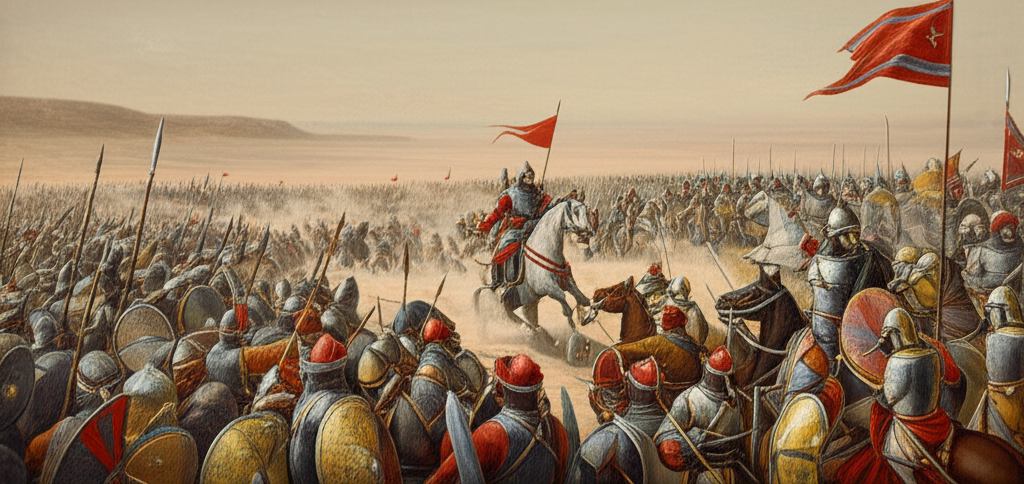
Key Historical Facts
| Fact | Detail |
|---|---|
| Epic Battles | Battle of Ain Jalut |
| Date | 3 September 1260 |
| Location | Ayn Jalut, Palestine (32.54, 35.37) |
| Belligerents, Commanders & Forces | Mamluk Sultanate: Qutuz, Baybars (Strength: 20,000, Casualties: 3,000) · Mongol Empire: Kitbuqa (Strength: 20,000, Casualties: 15,000) |
| Weather | Hot |
| Outcome | Mamluk Victory |
Belligerents, Commanders & Forces
Mamluk Sultanate
- Commander
- Qutuz, Baybars
- Stance
- Defending
- Strength
- 20,000
- Casualties
- 3,000
Mongol Empire
- Commander
- Kitbuqa
- Stance
- Attacker
- Strength
- 20,000
- Casualties
- 15,000
Historical Significance
The Mongol legend of invincibility is over.
Outcome
Mamluk Victory
Chronological Phases of the Battle
-
1. 26 July 1260
Expedition Decision in Cairo and the Advance of the Mamluk Army
Sultan Qutuz responded to the letter of surrender sent by Hulagu Khan to Cairo by executing the Mongol ambassadors and displaying their heads in Bab Zuveyla. Qutuz took action immediately after Hulagu withdrew with the majority of his army, leaving a limited force under the command of Ketbugha in the west of the Euphrates. A large army consisting of the Egyptian army, Shahruzuri Kurds, Arabs, Turkmens and Syrian battalions gathered in Cairo. Qutuz, who broke the opposition of the emirs towards the expedition in Al-Salihiyya with an effective address, started the advance with his troops on 26 July 1260.
-
2. 1260
Capture of Gaza Outpost by Baybars
Sultan Qutuz appointed Baybars as the head of the vanguard to discover enemy movements. The soldiers under the leadership of Baybars quickly moved to Gaza, which was a Mongolian outpost at that time. Mongolian commander in the region, Baydara, conveyed the situation to Ketbuğa with an urgent report; but before the order to wait for the main forces arrived, Baybars captured Gaza. When Qutuz's Egyptian army entered the city, Baydara could not hold on and had to retreat. This initial military success allowed the Mamluk army to advance northward.
-
3. 1260
Concentration of Mongol Forces in Baalbek and Bika Valley
According to Reşidüddin, Ketbuğa learned that the Egyptian army was approaching while he was in Baalbek. Yunini states that the camp was initially established in the Bika Plain. The Mongol commander, who was informed that the Mamluks had entered Syria and were advancing towards the north, gathered his soldiers who were dispersed for grazing and garrison work and headed towards the south. Georgian and Armenian battalions and detachments of two Ayyubid princes joined their forces, which numbered between 10,000 and 12,000. The Ketbugh made a prudent decision and chose to deploy in the Ayn Jalut location.
-
4. 1260
Frankish Diplomacy and Supply Permission on the Plains of Acre
Sultan Qutuz, who followed the Palestinian coastline in order to access water resources in the hot season, sent ambassadors to the Acre administration to obtain the right of free passage through the lands under Frankish rule. The Acre Franks, disturbed by the Mongol plunder of Sidon, chose to remain neutral and allowed the Mamluk army to pass through their territory. The Islamic army, which encamped in the Acre plain, was supplied with provisions by the Franks. Freed from the worry of being shot from behind, Kutuz moved his forces from Acre to the interior and directed them towards the Mongols.
-
5. 3 September 1260
Mongol Attack and Fake Ricat Trap in Ayn Jalut
On September 3, 1260, the battle began with the attack of the Mongols in the Ayn Jalut location. Sultan Qutuz in the Mamluk army, who knew the terrain very well, hid most of his forces in the wooded areas in the highlands. Leading commander Baybars provoked the Mongol forces with hit-and-run tactics and then started a fake retreat, drawing the enemy towards the hill. Ketbugha, who did not suspect trickery, followed the fleeing Mamluks with all his troops. When the Mongol troops reached the high ground, the hiding Mamluks emerged, started a rain of arrows and completely surrounded them with a cavalry attack.
-
6. 3 September 1260
Qutuz's Landing in the Square and the Counter Attack in the Direction of Baysan
Mongolian troops who wanted to break the siege brought the Mamluk left wing to the point of disintegration with a harsh attack. Seeing the situation, Sultan Kutuz took off his helmet and showed himself to his soldiers and shouted 'Va Islamah!' He jumped into the war himself with a shout. The sultan advanced to the weakened flank with his own special unit and repelled the Mongols by gaining resistance in the army. Although the Mongols, who retreated to the Baysan vicinity, regrouped and launched a successful counter-attack, the Mamluks, who held geographical and moral superiority, maintained dominance. Ketbugha was killed and the Mongol army in the region was destroyed.
-
7. 1260
Liquidation of the Mongol Forces Remaining in Homs Square
Following the victory of Ayn Jalut, the Mamluks captured Damascus five days later and Aleppo within a month. Although Sultan Qutuz was killed by a conspiracy led by Baybars on the way back to Egypt, the operation continued in Syria. Local Ayyubid emirs, who had sworn loyalty to the Mamluk Sultanate, inflicted a heavy defeat on another Mongol force of 6,000 men in Homs. This victory definitively ended the Mongols' first campaign against the Syrian region and strengthened the halt of the Mongol advance.
Frequently Asked Questions
When and where did Battle of Ain Jalut take place, and what was the outcome?
Battle of Ain Jalut took place on 3 September 1260 at Ayn Jalut, Palestine and ended with Mamluk Victory.
Who were the commanders and troop numbers in Battle of Ain Jalut?
Mamluk Sultanate: Qutuz, Baybars (Strength: 20,000, Casualties: 3,000) · Mongol Empire: Kitbuqa (Strength: 20,000, Casualties: 15,000)
Why is Battle of Ain Jalut historically significant?
The Mongol legend of invincibility is over.