Battle of 73 Easting
This is the armored engagement that took place between the U.S. 2nd Armored Cavalry Regiment and the Iraqi Republican Guard Tawakalna Division during the Gulf War. Coalition forces' advanced thermal sights and GPS technology provided a decisive advantage against Iraqi tank units caught unprepared in a sandstorm, going down in history as one of the last major tank battles of the 20th century.
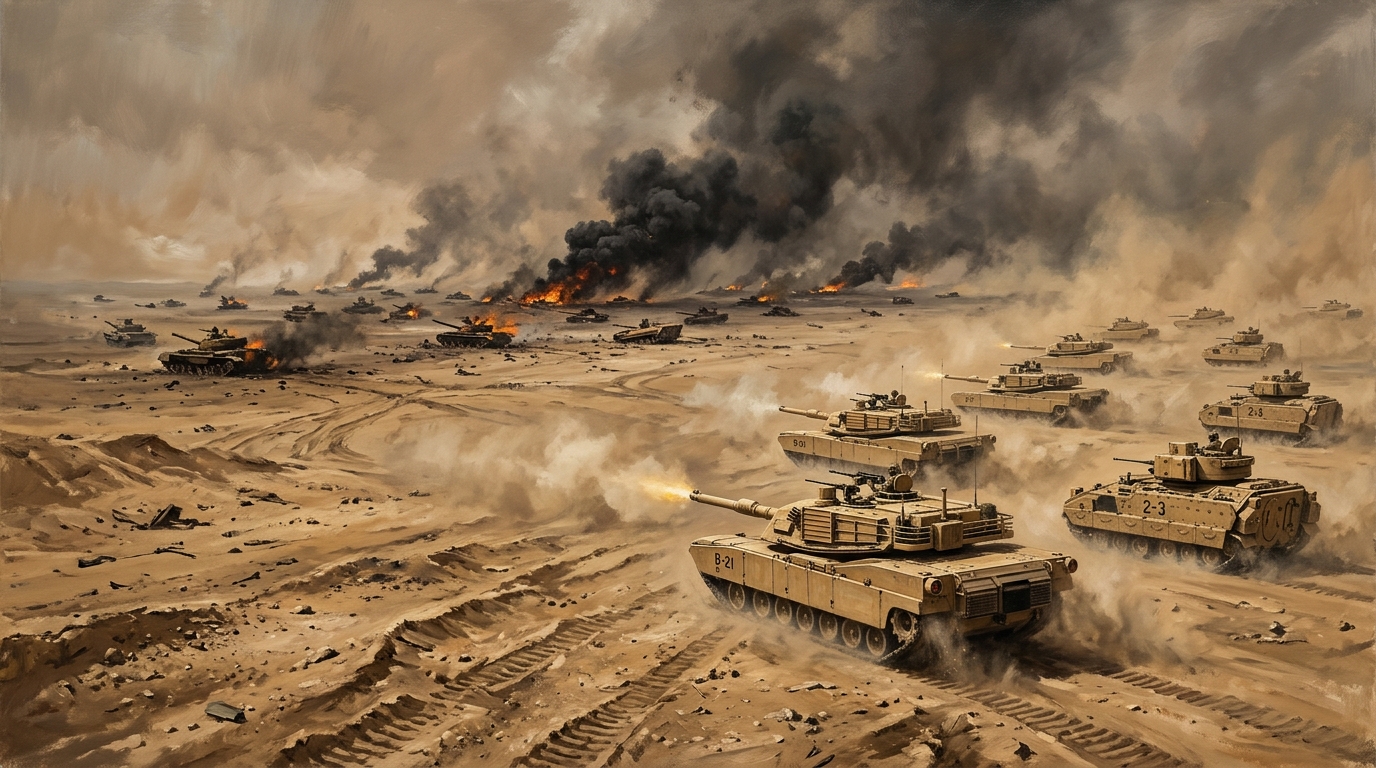
Key Historical Facts
| Fact | Detail |
|---|---|
| Epic Battles | Battle of 73 Easting |
| Date | February 26, 1991 |
| Location | Near the Iraq-Kuwait Border, Iraq (29.05, 46.45) |
| Belligerents, Commanders & Forces | Coalition Forces (US and UK): Captain H.R. McMaster (Strength: 4,000, Casualties: 1 Bradley kayıp, 6 ölü, 19 yaralı) · Iraqi Army (Republican Guard): Salah Aboud Mahmoud (Strength: 3,000, Casualties: 160 tank ve ZPT imha edildi, 600-1000 ölü ve yaralı, 1300 esir) |
| Weather | A severe sandstorm that severely restricted visibility |
| Outcome | Decisive Coalition Victory |
Belligerents, Commanders & Forces
Coalition Forces (US and UK)
- Commander
- Captain H.R. McMaster
- Stance
- Attacker
- Strength
- 4,000
- Casualties
- 1 Bradley kayıp, 6 ölü, 19 yaralı
Iraqi Army (Republican Guard)
- Commander
- Salah Aboud Mahmoud
- Stance
- Defending
- Strength
- 3,000
- Casualties
- 160 tank ve ZPT imha edildi, 600-1000 ölü ve yaralı, 1300 esir
Historical Significance
Proving the decisive role of thermal imaging systems and satellite navigation in modern armored warfare doctrine, this conflict is a textbook battle showing how the elite units of the Iraqi army were paralyzed in the face of technologically superior armored elements.
Outcome
Decisive Coalition Victory
Chronological Phases of the Battle
-
1. 15:30
Advance Through a Sandstorm
Eagle Troop of the US 2nd Armored Cavalry Regiment advanced rapidly toward the 70 Easting map coordinate amid a severe desert sandstorm. Equipped with thermal sights and GPS, nine M1A1 Abrams tanks silently approached Iraqi positions in near-zero visibility.
-
2. 16:18
Contact at the 73 Easting
The vanguard unit led by Captain McMaster encountered entrenched Iraqi T-72 tanks the moment it crested the sand dune. The Iraqi crew could not see the American armor due to the storm. McMaster ordered fire without hesitation, and within minutes, dozens of Iraqi tanks were in flames.
-
3. 16:45
Breaching of the Defensive Line
As Eagle Troop breached the Iraqi line, Ghost and Cougar troops joined the assault from the flanks. Although Iraqi units attempted infantry-supported counterattacks, the 25mm cannons and TOW missiles of the M2 Bradley vehicles rapidly destroyed the Iraqi infantry and armored vehicles.
-
4. 17:30
Crushing of the Counter-Offensive and Clearance
The final armored counter-attack launched by the Republican Guard's Tawakalna Division was swiftly suppressed by the superior range fire of Abrams tanks. The Iraqi division's defense collapsed, and hundreds of Iraqi soldiers surrendered. Coalition forces established total control over the region.
Frequently Asked Questions
When and where did Battle of 73 Easting take place, and what was the outcome?
Battle of 73 Easting took place on February 26, 1991 at Near the Iraq-Kuwait Border, Iraq and ended with Decisive Coalition Victory.
Who were the commanders and troop numbers in Battle of 73 Easting?
Coalition Forces (US and UK): Captain H.R. McMaster (Strength: 4,000, Casualties: 1 Bradley kayıp, 6 ölü, 19 yaralı) · Iraqi Army (Republican Guard): Salah Aboud Mahmoud (Strength: 3,000, Casualties: 160 tank ve ZPT imha edildi, 600-1000 ölü ve yaralı, 1300 esir)
Why is Battle of 73 Easting historically significant?
Proving the decisive role of thermal imaging systems and satellite navigation in modern armored warfare doctrine, this conflict is a textbook battle showing how the elite units of the Iraqi army were paralyzed in the face of technologically superior armored elements.