Naval Battle of Tsushima
Japan's destruction of the Russian Baltic Fleet is the most decisive victory in the history of modern naval warfare.
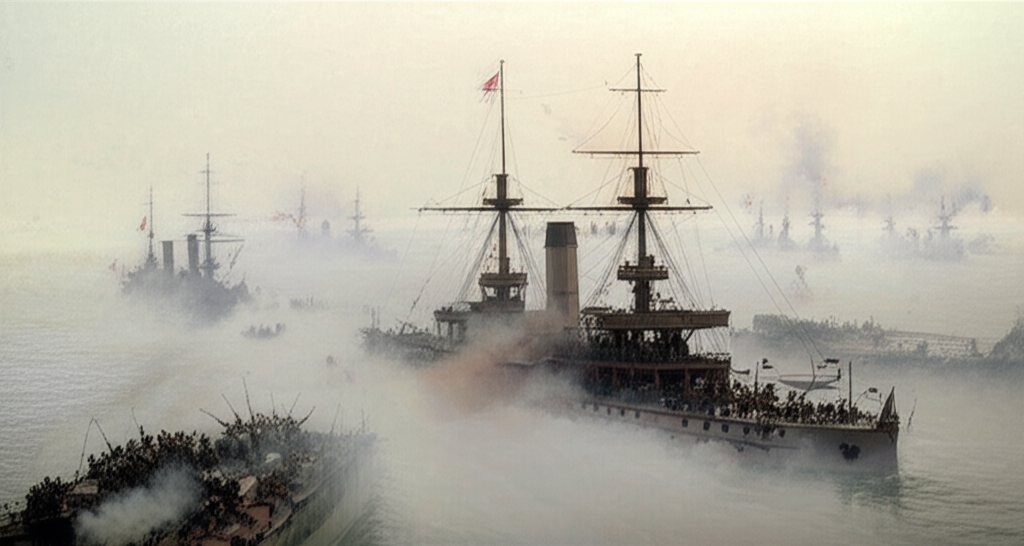
Key Historical Facts
| Fact | Detail |
|---|---|
| Epic Battles | Naval Battle of Tsushima |
| Date | 27-28 May 1905 |
| Location | Tsushima Strait, Japan (34.0, 129.0) |
| Belligerents, Commanders & Forces | Empire of Japan: Togo Heihachiro (Strength: 89, Casualties: 117) · Russian Empire: Zinoviy Rozhestvensky (Strength: 38, Casualties: 4,380) |
| Weather | Foggy |
| Outcome | Japanese Victory |
Belligerents, Commanders & Forces
Empire of Japan
- Commander
- Togo Heihachiro
- Stance
- Defending
- Strength
- 89
- Casualties
- 117
Russian Empire
- Commander
- Zinoviy Rozhestvensky
- Stance
- Attacker
- Strength
- 38
- Casualties
- 4,380
Historical Significance
It was the first time an Asian country defeated a European power.
Outcome
Japanese Victory
Chronological Phases of the Battle
-
1. 25–26 May 1905
Tsushima Strait Route and Deployment Preparations
Admiral Rojestvenski chose the Tsushima Strait, the shortest and direct route to reach Vladivostok after months of long transit from the Baltic. Announcing his decision on 25 May 1905, he diverted his transports and auxiliary cruisers to Shanghai and steered northeast with his main combat elements. The Russian Second and Third Pacific Fleet, consisting of 38 pieces, were to encounter the Japanese Combined Fleet under Admiral Tōgō, based east of Tsushima Island between Korea and Japan. The Russian fleet approached Japanese territorial waters in radio silence, planning to pass undetected.
-
2. 27 May 1905
First Contact and Radio Notification in the Tsushima Strait
When the Russian fleet entered the Tsushima Strait on the night of May 26, dense fog provided the Russian forces with a concealment advantage. However, at 02.45 on the morning of May 27, the Japanese auxiliary cruiser Shinano Maru noticed the lights of the Russian hospital ship Orel, which kept its lights on in accordance with the rules of war. At 04.55, Shinano Maru radioed the flagship Mikasa at Masampo that the enemy was at square 203. Receiving the radio message at 05.05, Admiral Tōgō immediately prepared the Combined Fleet for departure. Despite the foggy weather, Japanese reconnaissance ships constantly conveyed the formation and route of the Russian forces thanks to wireless telegraphy, giving the Japanese command a great surveillance advantage.
-
3. 27 May 1905
Daytime Armored Battle and T-Turn Maneuver
At 13:40 on 27 May, the two fleets made contact and Tōgō raised the famous Z flag. While the Russian fleet advanced from south-southwest to north-northeast, the Japanese fleet approached from the northeast and made a 180-degree U-turn. Admiral Rojestvenski chose to engage in pitched battle and opened fire at 14.08. Although Russian cannons scored hits on Mikasa, the Japanese navy's Shimose explosives and advanced salvo fire control gained the upper hand. The shell of the Japanese battleship Fuji blew up the ammunition depot of the Russian battleship Borodino. Rojestvenski was hit in the head by shrapnel and fell unconscious. By sunset, the battleships Knyaz Suvorov, Oslyabya, Alexander III and Borodino were sunk and command passed to Nebogatov.
-
4. 27–28 May 1905
Night Torpedo Raid and Armored Cruiser Losses
At around 20:00 on the night of May 27, the Japanese sent 21 destroyers and 45 torpedo boats to the Russian line. In the attacks that lasted for three hours, there were collisions between small boats and Russian ships. The dispersed Russian ships revealed their positions when they turned on their searchlights to detect the attackers. The old battleship Navarin hit floating chain mines thrown in front of her and then sank after being hit by four torpedoes. Severely damaged, Sissoi Veliky was sunk the next day. The old armored cruisers Admiral Nahimov and Vladimir Monomah, which suffered torpedo and collision damage, took on water and were towed off Tsushima Island and sunk by their crews the next morning.
-
5. 28 May 1905
Siege of Nebogatov's Fleet and the XGE Banner
At 05.23 on the morning of May 28, the remaining elements of the Russian fleet were detected as they moved northeast. Tōgō's battleships surrounded the remaining fleet under Rear Admiral Nebogatov south of Takeshima, opening fire from 12,000 meters. The Russian cruiser Izumrud managed to escape to the southeast. Realizing that he could not resist the Japanese battleships in terms of range and speed, Nebogatov ordered the four battleships under his command to surrender. The XGE flag, the international sign of surrender, was hoisted on Russian ships. Since this sign was not included in the code books of the Japanese side, the fire continued for a while. Eventually, Oryol, Imperator Nikolai I, General-Admiral Apraksin and Admiral Seniavin fell into Japanese hands.
-
6. 28–30 May 1905
Pursuit and Captivity of Rojestvensky Off Ulsan
The Japanese destroyers Sazanami and Kagerō, which were damaged in the battle on the night of 27 May, completed their temporary repairs in Ulsan Port and left the port on the morning of 28 May. While two Japanese destroyers were sailing to join the Combined Fleet, they spotted Byedoviy, carrying the wounded Admiral Rojestvensky and his headquarters officers, and the escorting destroyers Grozny. Contact was made at 15.25; While Grozny accelerated and fled, heading towards Vladivostok, Byedoviy surrendered. The seriously wounded Rojestvenski and his staff were taken prisoner. Japanese destroyers, accompanied by the cruiser Akashi, towed the surrendered Byedoviy and took him to Sasebo Port, and thus the Russian commander-in-chief was taken into captivity.
-
7. May – September 1905
Cruisers' Escape to Manila and the Peace of Portsmouth
As a result of the battle, all 11 Russian battleships were sunk or captured; More than 5,000 Russian sailors lost their lives and more than 6,000 were taken prisoner. The protected cruisers Aurora, Jemtchug and Oleg, commanded by Rear Admiral Oskar Enqvist, fled south and took refuge in the American base Manila in the Philippines, where they were interned until the end of the war. Only the cruiser Almaz and two destroyers reached Vladivostok; Some other auxiliary ships were disarmed in Shanghai. The loss of almost all of the Baltic Fleet's heavy ships forced the Russian Empire to sue for peace, and the Treaty of Portsmouth was signed in September 1905, ending the Russo-Japanese War with Japan's decisive victory.
Frequently Asked Questions
When and where did Naval Battle of Tsushima take place, and what was the outcome?
Naval Battle of Tsushima took place on 27-28 May 1905 at Tsushima Strait, Japan and ended with Japanese Victory.
Who were the commanders and troop numbers in Naval Battle of Tsushima?
Empire of Japan: Togo Heihachiro (Strength: 89, Casualties: 117) · Russian Empire: Zinoviy Rozhestvensky (Strength: 38, Casualties: 4,380)
Why is Naval Battle of Tsushima historically significant?
It was the first time an Asian country defeated a European power.