Naval Battle of Midway
The turning point of the Pacific War. The USA defeated the Japanese navy.
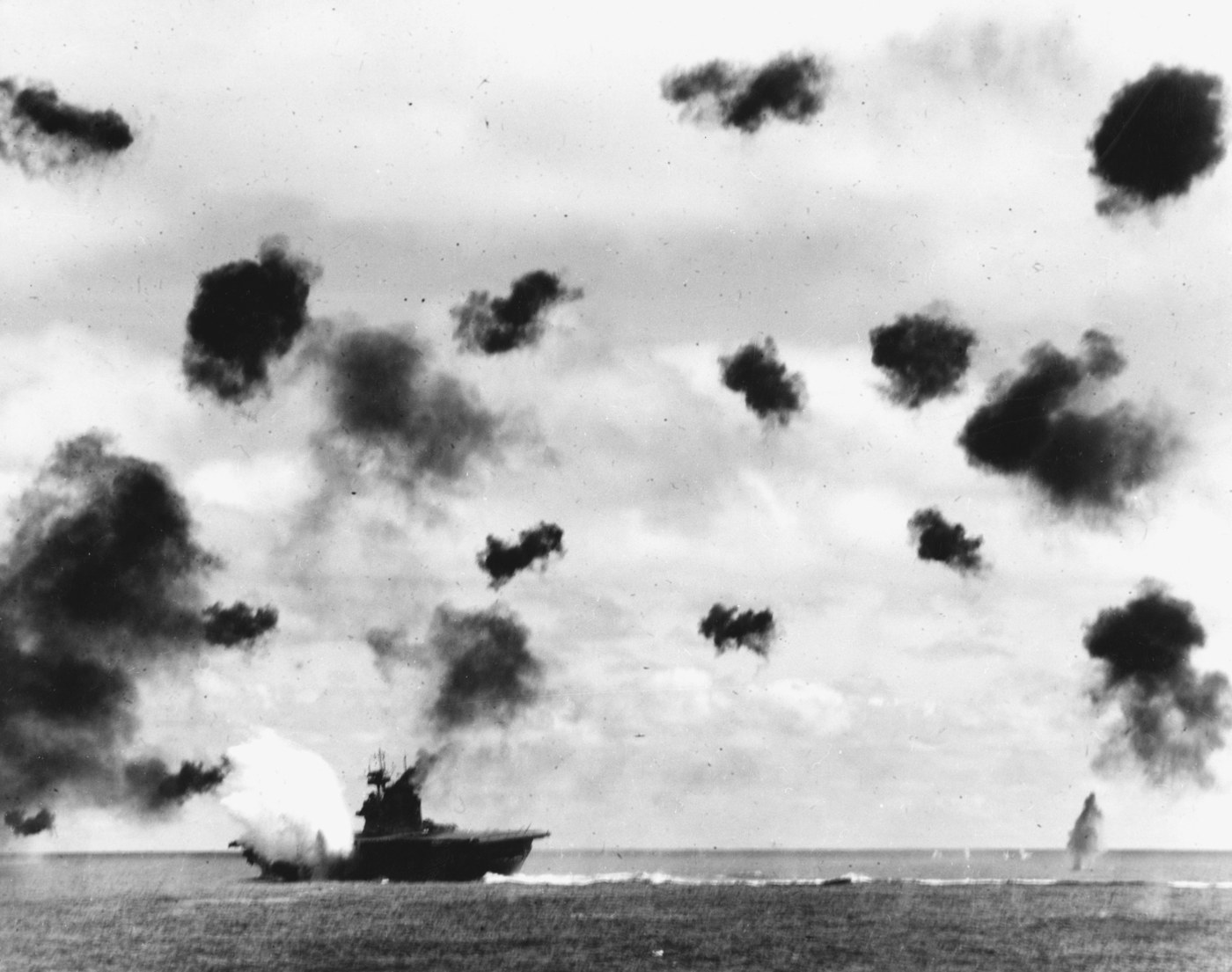
Key Historical Facts
| Fact | Detail |
|---|---|
| Epic Battles | Naval Battle of Midway |
| Date | 4-7 June 1942 |
| Location | Midway Island, Pacific (28.2, -177.35) |
| Belligerents, Commanders & Forces | USA: Chester Nimitz (Strength: 3, Casualties: 307) · Japan: Isoroku Yamamoto (Strength: 4, Casualties: 3,057) |
| Weather | Ocean air |
| Outcome | US Victory |
Belligerents, Commanders & Forces
USA
- Commander
- Chester Nimitz
- Stance
- Defending
- Strength
- 3
- Casualties
- 307
Japan
- Commander
- Isoroku Yamamoto
- Stance
- Attacker
- Strength
- 4
- Casualties
- 3,057
Historical Significance
Japanese supremacy in the Pacific ended.
Outcome
US Victory
Chronological Phases of the Battle
-
1. 3–7 June 1942
Beginning of the Aleutian Campaign and Preparations for Attu-Kiska
The Imperial Japanese Navy accepted the occupation of Attu and Kiska, one of the Aleutian Islands of the Alaska Territory, in order to provide army support for the Midway operation. The Japanese Ground Forces aimed to take control of the home islands in order to put them out of range of American land-based bombers in Alaska. According to the original plan, Operation AL was envisaged to begin simultaneously with the Midway offensive. However, due to a one-day delay in Nagumo's task force getting to sea, the Aleutian operation began on June 3, the day before the Midway offensive. This action removed additional ships from the main battlefield that could have reinforced the fleet attacking Midway.
-
2. 3–4 June 1942
First Contact and Air Raid on Tanaka Fleet on Approach to Midway
At approximately 09:00 on June 3, American maritime patrol aircraft PBY pilot Jack Reid detected the Japanese Occupation Force 500 nautical miles west-southwest of Midway. Reid incorrectly reported this fleet as the main fleet. Taking off from Midway base at 12:30 p.m., nine B-17 bombers reached Tanaka's transport group three hours later and dropped their bombs under intense anti-aircraft fire; However, no significant damage was caused to the ships. At around 01:00 on the morning of June 4, a torpedo fired from a PBY hit the Japanese tanker Akebono Maru. This attack was the only successful hit by American forces with air-launched torpedoes throughout the war.
-
3. 4 June 1942
Midway Offensive of the Japanese Fleet and Counterattacks from the Island
At 04:30 on the morning of June 4, Admiral Nagumo launched the first attack wave of 108 aircraft against Midway. Midway radar detected the approaching Japanese planes from a distance of 93 nautical miles, and fighters from VMF-221 squadron met the Japanese. Despite heavy losses, the base was heavily bombed. Meanwhile, American bombers taking off from Midway launched a series of attacks on Nagumo's aircraft carriers. The SBDs and SB2Us of the VMSB-241 fleet and the torpedo-loaded B-26s and B-17s of the army could not penetrate the Japanese defenses. While the B-26 piloted by Lieutenant Muri was scanning Akagi, Lieutenant Mayes' shot down plane narrowly passed the ship's bridge.
-
4. 4 June 1942
Nagumo's Decision Dilemma and the American Fleet's Early Order to Attack
At 07:15, Nagumo ordered the re-equipment of reserve aircraft with general-purpose bombs against ground targets. However, at 07:40, a reconnaissance plane taking off from the cruiser Tone reported that it saw an American naval force in the east. Although Rear Admiral Yamaguchi, commander of the 2nd Carrier Division, suggested attacking immediately with the means at hand, Nagumo chose to wait to meet the air group returning from Midway and equip reserve aircraft with torpedoes. Meanwhile, Fletcher at Yorktown ordered an immediate attack on Spruance, based on PBY reconnaissance reports. Spruance aimed to catch the Japanese decks unprepared by starting the takeoff in scattered groups without waiting for the planes to gather.
-
5. 4 June 1942
American Dive Bombing and the Shooting of Three Aircraft Carriers
American torpedo squadrons VT-8, VT-6, and VT-3 drew the attention of Japanese Zero patrols to low altitude, disrupting Japanese air cover at the cost of heavy losses. At 10:22, the Enterprise squadrons (VB-6 and VS-6), commanded by Major McClusky, who were tracking the destroyer Arashi, and VB-3, commanded by Lieutenant Leslie of Yorktown, reached the target. Kaga was hit by multiple bombs and burst into flames; Lieutenant Best's bomb hit Akagi, detonating the fuel and ammunition on deck. Simultaneously, Sōryū also went to hell, taking three hits. In just six minutes, three Japanese aircraft carriers suffered fatal damage, and Admiral Nagumo was forced to move his flag to the light cruiser Nagara.
-
6. 4 June 1942
Hiryū's Counterattacks and Sinking by Enterprise Planes
The only surviving Japanese aircraft carrier, Hiryū, immediately counterattacked. D3A bombers in the first attack wave hit Yorktown with three bombs; B5N planes in the second wave, which arrived after the repairs of the damage control teams, hit the ship with two torpedoes, cutting off its power. After a reconnaissance plane located Hiryū in the late afternoon, Enterprise launched 24 dive bombers, including elements of Yorktown. During the attack, Hiryū was hit by at least four bombs and was left immobile and engulfed in flames. After the crew was evacuated, the ship sank the next morning; Admiral Yamaguchi chose to sink with his ship.
-
7. 5–7 June 1942
The Battle of Mogami and Mikuma and the Sinking of Yorktown
On the night of June 5, the Japanese cruiser detachment assigned to bombard Midway received orders to withdraw. Meanwhile, during maneuvers to avoid the American submarine Tambor, the heavy cruisers Mogami and Mikuma collided. Mikuma, which was heavily damaged and lost speed, was sunk by American aircraft attacks in the following days. While the damaged Yorktown was being towed for salvage during this period, on the afternoon of June 6, the Japanese submarine I-168 broke through the defense line and fired three torpedoes. One of the torpedoes sank the escorting destroyer Hammann, two hit Yorktown. Following the evacuation of the crew, Yorktown capsized and sank at 07:01 on the morning of June 7.
Frequently Asked Questions
When and where did Naval Battle of Midway take place, and what was the outcome?
Naval Battle of Midway took place on 4-7 June 1942 at Midway Island, Pacific and ended with US Victory.
Who were the commanders and troop numbers in Naval Battle of Midway?
USA: Chester Nimitz (Strength: 3, Casualties: 307) · Japan: Isoroku Yamamoto (Strength: 4, Casualties: 3,057)
Why is Naval Battle of Midway historically significant?
Japanese supremacy in the Pacific ended.